If you are already studying ACCA, the 2027 changes can feel like a moving target. Some websites say “rush to finish.” Others say “relax, everything carries over.” The truth sits in the middle, and the right move depends on exactly where you are today.
We have read ACCA’s official guidance for current students closely, and in this post we turn it into a clear action plan. Whether you are at Applied Knowledge, Applied Skills or Strategic Professional, you will know what to prioritise. This guide comes from the team at Abeel School of Accountancy, so it is written for real students with real deadlines.
The Good News First
ACCA has confirmed that students move across to the redesigned qualification at transition and receive credit for equivalent elements they have already completed. The levels map like this:
| Current level | New level |
|---|---|
| Applied Knowledge | Knowledge |
| Applied Skills | Expertise |
| Strategic Professional | Strategic Professional |
Nothing you have passed is thrown away. But a few smart moves before the cut-off can save you hours of extra work and extra fees, and that is what this guide is about. You can read ACCA’s own wording on its page for current ACCA Qualification students.
Dates to Keep in Mind
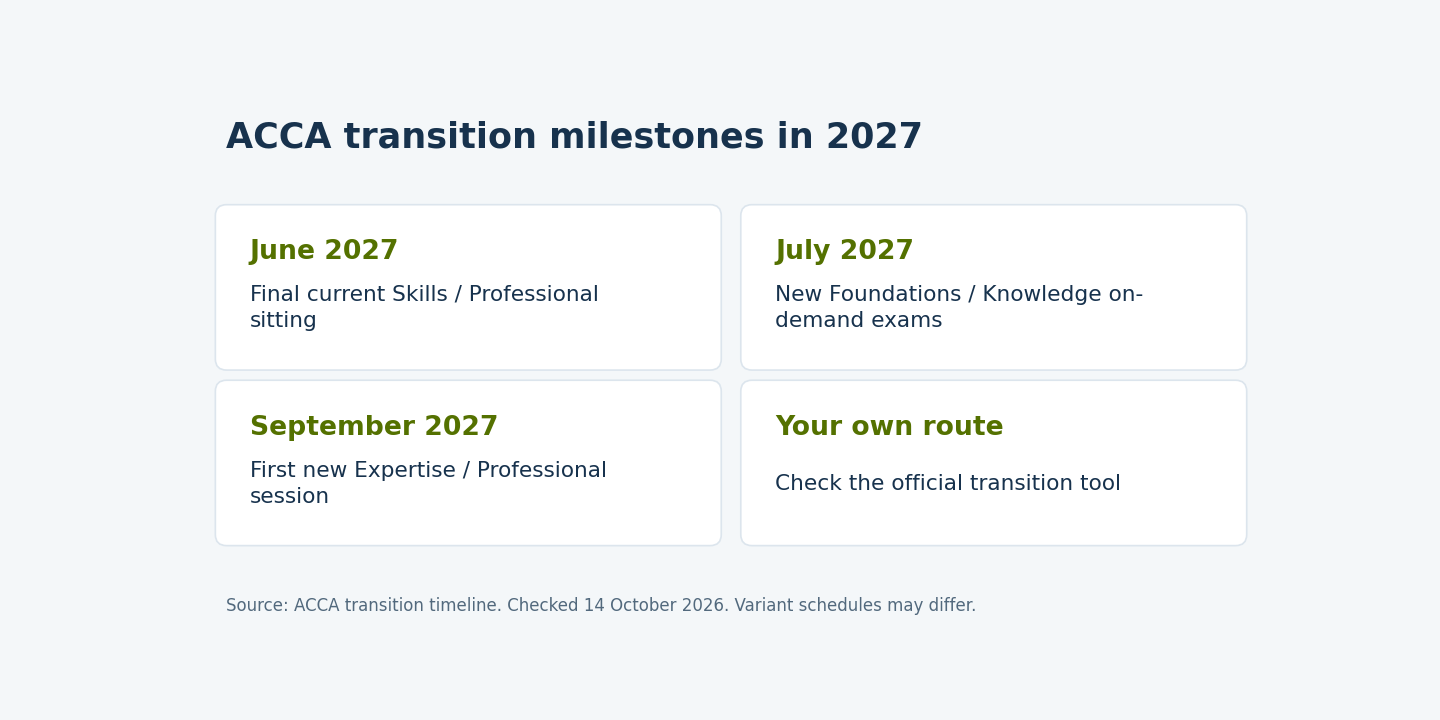
Based on ACCA’s guidance and its official timeline:
- June 2027: final session for current Applied Skills and Strategic Professional session exams
- July 2027: the on-demand Law variants have a slightly later completion date, and the Ethics and Professional Skills Module (EPSM) deadline is mid July 2027 (exact date to be confirmed by ACCA)
- September 2027: first Expertise and Strategic Professional exams in the new structure
Always double check exact dates on ACCA’s pages, because they can be updated.
If You Are at Applied Knowledge
Your three exams (FA, MA and BT) map as follows: FA to K1 and MA to K2. Business and Technology does not have an exam equivalent, but passing it gives you credit for the Responsible Business Management module.
What to do:
- Finish BT if you can. If you do not complete BT before transition, ACCA says you will need to complete the Responsible Business Management module, which is chargeable (price to be confirmed in January 2027) and expected to take around 60 hours.
- Complete the Foundations in Professionalism module if you want the current Diploma awarded before transition. The current Diploma requires FA, MA, BT and the module by mid July 2027.
- Start Corporate and Business Law early. Law becomes K3 in the new structure. ACCA encourages students who finish Applied Knowledge to study LW as their first Applied Skills exam, and it can be taken on demand.
If You Are at Applied Skills
This is the group with the most to gain from planning. Your papers map to Expertise: TX to E1, FR to E2, AA to E3, FM to E4 and PM to E5. Law moves to K3.
What to do:
- Aim to finish all Applied Skills exams, including LW, before transition. ACCA states that students who complete every Applied Skills exam, including LW, will not be required to take the Digital Tech and Innovation module.
- Understand the cost of skipping it. If you do not finish all of them, that module is chargeable (price to be confirmed in January 2027), expected to take around 100 hours and must be purchased before you can enter Strategic Professional exams.
- Do not forget LW. Anyone who has not passed it must enter K3 Business Law before, or at the same time as, their Expertise exams.
- Complete EPSM if you are heading toward Strategic Professional, which we cover below.
To earn the current Advanced Diploma under today’s rules, ACCA requires all Applied Skills exams in or before the June 2027 session and EPSM by mid July 2027.
If You Are at Strategic Professional
Good news here: the new rules are lighter. The new Strategic Professional level requires both Essentials (S1 and S2) and just one options exam instead of two.
Your equivalent credits are:
- SBR to S1 and SBL to S2
- AAA to SAA, AFM to SCF, ATX to STA and APM to SPI
What to do:
- If you have one options exam and Essentials outstanding, ACCA suggests prioritising your remaining Essentials exams, which may support faster progression to membership.
- Remember the seven year rule. You must complete Strategic Professional within seven years of passing your first Strategic Professional exam. This rule is unchanged.
- Think about the extra option. If you have already passed one option, a second one is no longer required in the new structure, but each exam still deepens your expertise. Decide based on your career, not only on requirements.
EPSM: Small Module, Big Impact
The Ethics and Professional Skills Module will not exist in the redesigned qualification. Students who complete it before transition receive credit for the new Ethical, Sustainable Leadership module. Students who do not complete it will need the new module instead, which ACCA expects to take about 70 hours and be chargeable, compared with roughly 20 hours and an approximate fee of £83 for EPSM.
That is a big gap in effort. For most students heading toward Strategic Professional, finishing EPSM before the deadline is one of the easiest wins available. ACCA also continues to recommend completing EPSM before taking any current Strategic Professional exam, because it supports your chances of passing.
PER: No Change, Keep Recording
The Practical Experience Requirement stays as it is: 36 months of supervised experience with performance objectives. In future, up to six months may be gained through simulated experience from selected optional employability modules, but details will come later. Keep recording your experience from the day you start in a relevant role.
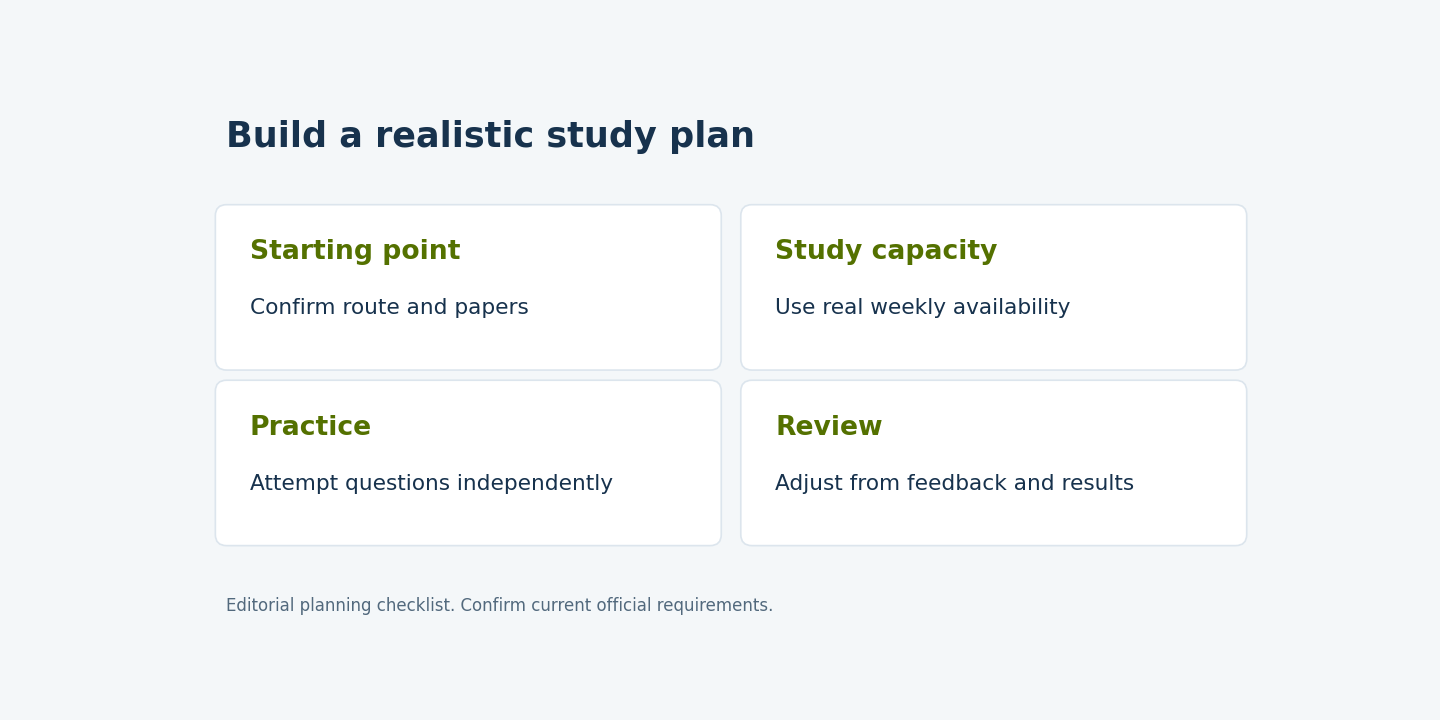
A Simple Session Plan from Now to June 2027
We are in October 2026, so you have three session windows left: December 2026, March 2027 and June 2027.
- Count your remaining papers. Write down exactly what is left, including LW and EPSM.
- Decide how many you can prepare well. One strong attempt beats two rushed ones.
- Treat June 2027 as a backup, not a plan. Aim to finish earlier, so a resit is still possible.
- Book on-demand papers like LW around your session exams.
- Use ACCA’s transition tool to confirm how your own record maps across.
Common Mistakes to Avoid
- Leaving Law until last. It affects both K3 and module credit.
- Skipping EPSM. The saving in hours is significant.
- Rushing too many papers. More attempts do not help if preparation is thin.
- Relying on old study kits. Use materials matched to the current syllabus and exam session.
- Assuming fees. Prices for the new modules will be confirmed by ACCA in January 2027, so check before you budget.
Why Students Trust Abeel School of Accountancy for the Transition
Transition years reward students who plan, revise and stay consistent. If you are unsure where you stand, the advisers at Abeel School of Accountancy can walk through your exam record and build a realistic plan. Begin on our ACCA counselling page.
Ask Abeel School of Accountancy about its current live revision sessions, course-completion plan and teaching terms before enrolling. Each week, students revise with a teacher live, so tax rules, audit procedures and reporting standards stay fresh instead of fading. Smart course completion makes sure the syllabus is finished early, which leaves proper time for past papers and exam technique before the June 2027 deadline. See how it works on our ACCA programme page.
Frequently Asked Questions
Q1. Will my current ACCA passes still count in 2027?
Yes. ACCA has confirmed that students receive credit for equivalent elements already completed when they move to the redesigned qualification.
Q2. What is the final session for current Applied Skills exams?
June 2027. The on-demand Law variants have a slightly later completion date of July 2027, but always confirm the exact dates on ACCA’s exam entry pages.
Q3. What happens if I do not complete all Applied Skills exams before transition?
You will need to complete the Digital Tech and Innovation module in the new structure. ACCA describes it as chargeable and expected to take about 100 hours, and it must be purchased before you can enter Strategic Professional exams.
Q4. Is EPSM worth completing before transition?
For most students, yes. EPSM gives you credit for the Ethical, Sustainable Leadership module, which would otherwise take much longer to complete. Our advisers at Abeel School of Accountancy can help you fit it into your plan.
Q5. I have passed Business and Technology. Does that help?
Yes. A completed BT exam gives you credit for the Responsible Business Management module at Knowledge level.
Q6. How many options exams will I need at Strategic Professional?
One. The new structure requires both Essentials plus a single options exam, replacing the current requirement of two.
Q7. What makes your institute different from other ACCA institutes?
We are the only institute offering weekly live revision sessions combined with smart course completion. Students revise every week and finish the syllabus early, so the final weeks before the exam are for practice, not panic.
Final Thoughts
For current ACCA students, the 2027 changes are an invitation to plan, not a reason to panic. Finish what you can comfortably finish, pay special attention to Law, EPSM and complete Applied Skills sets, and let ACCA’s credit mapping protect the rest.
If you want a team that follows every ACCA update and a study system built on weekly revision, Abeel School of Accountancy is ready to guide you. Reach out through our contact page and turn the transition into your advantage.
Detailed guides for the 2027 transition
Choose the question that matches your current decision. Use ACCA’s official transition tool for your personal credit result.
- ACCA Study Plan for the 2027 Syllabus Transition: A Month-by-Month Guide
- Will You Need to Resit Exams in the New ACCA Syllabus?
- What Happens to Applied Skills Papers in 2027?
- Old vs New ACCA Syllabus: Side-by-Side Comparison
- New ACCA Exam Structure 2027: Knowledge, Skills and Strategic Explained
- How to Finish ACCA Before the New Syllabus Starts
- Halfway Through ACCA? How the 2027 Changes Affect You
- ACCA Transition Tool: How It Maps Your Passed Exams
- ACCA Transition Timeline: Old Syllabus to New Syllabus
- ACCA Subjects List 2027: Full Breakdown by Level
- ACCA Optional Papers 2027: Choosing Your Elective
- ACCA New Syllabus 2027: Every Change Explained
- ACCA Exams Reduced from 13 to 11: What Is Removed?