We’re now mid-October 2026. The final session under the current ACCA syllabus is June 2027, which gives you roughly eight months. That’s enough time to make real progress, but only if you have a plan.
Most students don’t struggle with the syllabus change itself. They struggle because they have no timeline. At Abeel School of Accountancy, we help students turn “I should probably start planning” into a schedule they can follow. This guide gives you the same approach.
Step 1: Know Where You Stand
Before you plan anything, get clear on your position:
- List every paper you’ve passed and any exemptions.
- Run your record through ACCA’s official Transition Tool to see how your passes map to the new structure.
- Note what’s left, including LW, EPSM, your Options paper and your PER progress.
If you’d like to understand the credit logic first, read our guide on whether passed ACCA exams still count in 2027.
Step 2: Pick Your Scenario
Your plan depends on which of these describes you.
Scenario A: Close to finishing (3 or fewer papers left). Your goal is to finish under the current syllabus. Spread your remaining papers across the available sessions, keeping June 2027 as a backup, not your first attempt.
Scenario B: Mid-qualification (4 to 8 papers left). Aim to clear as many Applied Skills papers as you can, especially LW, which maps to K3 and helps complete the full Skills set. The rest will transition across.
Scenario C: Just starting. You’ll mostly study under the new structure. Start now with the early papers, since entry requirements and exemptions are unchanged, as BPP points out.
Not sure which you are? Our advisers at Abeel School of Accountancy can tell you in one short conversation.
Step 3: Build Your Timeline
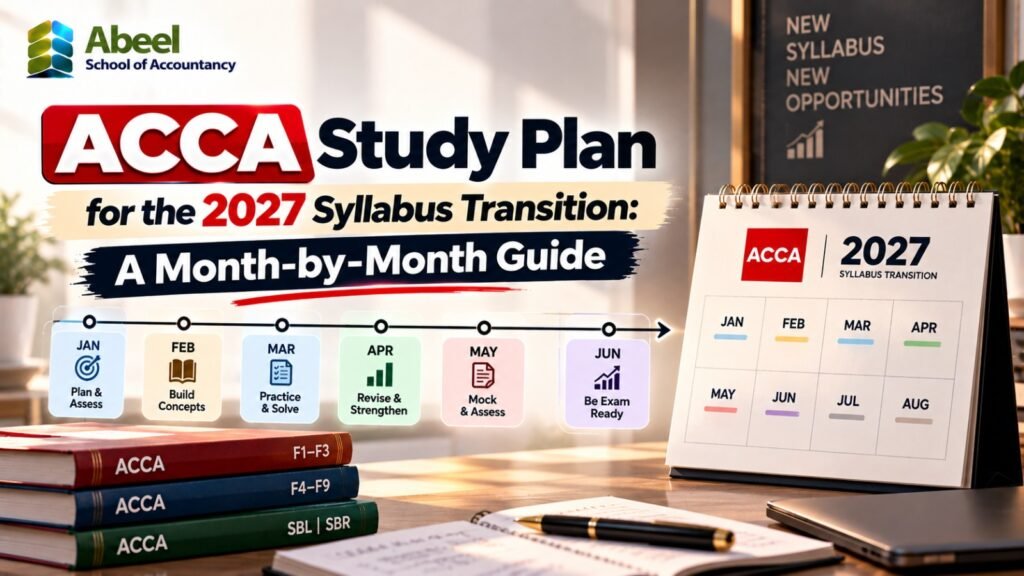
Here’s a sample route from now to the changeover. Adjust it to your own number of papers and confirm session dates on ACCA Global.
| Period | Focus |
|---|---|
| Oct to Nov 2026 | Check your record, set exam targets, book your next sitting, start structured study |
| Dec 2026 session | Sit your first target paper(s); begin the next paper straight after |
| Jan to Feb 2027 | Move to the next paper; schedule EPSM or start it if still pending |
| Mar 2027 session | Sit your second target; assess whether June is a realistic final push |
| Apr to May 2027 | Intensive revision for June; resolve any outstanding LW or Options decisions |
| June 2027 | Final session under the current syllabus; treat it as your last safe attempt |
| July 2027 | New Knowledge exams and employability modules launch; check EPSM cut-off |
| Sept 2027 | First session for Expertise and the redesigned Strategic Professional |
Two warnings. First, OpenTuition advises against leaving a session-based paper until the very last sitting, since you’d have no room for a resit. Second, ACCA says the exact mid-July 2027 EPSM cut-off is still to be confirmed, so don’t leave ethics to the end.
Step 4: Choose Your Paper Order Wisely
A few principles to guide the order you take your remaining exams:
- Pair related papers. Taxation with Financial Reporting, or Audit with Law, often overlap in logic and make revision easier.
- Don’t stack two heavy papers in one session unless you’ve done them before or have lots of study time.
- Do LW earlier, since it’s part of the complete Skills set and moves to Knowledge level.
- Pick your Options paper based on your career goals. Remember, only one Option is needed in the new structure, and a current Options pass maps across.
- Keep your strongest paper for the toughest session. Confidence counts.
Step 5: Set a Weekly Routine That Survives Real Life
A plan fails when it ignores your actual week. Here’s a realistic template for a working student:
- Weekdays (4 evenings): 90 minutes of focused study. Lectures or notes on two evenings, practice questions on the other two.
- Saturday: 3 to 4 hours of exam-style questions under timed conditions.
- Sunday: 1 hour of review, covering mistakes from the week, then rest.
- Weekly total: around 10 to 12 hours, which is a sustainable pace for most people.
Full-time students can nearly double this, but the structure stays the same: learn, practise, review.
Step 6: Use Past Questions Early
The biggest mistake we see is saving practice questions for the final month. Start them in the first third of your study period. Mark your answers honestly, note why you lost marks, and revisit weak topics. Also, because the newer exams emphasise judgement and data, practise explaining your answers in plain English, not only getting the numbers right.
Step 7: Build in a Safety Net
Life happens. Illness, work pressure and family commitments can all disrupt a plan. Protect yourself by:
- Leaving at least one spare session before June 2027
- Keeping the last two weeks before each exam clear of new topics
- Having a Plan B paper order if your first choice falls through
Don’t Forget PER and Employability
Your Practical Experience Requirement of 36 months plus performance objectives continues, and so does the Strategic Professional seven-year rule. Log your PER regularly instead of cramming it at the end. If you want to understand how these skills line up with job expectations, our guide on what employers want from ACCA students in 2027 explains it.
How Abeel School of Accountancy Supports Your Plan
A plan is easier when someone is checking it with you. At Abeel School of Accountancy, we offer:
- A personal transition review using your ACCA record
- A custom study calendar built around your job and exam dates
- Regular mock exams and feedback so you know where you stand
- Digital and data-skills teaching that matches where the qualification is heading
- Career guidance once you reach membership
Explore our ACCA courses or book a free planning session.
Frequently Asked Questions (FAQs)
1. How long should I study for each ACCA paper?
It depends on the paper and your background, but many students allow roughly 10 to 14 weeks per paper at 10 to 12 hours a week. Your adviser can tailor this.
2. Should I sit more than one paper per session?
Only if you have the time and the papers aren’t both heavy. Many working students do better with one paper per session, with a second only if it’s lighter or closely related.
3. What happens if I fail in June 2027?
You’d carry on under the new structure, and passed exams still map across. That’s why we suggest aiming for an earlier attempt and treating June as a backup.
4. Do I need to finish before the new syllabus starts?
No. Passed exams transition into the new structure, so finishing before 2027 is a choice, not a requirement.
5. When should I do EPSM?
Early. Completing it by ACCA’s transition cut-off gives credit for the Ethical, Sustainable Leadership module, and the exact date is still to be confirmed.
6. How can Abeel School of Accountancy help me build my study plan?
We review your record, map your credits, and create a sitting-by-sitting calendar with mock exams along the way. Contact Abeel School of Accountancy to get started.
7. Is it too late to start a plan if I’m already studying?
Not at all. Even with eight months to go, a clear schedule can make a big difference.
Final Thoughts
A good ACCA study plan for the 2027 transition has four ingredients: knowing your position, choosing your scenario, mapping a realistic timeline and building a safety net. You don’t need to study every hour of the day. You need to study consistently, and with a clear finish line.
If you’d like help turning this into your own schedule, reach out to Abeel School of Accountancy today and we’ll build it with you.
Plan your next step
Use these related guides to connect the changes with your own exam record and revision plan.