If you have been reading about the new ACCA qualification, you have probably seen the same thing everywhere: a table of old paper names on one side and new exam codes on the other. Useful, yes, but it leaves the important questions unanswered. Is the content really different? Is the new version harder? And what should you do about it today?
At Abeel School of Accountancy, we believe a comparison should help you decide, not just inform you. So let us go through the old and new ACCA syllabus side by side, level by level, and then look at what is actually changing inside the papers.
The Structure: Old vs New at a Glance
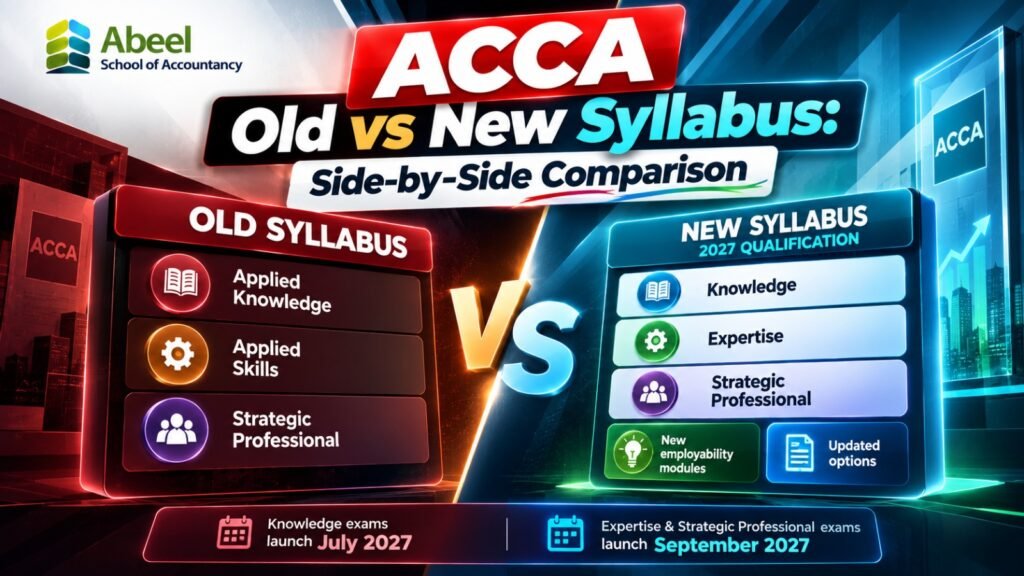
| Feature | Current ACCA | New ACCA (from 2027) |
|---|---|---|
| Levels | Applied Knowledge, Applied Skills, Strategic Professional | Foundations, Knowledge, Expertise, Strategic Professional |
| Total exams | 13 | 11 (excluding Foundations) |
| Knowledge level | BT, MA, FA | K1, K2, K3 |
| Middle level | 6 papers | 5 papers (Expertise) |
| Strategic Professional | 2 compulsory + 2 options | 2 compulsory + 1 option |
| Options choice | 2 from 4 | 1 from 5 |
| Skills modules | Ethics and Professional Skills Module (EPSM) | Essential Employability Modules |
| Exam format at lower levels | Computer-based on demand at Applied Knowledge | On-demand computer-based at Foundations and Knowledge |
You can confirm the structure yourself in ACCA’s qualification levels infographic.
Level by Level: Paper Comparison
Knowledge level (replacing Applied Knowledge). Old: Business and Technology, Management Accounting, Financial Accounting. New: K1 Financial Accounting, K2 Management Accounting, K3 Business Law. Business and Technology is removed as a standalone exam, and Business Law moves down from the middle level. You also complete the Responsible Business Management module here.
Expertise level (replacing Applied Skills). Old: LW, PM, TX, FR, AA and FM. New: E1 Taxation, E2 Financial Reporting, E3 Audit, Risk and Control, E4 Finance and Investment and E5 Performance with Data Analysis. One paper fewer, because Law has moved down. The Digital Tech and Innovation module sits alongside this level.
Strategic Professional. Old: SBR and SBL plus two from AAA, AFM, ATX and APM. New: S1 Business and Sustainability Reporting and S2 Strategic Business Leader plus one from SAA, SCF, STA, SPI or the brand new SDS Data Science Professional. The Ethical, Sustainable Leadership module belongs here.
What Really Changes Inside the Papers?
Names are easy to compare. Content is what students care about. Based on ACCA’s announcements and published guides from several providers, here are the changes worth knowing.
Audit and Assurance becomes Audit, Risk and Control. The new name tells the story. Risk management is built into the paper, so expect less focus on audit procedures alone and more on how organisations identify and control risk.
Financial Management becomes Finance and Investment. The scope widens beyond corporate finance basics to include financial markets and investment topics. It feels closer to what a finance professional sees on the job.
Performance Management becomes Performance with Data Analysis. The core performance and management accounting ideas remain, but data analysis is added. Students should be ready to interpret and use data, not just calculate with it.
Strategic Business Reporting becomes Business and Sustainability Reporting. Sustainability reporting moves into the title and the core of the syllabus. Candidates need to be comfortable with reporting beyond the traditional financial statements.
Financial Reporting and Taxation continue with updates. The papers keep their core purpose, with topic updates and refreshed material, including the shift to IFRS 18 in presentation of financial statements that is already appearing in the current syllabus.
Strategic Business Leader continues largely as it is. If you are comfortable with the current case study style, S2 will feel familiar.
Because exact syllabus content is published paper by paper, always check ACCA’s official study guides for the specifics once they are released.
The New Things That Did Not Exist Before
Some elements of the new syllabus have no old equivalent at all, and these are the ones students should prepare for first.
Foundations level. An entry route for students who do not meet direct entry requirements, with F1 Accounts Preparation, F2 Management Information and F3 Decision Making with Data.
Data Science Professional (SDS). A new options exam teaching how to use data to solve business problems.
Essential Employability Modules. Online assessed modules covering areas such as enterprise, responsible business, digital technology and ethical leadership. They are not timed exams, but they are required.
Higher awards along the way. Passing levels brings recognised diplomas and designations, so progress is visible long before final membership.
Key Dates for the Switch
According to ACCA’s official timeline, these dates matter:
- Until June 2027: exams follow the current syllabus
- July 2027: first Foundations and Knowledge exams under the new structure, on demand
- September 2027: first Expertise and Strategic Professional exams
If you want to see where your own progress sits, ACCA provides official transition resources, and our team can walk you through them. Start on our ACCA counselling page and the advisers at Abeel School of Accountancy will help you map your path.
What Should You Do Right Now?
The best move depends on where you stand today.
Not started yet. There is no need to wait for 2027. Passes under the current syllabus are expected to carry across through ACCA’s mapping, so starting now builds momentum.
Midway through the middle level. Try to clear as many current papers as you can before the June 2027 cut-off, then let the mapping carry your progress.
At Strategic Professional. Check your exact combination of passed papers with ACCA, because the options rule is changing and your best timing depends on what you have already cleared.
Starting fresh in late 2027. Begin with Foundations or Knowledge according to your entry level, and focus on data and sustainability skills early.
Is the New Syllabus Harder?
It is different rather than simply harder. With fewer papers, each one carries more weight and touches more themes. Data, risk, sustainability and professional judgement appear more often, and the on-demand computer-based format needs practice on screen. Students who revise steadily will adapt well. Students who cram will feel the pressure.
Studying the Smart Way Through the Transition
Syllabus changes reward students who build habits, not students who rush. This is where Abeel School of Accountancy stands apart.
Abeel School of Accountancy is the only institute that conducts weekly live revision sessions along with smart course completion, something no one else offers. Every week, students revisit what they have learned with a teacher live, so new topics like data analysis and sustainability reporting stay fresh instead of fading. Smart course completion makes sure the full syllabus is finished early, leaving time for past paper practice and exam technique. See how it works on our ACCA programme page.
Frequently Asked Questions
Q1. What is the biggest difference between the old and new ACCA syllabus?
The structure. ACCA moves to four levels with a new naming system, drops from 13 to 11 exams, adds a Foundations level and reduces the options requirement from two to one.
Q2. Which old papers are removed?
Business and Technology is removed as a standalone exam, and the second options paper is no longer required. Corporate and Business Law is not removed, because it moves down to Knowledge level as K3 Business Law.
Q3. Is the content of papers like Taxation and Financial Reporting completely different?
No. They keep their core purpose with updated topics. The larger content shifts are in Audit, Risk and Control, Finance and Investment, Performance with Data Analysis and Business and Sustainability Reporting.
Q4. Will my old exam passes still count?
ACCA has confirmed that passes under the current structure carry across through its mapping process. Check your own record using ACCA’s transition resources.
Q5. Should I start ACCA now or wait for the new syllabus?
Waiting rarely helps. Starting now gives you time to build knowledge and confidence, and your passes are protected. Our counsellors at Abeel School of Accountancy can help you choose the best starting point for your situation.
Q6. Are the Essential Employability Modules exams?
No. They are online assessed modules rather than timed exams, but they are part of the qualification.
Q7. What makes your institute different from other ACCA institutes?
We are the only institute offering weekly live revision sessions combined with smart course completion. Students revise every week and finish the syllabus early, so exam preparation never turns into a last minute rush.
Final Thoughts
Placed side by side, the old and new ACCA syllabus share more than they differ. The core of accounting, audit, tax and reporting remains. What changes is the structure around it and the emphasis on data, risk, sustainability and professional skills. Prepare early, revise steadily and the transition becomes an advantage rather than an obstacle.
If you want a team that tracks every ACCA update and a study system built on weekly revision, Abeel School of Accountancy is ready to guide you. Reach out through our contact page and begin your ACCA journey with a clear plan.