Imagine spending two years passing ACCA exams, then hearing that the entire qualification is changing. Your first question is probably the same as every other student’s: “Where do all my passes go?”
ACCA’s answer is a dedicated Transition Tool that shows how your current progress fits into the redesigned qualification. It sounds simple, but many students either ignore it or misread the results. At Abeel School of Accountancy, we want you to use it with confidence, so this guide explains how the mapping works, how to read your results and what to do next.
What Is the ACCA Transition Tool?
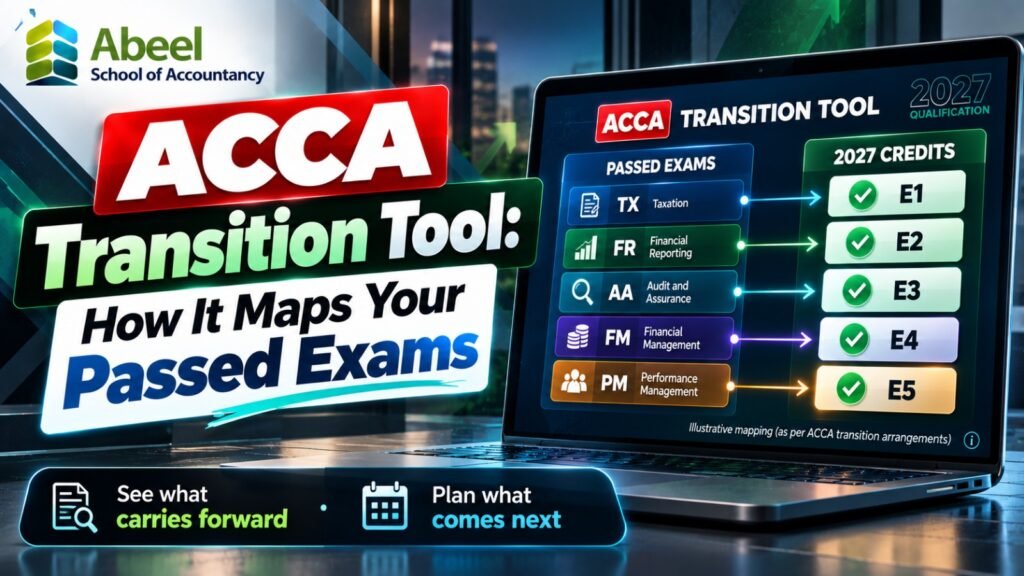
ACCA describes its Transition Tool as a helpful way to see how your current progress maps onto the redesigned qualification. Rather than guessing from blog posts (including ours), you check your own record against ACCA’s official rules.
That matters because everyone’s position is slightly different. A student with an exemption, a partly finished Applied Skills level and EPSM still pending has a different result from someone who has only passed FA. The tool is designed to handle those differences. You can find the link to it on ACCA’s student guidance pages for the future qualification.
The Rules Behind the Mapping
The tool does not invent anything. It applies ACCA’s published credit rules, which you can read on ACCA’s page for current ACCA Qualification students. Understanding those rules makes the results far easier to interpret.
Level to level. Applied Knowledge moves to Knowledge, Applied Skills moves to Expertise and Strategic Professional stays as Strategic Professional.
Exam to exam. Each passed exam receives credit for its equivalent:
| Passed exam | Credit |
|---|---|
| FA | K1 Financial Accounting |
| MA | K2 Management Accounting |
| LW | K3 Business Law |
| TX | E1 Taxation |
| FR | E2 Financial Reporting |
| AA | E3 Audit, Risk and Control |
| FM | E4 Finance and Investment |
| PM | E5 Performance with Data Analysis |
| SBR | S1 Business and Sustainability Reporting |
| SBL | S2 Strategic Business Leader |
| AAA, AFM, ATX, APM | SAA, SCF, STA, SPI |
Module credit. Some passes earn credit for the new Essential Employability Modules. A completed BT exam gives credit for Responsible Business Management. Completing all Applied Skills exams, including LW, means you do not need the Digital Tech and Innovation module. Completing EPSM gives credit for Ethical, Sustainable Leadership.
New elements. The new Data Science option (SDS) has no current equivalent, so no old pass maps to it.
Three Worked Examples
To make this concrete, here are three illustrative students. These examples follow ACCA’s published credit rules, but your own result from the official tool is what counts.
Student A: partway through Applied Skills. Priya has passed FA, MA, BT, LW and TX. Under the credit rules, she would expect credit for K1, K2, K3 and E1, plus the Responsible Business Management module because she passed BT. Her remaining Expertise exams would be E2 to E5 equivalents, and she would think carefully about finishing the rest of Applied Skills before June 2027, which could also spare her the Digital Tech and Innovation module.
Student B: all of Applied Skills done, EPSM pending. Omar has passed every Applied Skills exam including LW. He would expect credit for E1 to E5 and K3, and he would not need the Digital Tech and Innovation module. He would move onto Strategic Professional, and EPSM would be his priority, because completing it before the mid July 2027 cut-off earns credit for the Ethical, Sustainable Leadership module.
Student C: well into Strategic Professional. Aisha has passed SBR, SBL and AAA and has completed EPSM. She would expect credit for S1, S2, SAA and the Ethical, Sustainable Leadership module. Because the new structure requires only one options exam, ACCA’s guidance says this combination can lead to the Strategic Professional Certificate at transition.
Notice the pattern. In each case, the tool is reporting what ACCA’s rules already say. Your job is to turn that into a plan.
How to Use the Tool Well: A Simple Routine
Exact screens may change as ACCA updates the tool, so think of this as a routine rather than a click guide.
1. Start from your official record. Make sure your myACCA record is accurate, including any exemptions. The tool can only map what ACCA has recorded.
2. Enter or review your progress. Check that every passed paper, module and exemption appears correctly.
3. Read the credit results carefully. Look at which exams show credit, which modules are credited and which elements remain.
4. Note the gaps. Pay special attention to Law, BT, the full Applied Skills set and EPSM. These are the elements where timing most often changes your outcome.
5. Re-check after every result. Progress changes after each exam session, so ACCA-aligned guides suggest revisiting the tool whenever your position changes.
6. Build your session plan. Now match your remaining elements to the sessions left. We are in October 2026, so December 2026, March 2027 and June 2027 are your remaining session windows. Confirm exact dates on ACCA’s official timeline.
What the Tool Cannot Do for You
A tool shows a result. It does not make decisions. There are a few things you still need to handle yourself.
- It cannot choose your strategy. Whether to rush a paper or wait is your call, ideally made with an adviser.
- It cannot predict exam outcomes. If you plan to sit a paper in June 2027, the tool cannot tell you whether you will pass.
- It may not reflect unfinished business. If you have a pending exemption or a missing record, fix that first.
- Fees and some deadlines may still be updating. ACCA has said module prices will be confirmed in January 2027, and some dates are to be confirmed.
Common Mistakes Students Make With the Tool
- Using it once and forgetting it. Your position changes after every pass.
- Ignoring the module lines. Students focus on exams and miss the 60, 70 or 100 hour modules that could be avoided.
- Trusting a blog over the official result. Use guides like this one to understand the rules, then rely on the tool for your own case.
- Leaving Law late. It affects K3 and the full Applied Skills set.
- Waiting for 2027 to start planning. Decisions made now have the most impact.
How Abeel School of Accountancy Helps You Read the Results
Many students open the tool, see a screen full of credits and modules, and still feel unsure. The advisers at Abeel School of Accountancy sit down with you, compare the tool’s result with your goals and turn it into a realistic session plan. Start on our ACCA counselling page.
Abeel School of Accountancy is also the only institute that conducts weekly live revision sessions along with smart course completion, something no one else offers. Each week, students revise with a teacher live, so the papers you plan to finish before June 2027 stay fresh in your mind. Smart course completion makes sure the syllabus finishes early, leaving time for past papers and exam technique. See how it works on our ACCA programme page.
Frequently Asked Questions
Q1. What does the ACCA Transition Tool do?
It shows how your current exam progress maps onto the redesigned ACCA Qualification, so you can see which exams and modules receive credit and what remains.
Q2. Where do I find the Transition Tool?
ACCA links to it from its student guidance pages for the future qualification. Use the official ACCA website so you are checking your real record.
Q3. Is the tool always accurate?
It applies ACCA’s published rules to your record, so accuracy depends on your record being up to date. If something looks wrong, contact ACCA directly and check your exemptions and passed papers.
Q4. Should I use the tool once or several times?
Several times. Re-check it after each exam result or whenever your plan changes, because your transition position can change.
Q5. Can the tool tell me whether I should rush my exams?
No. It shows credit and gaps, but the decision depends on your readiness, work schedule and goals. The advisers at Abeel School of Accountancy can help you weigh these before booking exams.
Q6. Will I lose credit for passed exams?
No. ACCA has confirmed that passed exams receive credit for their equivalents in the redesigned qualification.
Q7. What makes your institute different from other ACCA institutes?
We are the only institute offering weekly live revision sessions combined with smart course completion. Students revise every week and finish the syllabus early, so the final weeks before the exam are for practice, not panic.
Final Thoughts
The ACCA Transition Tool is your most reliable way to see where you stand in the new qualification. Use it early, use it often and combine its results with a clear study plan. When you know exactly which exams and modules are credited, planning stops feeling like guesswork.
If you want a team that follows every ACCA update and a study system built on weekly revision, Abeel School of Accountancy is ready to guide you. Get in touch through our contact page and turn your transition result into a confident plan.
Plan your next step
Use these related guides to connect the changes with your own exam record and revision plan.
- 2027 changes and current-student checklist
- Build a sitting-by-sitting study plan
- Review mock answers and target lost marks