

Whether ACCA is worth pursuing in Zimbabwe depends on the work you want to do, your starting position and the resources you can commit. The question cannot be answered responsibly by promising every learner the same salary or treating international recognition as automatic permission for every professional activity.
Use a decision record combining career evidence, official route information, a dated budget and realistic study capacity. This helps you compare ACCA with the alternatives relevant to your goal.
Define the career decision
Choose the type of role or responsibility you want to investigate. Review current employer requirements and identify the experience and skills requested alongside qualifications. Ask what the qualification would add to your own position.
If your goal involves regulated work, verify the relevant professional pathway separately. ACCA’s Zimbabwe audit-qualification information is a reminder that a membership discussion and an audit-permission discussion are not identical.
Establish your starting point
Check your exact education against current entrance requirements and obtain any exemption decision through the official process. Record unresolved questions rather than planning from the best possible outcome.
Then list the learning still required. Consider whether you can sustain independent practice and obtain appropriate feedback. A route with fewer remaining exams may still need revision of prior knowledge to support later work.
Compare the complete commitment
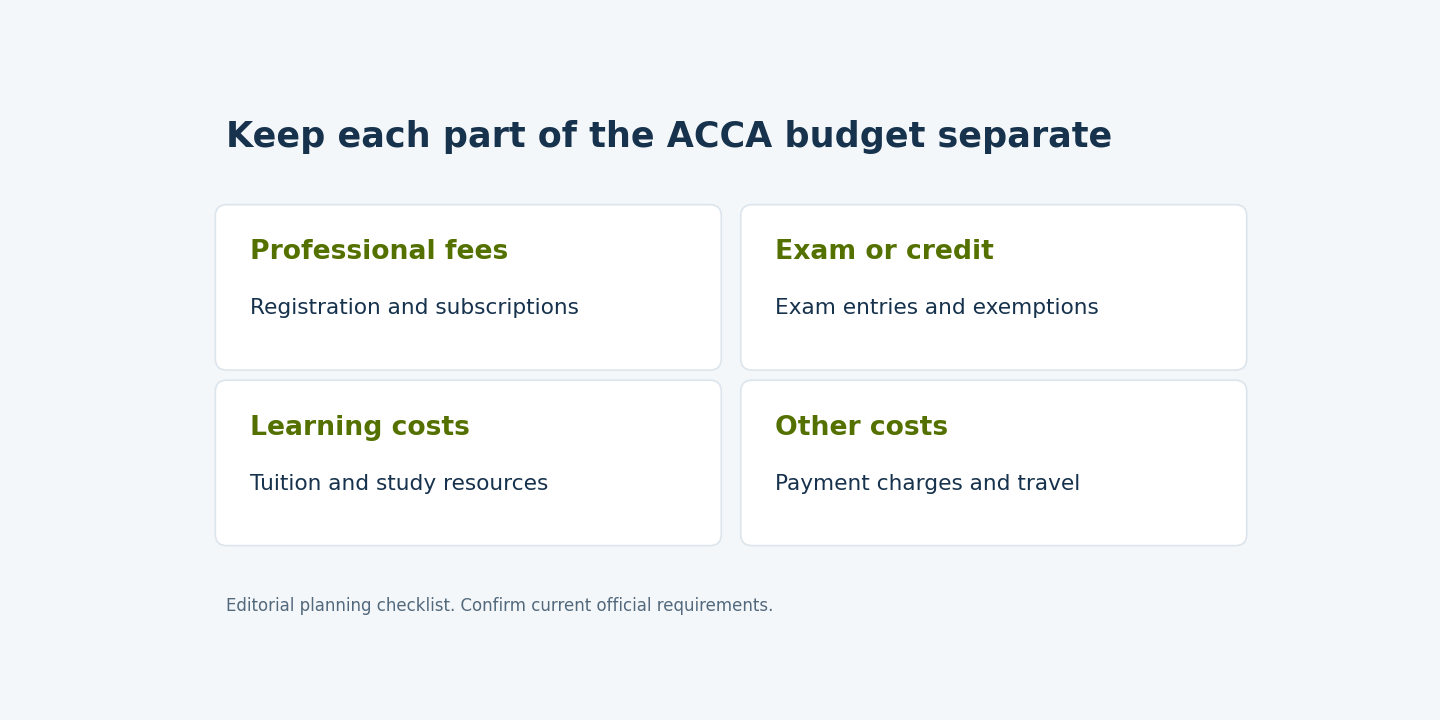
Build a dated budget with separate lines for tuition, applicable ACCA charges, study equipment, connectivity and confirmed travel. Record currencies and payment timing. Avoid comparing a full qualification estimate for one option with tuition alone for another.
Add time as a separate commitment. Map the ordinary and busy weeks you expect to face. Ask whether the study load can coexist with work, family responsibilities and any other education you are completing.
Plan how experience will develop
Membership planning includes relevant practical experience under the applicable requirements. Investigate whether your current or prospective work can support that plan and how review and sign-off would be arranged.
Do not assume another qualification immediately substitutes for the experience an employer asks for. Identify the practical tasks you can demonstrate and what exposure you still need.
Test the learning before committing heavily
Try a demo lesson and an independent question. Ask about the paper, syllabus period, marking, recording access and written course terms. Use the exercise to identify support needs rather than judging only the lecturer’s presentation.
A sensible next step can be a confirmed route, one suitable course or further research into employers. The decision is stronger when you can explain what evidence supports it and what uncertainty remains. Revisit the record when the fees, official arrangements or your circumstances change.
Write a decision statement you can evaluate
Replace the broad question “Is ACCA worth it?” with a statement about your own objective. For example, you might want to move from routine bookkeeping to reporting responsibilities, develop accounting knowledge alongside a degree, or prepare for a particular finance role. These objectives need different evidence. A qualification can contribute to a goal without being the only thing needed to achieve it.
Write the intended outcome, your present experience and the main gap you want to address. Then identify what would count as progress. That might be demonstrating a reporting task, improving your understanding of financial information or becoming eligible to apply for a role with a specified qualification requirement. Avoid using an unspecified higher salary as the only measure of value.
Collect employer evidence without inventing a salary promise
Review a small set of relevant, current vacancies and record the date, role, responsibilities and requested qualifications. Look at the work rather than only the title. Two finance positions can require different exposure to reporting, systems, controls or management information. Record the experience and practical skills requested alongside any professional qualification.
Distinguish an essential requirement from a preferred one. If a vacancy mentions several acceptable qualifications, it does not establish that every candidate with one of them will be selected. Equally, an entry-level role may provide useful experience without immediately matching your long-term title. Use the evidence to understand a pathway, not to predict an employment outcome.
A salary figure without a clear source, period, location and role definition can mislead a study decision. If an employer publishes a range, treat it as information about that vacancy rather than a universal ACCA salary. A personal budget should not depend on a future earnings increase that has not been offered or otherwise supported.
Compare ACCA with an actual alternative
A useful comparison names the alternative and explains why it is relevant. You might compare studying ACCA now with completing a degree first, developing experience before enrolling, or investigating another professional route. Compare each option against the same objective. Do not assume that all accounting qualifications provide identical opportunities or obligations.
For each option, record the educational entry position, expected learning, costs you can verify and time you can realistically allocate. Where professional permissions matter to your goal, obtain current guidance from the appropriate official body. Leave unresolved conditions visible. A comparison with important gaps should lead to further enquiries rather than a confident ranking.
Also consider the cost of delaying or starting too soon. Waiting may give you more time to clarify a route or save money, but it can postpone useful learning. Starting before your timetable and finances are workable may create avoidable pressure. The appropriate choice depends on your circumstances and evidence, not on a generic instruction to enrol immediately.
Make a budget that survives ordinary interruptions
Build the budget from actual categories: official charges, tuition, materials, equipment, payment-service costs and confirmed travel where relevant. Record which items are known, quoted or still estimated. Keep different currencies and recipients clear. Recheck the amounts before paying instead of treating a saved spreadsheet as a current invoice.
Consider cash flow as well as the total. Several individually manageable charges can become difficult when they fall due close together. Mark the payment dates beside the study milestones and compare them with the money you can reliably allocate. Avoid financing the plan solely from an expected job offer or an unconfirmed promotion.
Ask the tuition provider what happens if you need to pause, move the study period or revise the intended exam timing. Record the applicable access, transfer and refund terms. Keep official exam-entry rules separate. A course extension does not automatically change an exam booking, and an exam change does not automatically extend tuition access.
Test whether the study workload is usable
Try a representative learning cycle before committing to a large package: study an explanation, attempt a question independently and review mistakes. Record the actual time and the support needed. This is more informative than judging the workload from lecture duration alone. If a question remains difficult, identify whether the issue is the concept, the requirement or the answer format.
Put the cycle into an ordinary week with your existing commitments. Keep a recovery slot rather than assuming every evening will be available. If the trial works only during an unusually quiet week, adjust the plan. The Zimbabwe study timetable guide provides a focused way to organise learning, attempts and review.
Choose the size of the initial commitment accordingly. A larger package may have an attractive price but still be unsuitable if the access period or simultaneous workload exceeds what you can use. Ask about the paper sequence and current progression position before deciding. A manageable starting step can generate better evidence for the next decision.
Evaluate the tuition service separately from the qualification
Deciding that ACCA fits your objective does not settle which provider to use. Compare the course’s paper coverage, teaching language, access period, feedback and current written terms. Test the actual platform from Zimbabwe using the device and connection you expect to rely on. A public promotional video may not represent the full learning experience.
Ask about the support that matters to your weakness. Someone struggling with written explanations may need feedback on submitted answers. Someone returning after a study break may need help identifying gaps in prior learning. Neither need is answered solely by a statement that the course includes many videos. Use the Zimbabwe tuition comparison worksheet to organise the evidence.
Set a checkpoint instead of demanding certainty
You do not need to predict the entire career journey before making a sensible first decision. Set a checkpoint after an appropriate period of learning and independent practice. Review the work completed, recurring difficulties, actual costs and whether the original career objective still makes sense. Make changes from evidence rather than from the feeling that money already spent must justify every future purchase.
A checkpoint can lead to continuing the current plan, reducing the workload, changing the support arrangement or investigating a different route. Record the reason. If an official fee, exemption or booking arrangement changes, recheck the relevant source. If your responsibilities change, revise the timetable before the old plan becomes an unmanageable backlog.
Frequently asked questions about ACCA’s value
Will ACCA guarantee a job in Zimbabwe?
No qualification guarantees an individual job offer. Evaluate current employer requirements, relevant experience and the responsibilities you can demonstrate. Use study to develop capabilities alongside your qualification progress.
Is ACCA worth considering while I am at university?
Consider the combined workload, confirmed entry or exemption position and your intended career direction. Do not assume that university study automatically supplies credit or enough time for another course. Compare a concurrent plan with starting later using actual programme information.
How should I judge the return on the cost?
Record verified spending and the useful outcomes you are pursuing. Treat future earnings as uncertain unless supported by a specific offer or reliable evidence relevant to you. Include the time commitment and alternatives in the decision rather than relying on a single speculative salary figure.
Discuss your next step with ASA
For the wider route and study picture, read the ACCA in Zimbabwe guide. Explore Abeel School of Accountancy and ASA courses. Ask ASA about tuition with your qualifications, intended paper, location, preferred teaching language and available study hours. Confirm the actual course format and access conditions; this article does not imply a physical ASA branch or exam venue in Zimbabwe.
Sources reviewed 13 October 2026: ACCA minimum entrance requirements; Zimbabwe audit qualification. Planning examples are editorial suggestions, not guaranteed exam, employment or licensing outcomes.
More ACCA planning guides for Zimbabwe
- ACCA Entry Requirements in Zimbabwe: Check Your Exact Qualification
- ACCA Fees in Zimbabwe: Build a Budget You Can Update
- ACCA Exemptions in Zimbabwe: Check Your Programme Before Skipping Papers
- ACCA Modules in Zimbabwe: Turn the Qualification Structure into a Paper Plan
- ACCA Online Classes in Zimbabwe: Test Access, Timing and Feedback Before Enrolling
- Choosing ACCA Tuition in Zimbabwe: An Evidence-Based Comparison Worksheet
- Becoming an ACCA Member in Zimbabwe: Track Exams, Ethics and Experience
- ACCA Careers in Zimbabwe: Compare Roles Using Real Vacancy Evidence
- ACCA Study Planning in Zimbabwe: Build a Week That Includes Question Practice