

An ACCA budget in Zimbabwe should be a dated working record rather than one permanent total copied from another learner. Your route, exemptions, paper choices and study period change what you need to pay. Separate charges to ACCA from tuition and other costs before comparing providers.
Use the current official fees information applicable to your location and account. A tuition quotation in one currency does not establish the currency or amount of every external qualification charge.

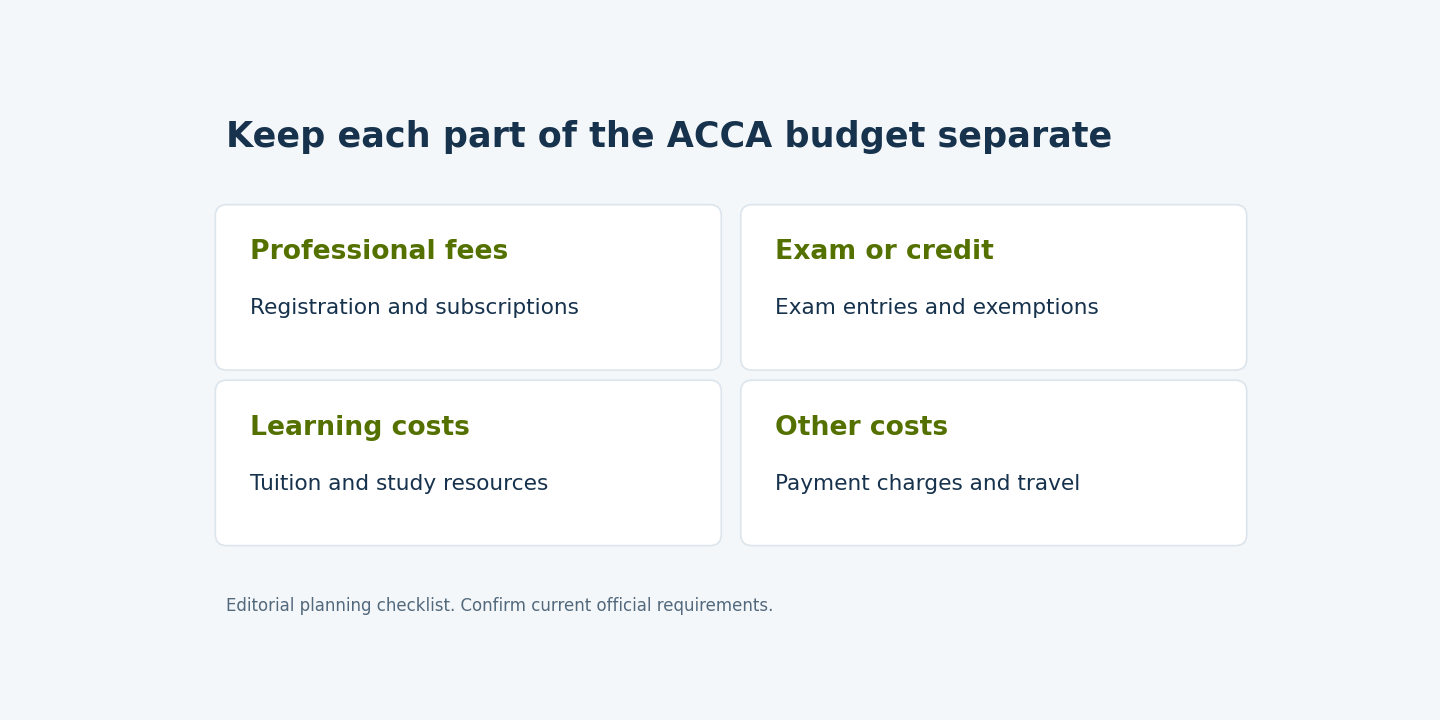
List each recipient and purpose
Make a budget with columns for purpose, recipient, quoted currency, amount, quotation date and expected payment time. Add a field showing whether a charge has been paid or remains an estimate. Avoid putting an estimate into the paid column simply because the same amount was quoted to a friend.
Identify registration, subscription, exams and exemptions where they apply to your route. Obtain the current tuition price separately, together with the access period and included support. Ask which services would require another payment.
Compare currencies without hiding assumptions
When translating a quotation into the currency you use to budget, record the rate date and any payment charges you have verified. A converted amount is an estimate until the payment method and applicable rate are known.
For example, two course quotations may appear similar after a rough conversion but provide different access periods. Compare the whole service and payment schedule rather than selecting solely on the converted headline figure.
Include the study costs outside the course
Add the device, data or internet access you actually need, and any confirmed exam travel. Check whether your existing equipment is suitable for tuition. Exam equipment or delivery conditions need a separate official check.
Record a resit contingency without assuming it will be used. If you later change your paper plan, revisit the contingency and the timing of external charges. A useful budget responds to changes instead of preserving an obsolete total.
Ask what happens when plans change
Before paying tuition, read the current terms on access, transfer, deferral and refunds. Obtain the policy from the provider rather than treating a past student’s experience as a promise. Exam-entry changes are governed by the applicable official booking conditions.
If an advertised discount affects the decision, record the eligibility conditions and expiry. Do not treat a temporary offer as the permanent cost of the qualification.
Review at every booking decision
Before entering the next exam, update the official charge, intended paper, currency and payment method. Keep the receipt and confirmation with your private study records. A budget that can be reconciled to real payments is more useful than a large unqualified estimate.
Discuss your next step with ASA
For the wider route and study picture, read the ACCA in Zimbabwe guide. Explore Abeel School of Accountancy and ASA courses. Ask ASA about tuition with your qualifications, intended paper, location, preferred teaching language and available study hours. Confirm the actual course format and access conditions; this article does not imply a physical ASA branch or exam venue in Zimbabwe.
Sources reviewed 13 October 2026: ACCA fees information. Planning examples are editorial suggestions, not guaranteed exam, employment or licensing outcomes.
Use three budget views instead of one headline total
An annual estimate, a first-stage commitment and a monthly payment plan answer different questions. The annual estimate helps you consider affordability over a longer period. The first-stage view shows what you need for the next confirmed part of study. The monthly view shows when funds must be available. Keep these views connected, but do not assume that a manageable monthly payment proves the full plan is affordable.
For a learner in Zimbabwe, keep every amount in its quoted currency until you make a dated comparison. If a conversion is necessary, record the rate source and date. Do not silently treat a current conversion as permanent. Keep external qualification charges separate from tuition, materials, connectivity and confirmed travel so you can see which decision affects each amount.
A fictional budget review before a tuition purchase
Tariro is a fictional learner comparing two tuition descriptions. One headline price looks lower, but its access period and feedback service are unclear. The other quotation specifies the paper, revision access and support included. She asks both providers the same questions before comparing the costs. This is an original budgeting example, not a real ASA customer story or a current fee quotation.
She also has an exemption question pending. Instead of calculating her whole study route from the most favourable possible outcome, she prepares two clearly labelled planning cases. One uses the papers currently confirmed; the other records what would change if the official decision changes the paper list. She does not treat the second case as a promise or purchase courses based on it without understanding transfer conditions.
Tariro then looks at the timing of payments rather than the total alone. A payment due before her planned savings are available needs attention even when the annual estimate looks manageable. She asks whether instalments, where offered, change the total charge and what happens if access or payments are interrupted. Written terms make the comparison more reliable.
A cost record with clear status labels
| Field | What to record | Useful status |
|---|---|---|
| Purpose | Registration, exam, tuition or another specific item | Required, optional or not yet confirmed |
| Recipient | The organisation receiving the payment | Verified or requiring clarification |
| Quotation | Date, amount, currency and included services | Current quote or older estimate |
| Payment | Due date and actual payment record | Planned, due or paid |
| Conditions | Transfer, cancellation and access information | Read or clarification pending |
Do not mark an estimated cost as paid. Similarly, a payment made should not be treated as proof that another administrative step is complete. Keep the course enrolment record and examination booking confirmation separate. The budget should show what is known, what remains uncertain and which organisation can answer the next question.
Compare the service behind the price
A tuition comparison should identify the exact paper, syllabus period, timetable and access duration. Ask whether the charge includes individually marked practice, group discussions, recordings or model solutions. These services are different. A lower price may still suit a learner whose support needs are modest, while another learner may need more detailed feedback. Compare the actual description instead of assuming expensive always means better or cheap always means sufficient.
Use a demonstration lesson to test the learning need. After watching, attempt a fresh task independently and record what you cannot explain. If the difficulty is written application, ask specifically about marking and feedback. If you miss live lessons because of work, ask about recordings and question support outside class time. The relevant service is the one that addresses the problem you actually have.
Make currency assumptions visible
When two quotations use different currencies, record both original amounts and a clearly dated comparison. Check payment instructions from the relevant recipient. Do not invent a universal payment method, exchange rate or currency arrangement for all Zimbabwean learners. Individual providers and official charges may have different instructions, and those instructions need to be checked near payment.
Ask how a quoted amount is handled if you pay later or in instalments. Read the answer rather than assuming the original comparison will remain accurate indefinitely. If there are additional payment-processing costs, record the actual information supplied by the relevant service. Avoid adding a generic percentage to every budget without evidence.
Plan for a change in study circumstances
A change in work hours, a family responsibility or an official paper decision can affect the first-stage plan. Keep a separate contingency discussion rather than presenting every possible additional cost as certain. Identify what the change would affect: tuition access, paper selection, exam timing or travel. Then check the relevant conditions before making another commitment.
If your timetable becomes unrealistic, ask about available course changes before assuming that another purchase is the only solution. A review may show that the issue is workload rather than missing materials. Reducing the first-paper commitment or changing the study format can be a planning option, depending on the actual terms available. This article does not promise that every provider offers refunds or deferrals.
Review the budget with a sponsor using evidence
A useful sponsor discussion shows the confirmed starting stage, the next required payments and the services included. Explain which figures are quotations and which are estimates. Keep pending exemption or exam-delivery questions visible. A sponsor should be able to understand what a payment buys and what it does not establish.
Review the plan when official charges, provider terms or your paper list change. Retain earlier dated versions so you can explain why the estimate changed. Do not alter an old entry silently and then treat it as evidence of what was originally quoted. A simple history helps distinguish a changed assumption from a payment-record error.
Frequently asked questions about ACCA budgeting in Zimbabwe
Can one published total cover every learner?
A useful budget reflects the actual route, papers, services and timing involved. Use current official charges and written provider quotations rather than treating another learner’s total as your own.
Should tuition and qualification charges be combined?
Keep them on separate lines with their recipients and purposes. This makes it easier to compare teaching and understand what an individual payment covers.
Does an instalment price establish the full course cost?
Check the number of payments, total charge, access conditions and what happens if circumstances change. A monthly amount is incomplete information without those terms.
How can I ask ASA for a useful quotation?
Use the existing enquiry form to identify your paper, current stage, preferred lesson format and study period. Ask what the quotation includes and how long access lasts. Read the main ACCA in Zimbabwe guide for the broader overview and visit the ASA home page for teaching information. Confirm actual terms before paying.
More ACCA planning guides for Zimbabwe
- ACCA Entry Requirements in Zimbabwe: Check Your Exact Qualification
- ACCA Exemptions in Zimbabwe: Check Your Programme Before Skipping Papers
- ACCA Modules in Zimbabwe: Turn the Qualification Structure into a Paper Plan
- ACCA Online Classes in Zimbabwe: Test Access, Timing and Feedback Before Enrolling
- Choosing ACCA Tuition in Zimbabwe: An Evidence-Based Comparison Worksheet
- Becoming an ACCA Member in Zimbabwe: Track Exams, Ethics and Experience
- ACCA Careers in Zimbabwe: Compare Roles Using Real Vacancy Evidence
- ACCA Study Planning in Zimbabwe: Build a Week That Includes Question Practice
- Is ACCA Worth It in Zimbabwe? Compare Cost, Time and Career Fit