
Treat the starting qualification as a specific record
A plan to study ACCA from Iran should begin with the full name and duration of the award you hold. ACCA’s entrance database distinguishes between several Iranian school and pre-university qualifications; it should not be summarised as every high-school diploma being treated identically. Keep the certificate, award date and results together when seeking a decision. Where the title or route is unclear, ask ACCA to assess the actual record rather than relying on an informal translation of the qualification name.
Resolve practical access before purchasing lessons
Entry eligibility does not establish that every registration, payment or platform service will be available in your circumstances. Confirm current arrangements directly with ACCA and the relevant payment or service provider before committing money. Do not rely on an old account screenshot or another person’s experience as proof of present access. Use only the official routes offered for your own location and situation; this guide does not suggest ways around restrictions or account requirements.
Check provision and the actual booking separately
The examination-availability page reviewed for Iran lists centre-based options. Follow its current link for your intended paper, and verify the appointment, location and instructions through the correct booking process. A listed country is not a promise of a seat on your preferred date. Also distinguish an on-demand examination from a session examination when planning deadlines. Keep an entry confirmation separate from a course receipt so that your records show which step has actually been completed.
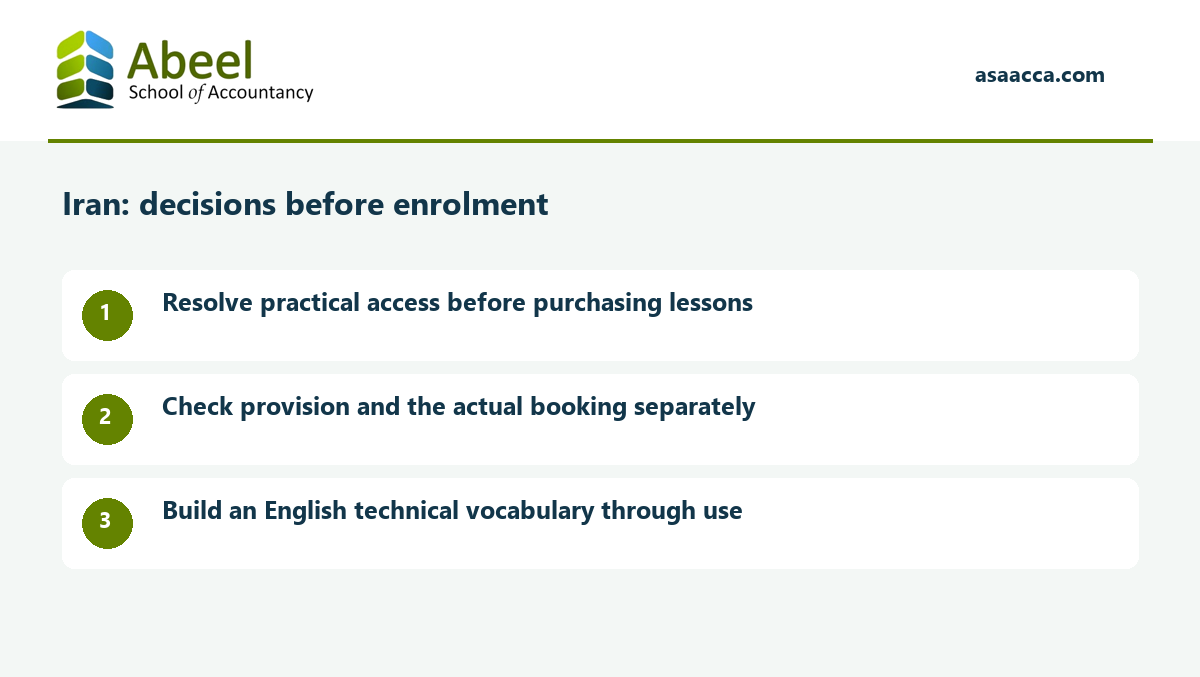
Build an English technical vocabulary through use
If your previous accounting study used another language, a practical starting exercise is to write a short explanation of a familiar transaction in English. Identify which words you understand conceptually but cannot yet use clearly in an answer. Create a vocabulary note with a definition, a small example and a sentence of your own. Then revisit the term while answering questions. This learning suggestion is not a claim about a universal language barrier; choose it only if it addresses your actual needs.
Ask a tuition provider precise questions
Before enrolling, check the teaching language, intended exam period, access duration and way of receiving feedback. Test a sample lesson and the associated materials using the device and connection you expect to use regularly. If access is inconsistent, resolve the issue before purchasing a full package. Keep claims about teaching separate from claims about official eligibility or examination administration. A tutor can help with a paper, but an official account decision remains with the relevant body.
A decision log can prevent unnecessary spending
Write down each unresolved question, who can answer it and what evidence you received. For example, keep an entry assessment, a confirmed booking and a course-access agreement in separate sections. Only move to the next purchase when the dependency is clear. If an answer changes, update the plan instead of continuing from the old assumption. The ASA resources below explain the wider qualification and active study methods, while the linked ACCA pages should be used for current official arrangements.
Build on the ACCA foundations
Official references for this guide
Describe your educational history without shortening award names
A prospective applicant may have several documents that describe different stages of education. List them chronologically and preserve the complete wording used by the awarding institution. Do not replace a precise vocational or school qualification with a broad English label simply because the shorter term seems familiar. Where a translation is needed, follow the current application instructions and retain the original document. The objective is to allow the official assessor to identify the actual award. An informal translation used in a social-media discussion is not a substitute for an individual assessment of the records submitted.
Test the complete access journey before buying tuition
There are several practical steps between finding a course and completing an assessment. Check whether you can use the relevant official account, follow the required application process, receive communications and arrange your intended examination through supported channels. Treat an unresolved step as a question to investigate rather than something a tuition purchase will automatically fix. Do not share account credentials with strangers or use unsupported arrangements to get around a restriction. Where access or payment remains uncertain, obtain guidance from the responsible organisation before committing money to a timetable that depends on it.
Separate currency planning from a quoted tuition price
If official charges and tuition quotations are expressed in different currencies, make a worksheet that records the original currency, the source of the amount and when it was checked. Your own payment route may introduce a different final cost from a simple conversion shown online. Avoid publishing or relying on an undated total that hides those assumptions. For planning, consider a range you can afford and identify the expense that would cause you to postpone the next stage. This is a budgeting exercise, not a promise about exchange rates or the availability of any payment service.
Check English readiness through an actual explanation task
Try reading a short accounting requirement and explaining what it asks you to do before attempting the answer. A vocabulary list alone may not reveal whether you understand a command word, a qualification or an exception. After studying a topic, explain the reasoning aloud and then write a concise response. Compare the explanation with the question, not just with a memorised definition. If language is the obstacle, ask a teacher for support that connects terminology with its accounting meaning. This is more useful than assuming that attendance in an English-language course demonstrates examination readiness.
Make the first commitment reversible
Until entry and practical access are confirmed, avoid treating a long course bundle as the only way to begin. Use introductory material to assess interest and baseline knowledge, and collect the questions that require official answers. Once those answers are available, choose a realistic first paper and establish a practice schedule. Keep a record of what the provider includes and how long access lasts. A staged decision protects your study time as well as your budget, particularly when a plan depends on several organisations responding or on arrangements outside the course provider’s control.