
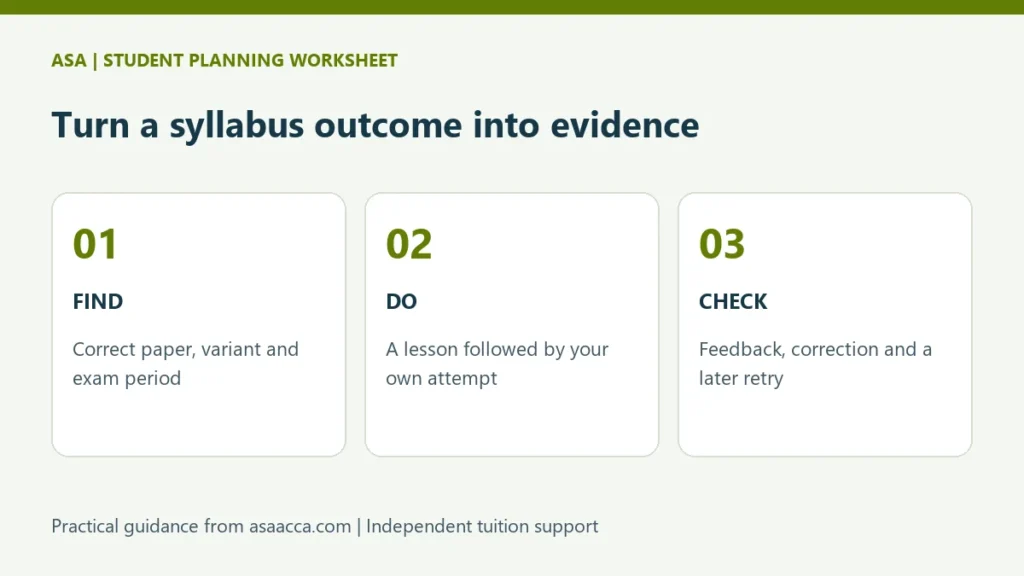
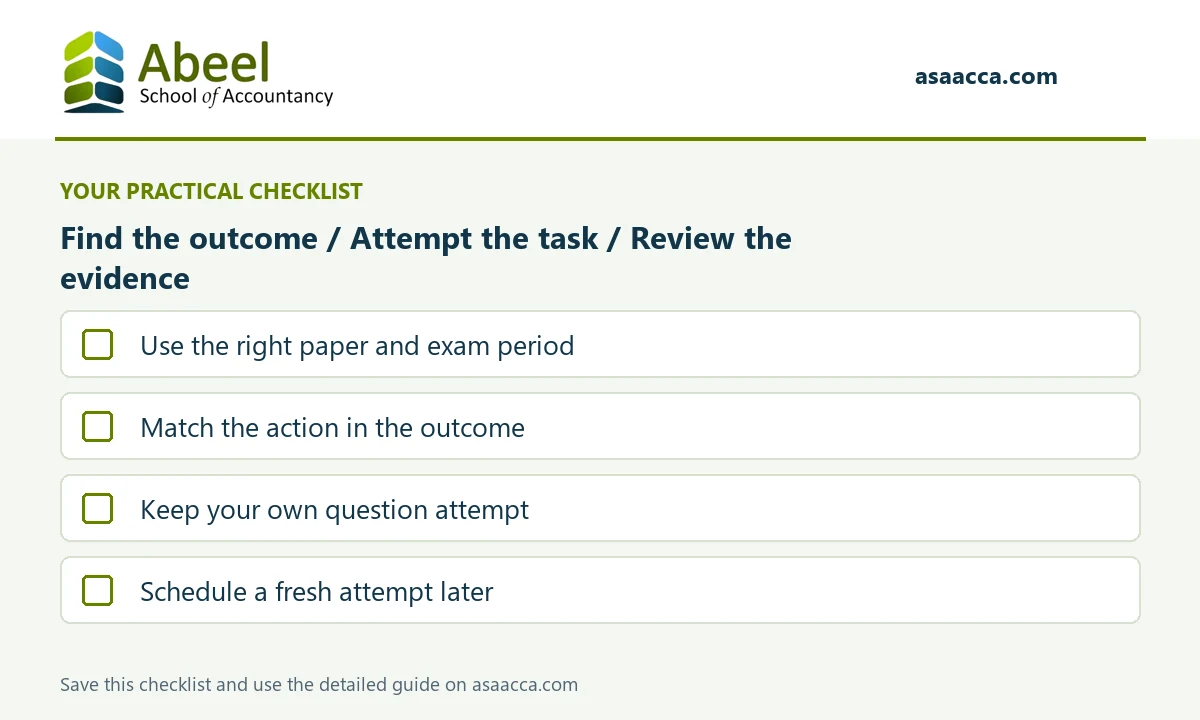
Use an ACCA syllabus and study guide to identify what you must be able to do, then connect each outcome to a lesson and an independent question attempt. A video playlist tells you what you watched; a syllabus-based record helps you see which skills you can demonstrate and which need more work.
Check the document before planning
Confirm the paper, variant where relevant, and examination period printed on the document. A search result or saved PDF may belong to a different year. This is particularly important when tax rules or qualification arrangements change. Use ACCA’s current study support resources to locate the appropriate paper information rather than treating an old download as permanent guidance.
Do not assume that a course called “ACCA” covers every paper or variant. Match the course description to the exact syllabus you intend to study. For a wider explanation of the qualification, start with What Is ACCA?; this article focuses on using a study guide in your weekly learning.
Read the action, not just the topic
Two outcomes can mention the same subject while asking you to do different things. Explaining an idea, calculating a figure and evaluating a decision require different evidence. Simply highlighting a heading does not show that you can perform the required task.
For example, after a lesson on a costing topic, you might explain the distinction between two cost categories, classify unfamiliar items and justify an ambiguous choice. This is an original illustration of study planning, not a reproduced ACCA question or a statement of a particular paper’s current examinable wording.
Build a five-column learning record
| Outcome reference | Learning task | Your evidence | Gap | Next review |
|---|---|---|---|---|
| Reference from your current guide | Read the relevant section and watch the lesson. | Explain the idea without copying notes. | Identify the step you cannot explain. | Set a date for a fresh attempt. |
| A related application outcome | Attempt an unfamiliar practice question. | Keep your workings and reasoning. | Distinguish knowledge errors from technique errors. | Retry after correcting the cause. |
Use your own references and tasks; the table is a template rather than an official assessment record. Avoid recording “complete” merely because a lesson has played to the end.
Review one small topic properly
- Identify the relevant outcome and read its scope.
- Study a focused lesson or chapter section.
- Close the solution and attempt a suitable question.
- Compare your reasoning with reliable feedback.
- Correct the error and schedule a later attempt without looking at the answer.
If you are following a tuition course, bring the specific gap to your tutor: the outcome reference, your attempt and the step you do not understand. This is more useful than asking for an entire chapter to be explained again.
Use the document to ask a better tuition question
When you cannot follow a topic, identify the outcome, show your attempt and point to the step where your reasoning breaks down. This gives a tutor something concrete to diagnose. Asking for help with “the whole paper” makes it harder to separate a small knowledge gap from a problem with question interpretation.
For example, you may understand a calculation in a worked lesson but choose the wrong figures in a fresh scenario. Your learning task is then to practise identifying relevant information, not simply to replay the arithmetic. Use the study record to name that distinction.
A weekly review that goes beyond completion ticks
At the end of the week, select one topic you labelled complete and attempt a fresh task without your notes. Compare the outcome with the evidence you recorded earlier. If your answer depends heavily on remembering a model solution, return the topic to active review rather than leaving it marked complete indefinitely.
Keep the record manageable. A short note explaining a recurring error is more useful than a large spreadsheet filled with unexplained colour codes. The purpose is to decide the next action, not to create an impressive-looking progress dashboard.
Handling changes in a course or syllabus
Check the exam period on your official document when choosing materials and when your intended sitting changes. If a tutor provides an updated coverage plan, compare it with the relevant current guide. Keep older notes clearly labelled so that you do not accidentally use an outdated resource as your primary reference.
For qualification-transition questions, use ACCA’s current guidance and your personal exam record. A learning worksheet is not an official exemption or transition decision. Resolve that administrative question separately, then use the correct study outcomes for the course you will take.
Questions about syllabus-based learning
Should I study topics in exactly the document’s order?
Not necessarily. A sensible course may group related concepts differently. The important check is whether the relevant scope and required skills are covered, with opportunities to practise and review them.
Can I use one good answer as proof of mastery?
One answer provides limited evidence. Try a fresh scenario later and check whether you can still explain the method without copying a solution.
Does this replace official exam guidance?
No. Use the official resources for your paper and exam period. This is a practical way to organise learning alongside them.
Keep technical study and exam practice connected
ACCA’s Study Hub guidance explains the role of its technical learning material and the importance of familiarity with the computer-based exam environment. Check the resources relevant to your paper. An ASA practice activity is independent tuition support and should not be mistaken for an official ACCA examination.
Browse ASA’s teaching, demo and course options to connect your chosen paper with tuition. If you are planning from Pakistan, the ACCA in Pakistan overview adds local route and planning context. For a full attempt review, continue with how to review an ACCA mock exam.