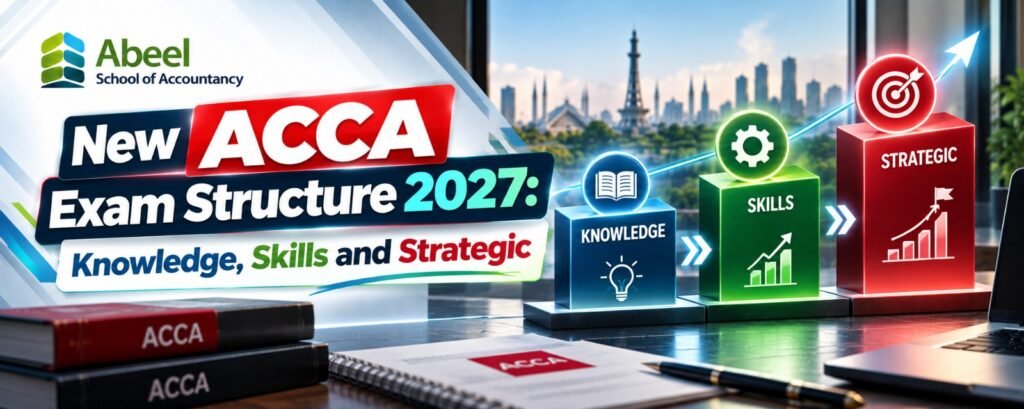
If you are planning an ACCA journey, you have probably heard that big changes are coming in 2027. Maybe you saw new exam codes like K1 or E5 and wondered whether your hard work so far still counts. Take a breath. The changes are significant, but they are very manageable when you understand them early.
At Abeel School of Accountancy, we have spent months studying ACCA’s “Accountancy Redefined” announcements so our students never feel lost during the transition. This guide breaks everything down in plain language: what is changing, what is staying, and how to prepare smartly.
Why Is ACCA Changing Its Qualification?
Accounting is no longer just about debits, credits and tax returns. Employers now expect finance professionals to work with data, understand sustainability reporting, think ethically and lead teams. ACCA has redesigned its qualification to match this reality, with more digital skills, more business judgement and a stronger focus on employability.
The old model of Applied Knowledge, Applied Skills and Strategic Professional is being replaced by a four-level structure. Think of it as the same mountain with a clearer, better-marked path.
The New Four-Level Structure at a Glance
Foundations: the entry point for students who do not yet meet direct entry requirements. It includes F1 Accounts Preparation, F2 Management Information and F3 Decision Making with Data.
Knowledge: this replaces Applied Knowledge. Instead of Business and Technology, Management Accounting and Financial Accounting, you will sit K1 Financial Accounting, K2 Management Accounting and K3 Business Law.
Expertise: this replaces Applied Skills with five exams: E1 Taxation, E2 Financial Reporting, E3 Audit, Risk and Control, E4 Finance and Investment, and E5 Performance with Data Analysis.
Strategic Professional: you sit two compulsory exams, S1 Business and Sustainability Reporting and S2 Strategic Business Leader, plus one options exam.
Notice the pattern. Data, sustainability and leadership now appear in the names of the exams themselves. That is ACCA telling the market what a modern accountant looks like.
What Has Actually Changed?
Here are the changes that matter most for your planning.
Business and Technology is no longer a standalone exam. The old BT paper disappears, and its content is absorbed across the new structure.
Business Law moves down a level. Corporate and Business Law, which many students sat in the middle of their journey, now becomes K3 at Knowledge level. You will meet it much earlier.
Performance Management gets a data upgrade. It becomes E5 Performance with Data Analysis, so expect more questions around interpreting and using data.
Sustainability takes centre stage. Strategic Business Reporting becomes S1 Business and Sustainability Reporting, reflecting the growing importance of ESG disclosures.
Fewer options, more choice. At the top level you choose one options exam instead of two, from a wider list of five: Audit and Assurance, Corporate Finance, Data Science, Performance and Insights, and Taxation Advisory. The Data Science option is brand new.
Essential Employability Modules arrive. These non-exam, online assessed modules cover areas such as Responsible Business Management, Digital Tech and Innovation, and Ethical, Sustainable Leadership. They replace the single Ethics and Professional Skills Module we know today.
Exams go on demand at lower levels. Foundations and Knowledge exams will be computer-based and available on demand, which gives students far more flexibility than fixed exam windows.
Key Dates to Remember
According to ACCA’s official future qualification timeline, the rollout works like this:
- June 2027: the final session for current Applied Skills and Strategic Professional exams
- July 2027: first Foundations and Knowledge exams under the new structure, available on demand
- September 2027: first sitting of the Expertise and Strategic Professional exams
Always confirm exam entry windows and fees directly with ACCA, as details can be updated. You can also view ACCA’s qualification levels infographic for the complete picture in one page.
What Happens If You Are Already Studying ACCA?
This is the question we hear most. The good news is that you do not start from zero. ACCA has confirmed that exams you pass under the current structure map across to the new one, and ACCA provides a transition tool so you can see exactly where you stand.
Your best move depends on where you are right now:
- Just starting: you can begin under the current structure and finish under the new one, or start fresh with the new exams when they launch.
- Midway through Applied Skills: try to clear as many current papers as possible before the June 2027 cut-off, then let the mapping carry your progress forward.
- Already at Strategic Professional: focus on finishing your remaining papers within the current syllabus if you can.
Not sure which group you fall into? Our ACCA course counselling page is a good place to start, and our team will happily map your progress for free.
How to Prepare for the New Structure
Changes like these reward students who prepare early and consistently. Here is the approach we recommend.
1. Learn the new exam codes and content. Download ACCA’s guidance packs and specimen exams as they are released. Familiarity removes fear.
2. Build your data comfort now. E5, F3 and the Data Science option all expect you to work with data. Even basic spreadsheet confidence will help you stand out.
3. Take sustainability seriously. It is no longer a side topic. It is examinable, and employers genuinely care about it.
4. Practise computer-based exams. On-demand CBEs feel different from paper exams. Timed practice on screen is essential.
5. Revise on a rhythm, not in a panic. This is where most students struggle, and where the right institute makes the difference.
Why Students Choose Abeel School of Accountancy
Studying alone through a transition is stressful. Studying with a team that tracks every ACCA update is a different experience entirely.
Abeel School of Accountancy is the only institute that conducts weekly live revision sessions along with smart course completion, something no other institute offers. Instead of waiting until the last month to revise, our students revisit what they learn every single week, with a teacher live in the room, ready to clear doubts on the spot. Smart course completion then ensures the syllabus is finished with enough time left for proper practice, so you walk into your exam calm rather than rushed.
When the exam structure changes, this weekly rhythm becomes even more valuable. New topics like data analysis and sustainability reporting stick far better when revised often, not crammed late. Learn more about our approach on our ACCA programme page or see how past students progressed in our student success stories.
Frequently Asked Questions
Q1. When does the new ACCA exam structure start?
The first Foundations and Knowledge exams begin in July 2027, and the first Expertise and Strategic Professional exams follow in September 2027. The final session under the current structure for Applied Skills and Strategic Professional is June 2027.
Q2. Will my current ACCA exam passes still count?
Yes. ACCA has confirmed that passes under the current structure carry across to the new one through a mapping process. You can check your own position using ACCA’s transition resources, and the team at Abeel School of Accountancy can walk you through it step by step.
Q3. Is Business and Technology (BT) completely removed?
BT will no longer exist as a standalone exam. Its ideas are spread across the new Knowledge level papers, and Business Law now sits at Knowledge level as K3.
Q4. How many options exams will I take at Strategic Professional?
Just one. You will choose one from five: Audit and Assurance, Corporate Finance, Data Science, Performance and Insights, or Taxation Advisory. You also sit the two compulsory papers, S1 and S2.
Q5. What are Essential Employability Modules?
They are non-exam, online assessed modules that build workplace skills such as responsible business practice, digital technology and ethical leadership. You need to complete them as part of your qualification, but they are not sat as timed exams.
Q6. Should I start ACCA now or wait for 2027?
Waiting rarely helps. Since passes carry forward, starting now builds momentum and confidence. Many students begin under the current structure and complete their journey under the new one.
Q7. What makes Abeel School of Accountancy different from other ACCA institutes?
We are the only institute offering weekly live revision sessions combined with smart course completion. That means steady revision all year and a syllabus finished early, so exam preparation never turns into a last minute rush.
Final Thoughts
The new ACCA structure is not something to fear. It is a smarter, more modern qualification that rewards students who understand data, sustainability and strategy. The students who thrive will be those who prepare early, revise regularly and learn from people who follow every update closely.
If you want a clear plan and a team beside you from your first exam to your last, Abeel School of Accountancy is ready to help. Reach out today through our contact page and take the first confident step toward your ACCA future.
Plan your next step
Use these related guides to connect the changes with your own exam record and revision plan.