

This guide to ACCA syllabus and papers separates the current qualification route from the 2027 transition. Reviewed: 14 October 2026. Check current requirements again before registration, payment or exam entry.
How the current ACCA syllabus is organised
The current ACCA Qualification is organised into Applied Knowledge, Applied Skills and Strategic Professional. Students without exemptions complete 13 examinations. The structure gradually moves from introductory accounting and business knowledge to interpretation, judgement and advanced professional application.
Use the structure as a learning map. Early papers introduce tools; later papers expect you to use those tools in unfamiliar business situations. Studying only definitions becomes less effective as the qualification progresses because marks depend increasingly on applying knowledge to the scenario.
If you have not yet confirmed your route, read ACCA entry requirements in Pakistan first. If you already hold a relevant qualification, review exemptions before counting papers. Your personal syllabus plan begins with the examinations remaining on your own account, not a generic list printed in a prospectus.
Applied Knowledge: BT, MA and FA
Business and Technology introduces the organisation, its environment, governance and the role of the accountant. Management Accounting develops information for planning, control and decisions. Financial Accounting builds the recording and preparation of financial information.
For BT, practise recognising how an idea applies to a situation rather than remembering a label alone. For MA, identify the calculation required, show the workings and explain what the result means. For FA, connect the transaction to the accounting entry and the effect on the financial statements.
The papers support different capabilities, so preparation should reflect the difficulty you actually encounter. A learner comfortable with numbers may still misread a business scenario; someone good at descriptive answers may need more calculation practice. Use short diagnostic questions to decide where to spend additional time.
Applied Skills: the six core papers
Corporate and Business Law develops legal understanding relevant to business. Performance Management develops planning, performance assessment and decision information. Taxation addresses the relevant tax syllabus and variant. Financial Reporting develops accounting and interpretation. Audit and Assurance addresses assurance work and evidence. Financial Management covers financing, investment and financial decisions.
Paper names alone are not enough to select materials. Tax and law variants can differ, and syllabus years matter. Confirm the correct version before buying a course or revision kit. A question bank that fits another jurisdiction may be useful for limited principles but cannot replace materials for your required variant.
Consider how topics connect. Reporting knowledge helps when interpreting audit scenarios. Management accounting concepts support performance analysis. Finance decisions often require both calculations and discussion. A paper plan that recognises these connections can include timely refreshers instead of treating every course as an isolated subject.
Strategic Professional: compulsory and optional papers
The current compulsory papers are Strategic Business Leader and Strategic Business Reporting. Students also select two options from Advanced Financial Management, Advanced Performance Management, Advanced Taxation and Advanced Audit and Assurance. Four option papers exist, but an individual does not normally complete all four for the current qualification.
Choose options using evidence: your performance in related papers, the work you want to pursue, the relevant variant and the time available for preparation. A friend’s preference or the reputation of a paper as easy is not a reliable selection method.
Advanced work requires a clear answer to the particular task. A technically correct paragraph can still be unhelpful if it does not address the requirement. Practise explaining a recommendation, supporting it with the facts given and identifying consequences. Our SBL recommendations guide gives a practical example.
Foundation Diploma is a separate starting route
Students entering through Pakistan’s current Foundation Diploma study seven foundation examinations and Foundations in Professionalism before the relevant progression. The preparatory paper list should not be inserted into the main 13-paper count without explaining which stage of the route it represents.
The foundation papers are FA1, MA1, FA2, MA2, FBT, FMA and FFA. They help establish recording, management information, accounting and business capability. The sequence should reflect both applicable progression rules and your readiness.
Keep a record of awards and module completion rather than focusing only on examination passes. A student who has passed several papers but not completed the required professionalism component may not yet have completed the intended award. Check the transfer process before arranging the first Applied Skills course.
On-demand examinations and session examinations
Computer-based describes the examination format; it does not mean every paper can be booked at any time. Some earlier examinations are available on demand, while later examinations use scheduled sessions. Law availability depends on variant, so avoid assuming one arrangement applies to every version.
Session sittings take place in March, June, September and December. Check current booking information for your location and paper. Online tuition, a home internet connection and a laptop do not establish permission to sit an exam remotely.
Use the Pakistan exam booking checklist to confirm the paper code, variant, session, entry deadline and venue instructions. Preserve your booking confirmation and examine the official instructions again near the examination rather than relying on an old timetable screenshot.
Progression rules and sensible paper loads
ACCA’s current progression guidance sets limits on examinations across exam cycles and the calendar year. It currently permits a maximum of four exams in an exam cycle and eight distinct exams in a calendar year. These limits are rules, not a recommended workload for every student.
Progression between levels also matters. Confirm the current rules and the options available in your own booking account before combining examinations. Do not interpret flexible study as permission to bypass an earlier level that has not been completed or appropriately entered.
A realistic plan may sit well below the maximum. Estimate the work needed for learning, questions and revision, and compare it with your available weeks. If you work full time, have family duties or need to rebuild prerequisites, a smaller load can allow better preparation and feedback.
Turn a syllabus document into a study plan
Download the current syllabus and study guide for the paper and examination period. Identify the assessable areas, learning outcomes and any stated examination approach. Use them as a checklist against the course content rather than assuming the textbook chapter list is sufficient.
For each area, record whether you have understood the concept, completed basic questions, attempted a mixed question and reviewed errors. These are separate milestones. Marking an area complete after watching its lecture can disguise a gap in application.
Review the checklist weekly. If a topic repeatedly produces mistakes, identify their cause. Is the rule unclear, the calculation unreliable, the requirement misread or the explanation too general? Each cause needs a different action. More passive reading is not automatically the best response.
Build calculations and written explanations together
Financial papers require more than obtaining a number. Write the method clearly, check units and explain the business meaning when required. A variance, ratio or investment result becomes useful when connected to the organisation’s circumstances.
For discursive questions, begin with the requirement verb and the marks available. Address the specific scenario rather than copying a memorised paragraph. Explain why your point follows from the evidence given, and avoid listing unsupported recommendations.
Use ASA’s ratio interpretation guide, working capital example and audit evidence examples for focused practice. These are learning aids; the official syllabus still defines the required coverage.
Use mocks to diagnose performance
A timed mock tests knowledge, interpretation, time allocation and familiarity with the examination environment. Treat the result as information about preparation. A low mark does not identify the cause until you review what happened in the individual questions.
Separate marks lost through missing knowledge from marks lost through poor application or time management. Rewrite an answer after studying the feedback, then attempt a fresh question on the same skill. Re-reading the model answer without another attempt may leave the problem unresolved.
Our mock exam review article provides an error-log method. Check a mock’s paper, variant, syllabus date and intended use before attempting it. Practice materials should not be presented as an official ACCA examination or as a prediction of the questions that will appear.
Ethics, experience and membership sit alongside exams
The examination syllabus is only part of the membership route. Keep ethics and practical experience in the plan from the outset. A student can pass the required papers while still needing other elements before becoming an ACCA member.
The current practical experience requirement includes relevant time, performance objectives and supervision. Discuss the work you can record with a suitable supervisor rather than assuming any employment counts in full. Your own contribution is what makes experience evidence useful.
Read practical experience planning in Pakistan and the fee guide to recognise the time and payment implications outside exam tuition. A paper timetable is strongest when it fits the wider professional route.
How to handle the redesigned qualification from 2027
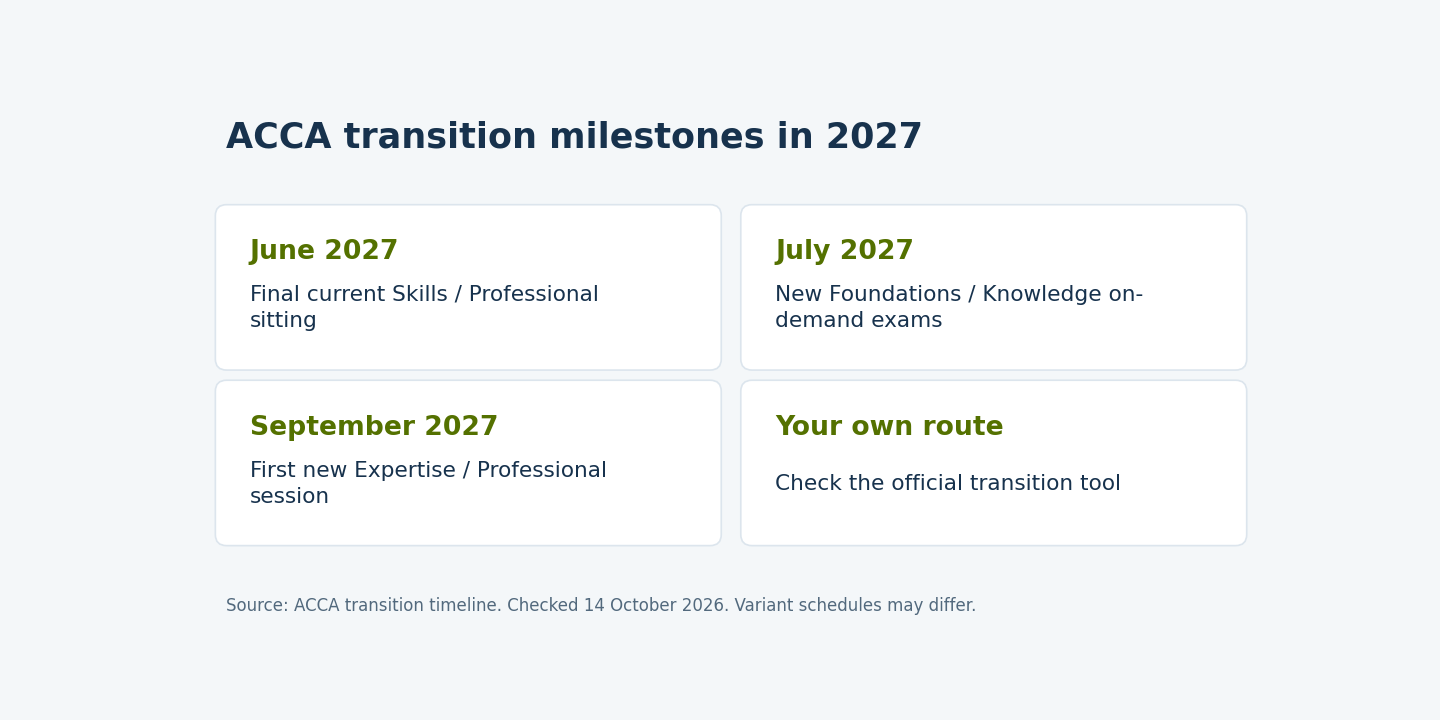
The redesigned route introduces changes from 2027, including employability modules and revised structure. A current-paper guide should not mix future paper names into the present examination plan without distinguishing the transition date.
Use the official transition tool with your completed examinations and expected next sitting. Confirm the syllabus used for any course you buy. Ask whether its tuition supports the examination before transition or a future equivalent, and request a clear explanation if the course spans both.
See ASA’s 2027 changes guide for orientation, then verify your own route through ACCA. Transition planning should be based on your record and the official schedule. Avoid stopping useful study merely because an undated post says the qualification is changing.
Frequently asked syllabus questions
Must I complete all four Strategic Professional options? Under the current route, you select two in addition to the two compulsory papers. Does every graduate have 13 papers remaining? No: an assessed exemption award can change the remaining examinations.
Does a foundation learner start directly with Applied Skills? Only after the relevant foundation completion and progression conditions are satisfied. Is the examination format identical across all papers? No: review the relevant current examination guidance and practise in the appropriate environment.
What should I choose first? Establish your route, identify the papers remaining and diagnose prerequisite knowledge. Then select a manageable load. The paper selection worksheet helps organise the decision alongside the qualification overview. A good syllabus plan ends in specific weekly tasks, not only a list of paper codes.
Discuss your study plan with ASA
Explore the ACCA in Pakistan guide and visit Abeel School of Accountancy for the broader study context. Use the contact page with your city, exact qualification, results, previous ACCA passes and available weekly hours. Request current written information about tuition, course access and support before committing to a paper.
Continue with What is ACCA?; entry requirements; fees and budgeting; exemptions; degree options. Each linked guide addresses a separate part of the decision.