
ACCA fees in Pakistan include separate professional-body charges and provider tuition costs. This guide helps you organise those amounts into a budget. Reviewed: 14 October 2026. Check current official charges and conditions before making a payment or accepting an exemption.
Why ACCA has no single permanent total cost
ACCA fees in Pakistan are best understood as a collection of payments across your study route. The total depends on your entry point, exemptions, papers attempted, time spent registered, tuition choices and examination outcomes. A fee quoted for one class cannot reliably stand for the cost of reaching membership.
Start with the route confirmed on your own records. A foundation learner, a direct-entry school leaver and a graduate with assessed exemptions may pay for different learning and examination stages. If you compare a tuition package before confirming the route, the apparent saving may relate to papers you do not need.
This guide explains how to build an adjustable budget rather than advertise a fixed lifetime figure. Use the official Pakistan fee page for current professional-body charges and obtain a separate dated tuition quotation. The ACCA introduction explains the overall route; the entry requirements guide helps establish your starting point.
Official fee snapshot for Pakistan: October 2026
The following GBP amounts were checked on ACCA’s Pakistan fee page. Reduced offers depend on eligibility; confirm the amount in your account. Tuition and payment-provider charges are separate.
| Item | GBP amount |
|---|---|
| Initial registration: displayed standard / reduced offer | 89 / 45 |
| Standard annual student subscription 2026 | 140 |
| Reduced first-year student subscription 2026 | 58 |
| Applied Knowledge exemption, per paper | 84 |
| Applied Skills exemption, per paper | 111 |
| Applied Skills: December 2026 standard / late entry | 143 / 366 |
| Ethics and Professional Skills Module | 83 |
| SBL: December 2026 standard / late entry | 252 / 406 |
| SBR or each option: December 2026 standard / late entry | 180 / 406 |
The listed December standard deadline is 2 November 2026 at 23:59 GMT; the late deadline is 9 November 2026 at 23:59 GMT. On-demand CBE centre prices are set by the centres. Check current availability, fees and eligibility before payment.
Separate the payment recipients
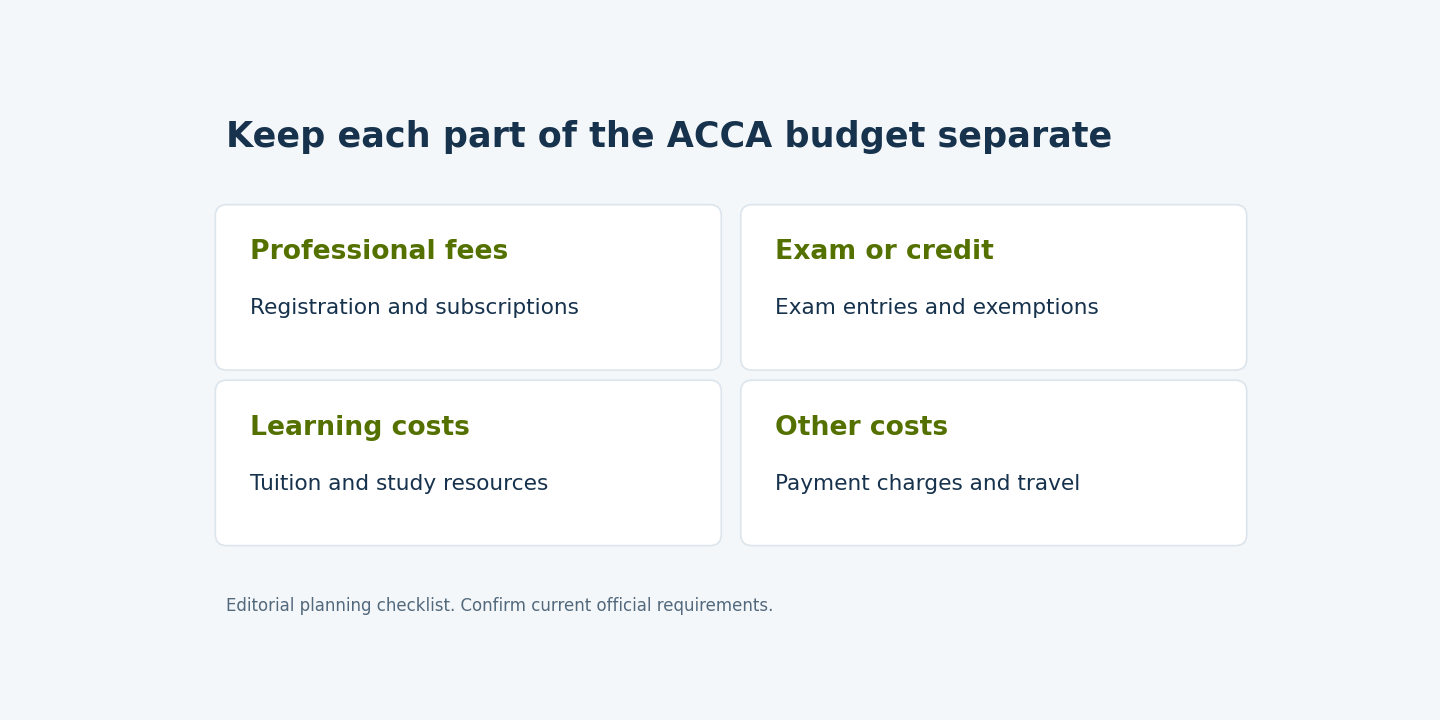
Create separate budget categories for payments to ACCA, a licensed examination centre where relevant, your tuition provider and other suppliers. This distinction makes it easier to understand what a package includes and who can answer a payment question.
Registration, subscription, exemption charges and certain examination or module fees belong to the professional-body side of the plan. Tuition covers the teaching arrangement agreed with the provider. Materials, internet, devices and travel may be separate. Some offers combine selected items, but the scope needs to be explicit.
Ask for an itemised quote that identifies each recipient, currency, deadline and inclusion. If a provider collects a payment on your behalf, request clear confirmation of what will be remitted and evidence of completion. A tuition receipt should not be interpreted as an official exam booking confirmation.
Registration and annual subscription
Initial registration is distinct from the annual student subscription. The subscription supports maintaining active student status, and a study break does not automatically remove all account obligations. Check your account and current official guidance before assuming that no examination entry means no payment is due.
ACCA’s Pakistan fee page may display standard amounts alongside reduced offers for eligible new students. Record the amount actually available to your account and the conditions attached to it. Do not assume the first-year reduction applies again in later years.
A longer timeline can increase the number of subscription years. This does not mean rushing examinations is always cheaper overall; an unrealistic load may create resit and additional tuition costs. Compare a workable schedule with its actual payment dates rather than choosing the shortest advertised duration.
Exam fees: match the exact paper and session
Examination charges depend on the paper and applicable arrangements. Some on-demand computer-based examinations are priced through the relevant centre. Session examinations can have different entry rates according to the deadline and level.
Check the code, variant, session and entry deadline before paying. Two papers at different stages may have different charges, and late entry can materially change the budget. Confirm the payment shown in your account rather than relying on an old social media price list.
Keep exam booking separate from tuition enrolment in your checklist. The exam booking guide covers these checks. If you intend to change an entry or cannot attend, consult the current official terms; do not assume the fee can automatically be refunded or transferred.
Exemption fees and their effect on the budget
An exemption can reduce the examinations remaining while still creating a charge. Therefore, calculate both the cost of claiming the assessed exemption and the cost of any refresher learning needed for later papers.
A graduate should confirm the actual award before budgeting as though all expected exemptions are available. The official calculator and account decision matter more than a generic statement that a degree receives a fixed number of credits.
See our exemptions guide for the decision. If your prior knowledge is strong, an exemption may save study and exam preparation time. If essential concepts have faded, targeted revision may be sensible. The economic comparison depends on your situation, not only the headline number of papers skipped.
Ethics, experience and later-stage charges
Include the applicable ethics module charge in your current-route budget. It is a separate professional requirement and should not disappear from the plan merely because your attention is on exam tuition.
Practical experience can introduce indirect costs such as commuting or additional training, even when the experience itself is part of paid employment. Those costs depend on the role and should not be represented as a universal ACCA fee.
Membership-related payments and any optional academic programme also require separate checks when the time comes. A budget for the first examination sitting is not a membership budget. Read practical experience planning and degree options if these decisions affect your longer-term goals.
How to compare tuition quotations
Compare equivalent course scope. Identify the paper, variant, syllabus year, start date and examination target. Then ask whether the quote includes live teaching, recordings, practice questions, marking feedback and revision.
Record the access period and what happens if you postpone the exam. A lower initial price with a short access period may become more expensive if you need to repurchase materials. Conversely, an extensive package may include support you cannot use within your schedule.
Ask how tutor feedback works in practice. Is it individual marking, a group discussion or a model answer? How many marked tasks are included, and when will feedback arrive? These details affect learning value. They should be checked alongside price rather than left until after payment.
Discounts, scholarships and instalments
Treat a discount as a specific offer with written conditions. Confirm the eligible paper or intake, original price, reduced amount and payment deadline. An offer for tuition should not be described as reducing ACCA’s own fees unless that is explicitly established.
If scholarship or financial support is advertised, ask about eligibility, evidence, selection and continuing conditions. Do not plan on receiving it before it has been awarded. Keep your budget workable under the confirmed payment arrangement.
For instalments, record the total amount and dates rather than only the first payment. Ask whether missed payments affect access and whether any additional charge applies. ASA’s current offers must be confirmed directly; this article does not invent a scholarship policy or imply that a particular discount is available.
Convert foreign-currency costs carefully
Keep pound-denominated charges in pounds in the original budget. Add a separate expected rupee conversion using a dated rate, then allow for the payment provider’s actual conversion and charges.
An illustrative calculation can explain the method without claiming a current rate. If a hypothetical charge is GBP 100 and an assumed rate is PKR 350 per pound, the base estimate is PKR 35,000 before any payment charges. These are teaching assumptions, not current ACCA fees or an exchange-rate quotation.
Update the conversion close to payment and compare it with the final checkout amount. A family funding several examinations should understand that the rupee estimate can change even if the pound amount remains the same. Avoid promising a fixed future rupee total when the underlying payments are in another currency.
Build a first-year budget worksheet
For each cost, record the description, recipient, currency, quoted amount, date checked, due date and inclusion in any package. Mark unknown figures as unconfirmed rather than filling them with guesses.
Separate one-time costs from recurring costs and examination-specific costs. This helps distinguish registration from subscriptions and tuition from entry charges. Add learning materials, data, device access and travel where those apply to your actual study arrangement.
Then put the due dates on a monthly calendar. The total may look affordable while several payments fall in the same month. A cash-flow plan shows when money needs to be available. If the timing is difficult, reconsider the paper load or ask about confirmed tuition payment options before committing.
Allow for resits without treating failure as inevitable
A contingency reserve protects the plan from uncertainty. It may cover a resit, extra revision, travel changes or an unexpected subscription year. Its size should reflect the costs and risks you actually face.
Do not budget repeated tuition automatically after a failed paper. Review the result and ask what support is needed. A focused question-practice or feedback intervention may be more useful than repeating every lesson.
The mock review guide helps diagnose problems before the examination. Use mock performance, available weeks and knowledge gaps to decide whether the planned sitting remains sensible. Paying before readiness is established can create a larger cost than extending preparation deliberately.
Compare online and classroom costs
Online tuition may reduce commuting but can increase your need for reliable connectivity, a suitable device and a quiet study space. Classroom study may involve travel, meals and time away from work. Neither format has a universal cost advantage.
Test the platform and understand recording access before enrolling online. If a phone is your main device, check whether learning activities and practice materials are workable on it. Examination preparation may still require computer-based practice.
Compare the full study arrangement, including time. A cheap course that regularly conflicts with your job may not produce the learning you need. Read the online classes guide and choose a format that supports consistent question attempts and feedback.
The 2027 transition and your budget
The redesigned qualification changes the route from 2027. Do not assume a current quotation automatically covers future modules or examinations with different arrangements. Ask how the quoted tuition relates to your intended sitting and transition position.
Use the official transition tool to understand your completed work and remaining requirements. Any amounts that have not been confirmed for your route should stay provisional in the budget.
Visit the 2027 changes guide for context, then review the current ACCA guidance and charges. Budgeting is an ongoing process: update the plan after results, a new exemption award, an employment change or a revised study timetable.
Frequently asked fee questions
Does tuition include registration and exam fees? Only if the written package explicitly says so. Is the cheapest course necessarily the best value? No: scope, access and feedback need to be compared. Are all exemption charges the same? Check the current charge for the relevant paper level.
Can I use last year’s rupee total? It is a historical comparison, not a current quotation. Will a scholarship cover everything? Only its confirmed award conditions establish coverage. Can I ignore subscription during a study break? Check official account obligations before making that assumption.
A sound budget ends with confirmed recipients, amounts and dates, plus clearly labelled estimates. It should be understandable to both the student and whoever is helping fund the study. Keep supporting quotes and confirmations so the plan can be revised without starting from memory.
Discuss your plan with ASA
Read our ACCA in Pakistan guide and visit Abeel School of Accountancy for the broader study context. Ask through the contact page for an itemised tuition quote and paper advice based on your confirmed route. Include your city, qualification, examination record and available study time. Keep a written record of the information used in your decision.
Related guides: What is ACCA?; entry requirements; syllabus and papers; exemptions; degree options.