ACCA is Changing From September 2027 Here is Exactly What You Need to Know
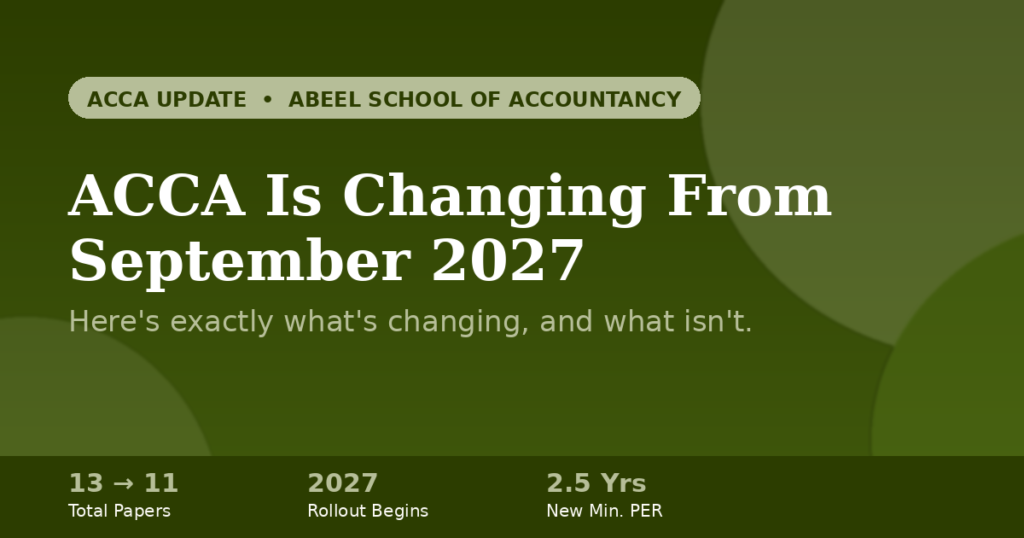
ACCA Changes From 2027, ACCA is cutting its exams from 13 papers to 11, renaming its three levels, adding new Essential Employability Modules, and building AI, data analytics, and sustainability into the core syllabus. If you’ve already passed exams, nothing is lost every pass carries forward automatically, and there’s no advantage to rushing before the change happens.
If you’re an ACCA student right now or even just thinking about starting chances are someone in your class WhatsApp group has already sent a panicked voice note about “the ACCA Changes 2027.” Seniors are giving mixed advice, half the group chat is guessing, and somehow every version of the story sounds a little scarier than the last.
So let’s actually sit down and go through it properly. No jargon, no scare tactics just what’s happening, why it’s happening, and what it means for you specifically.
At Abeel School of Accountancy, this has become the most-asked question in our office over the past few weeks: “Sir, should I rush and finish before 2027, or is it fine to continue normally?” It’s a fair question, and honestly, a smart one to ask before you make any decisions about your study plan. So let’s answer it properly.
What is ACCA Changes 2027 Actually?
ACCA is calling this its biggest overhaul in years, and they’ve branded it “Accountancy Redefined.” But don’t let the big name intimidate you the rollout itself is slow and deliberate, not a sudden switch.
Here’s the timeline as it currently stands:
| Phase | What Happens |
|---|---|
| Early 2027 | Essential Employability Modules become available |
| July 2027 | First exams under the new Foundations and Knowledge levels |
| September 2027 | First exams under the new Expertise and Strategic Professional levels |
Notice the pattern here: this is a phased rollout, not an overnight switch. If you’re sitting exams today, you won’t wake up one morning to a completely different qualification. You’ll transition gradually, and ACCA has built specific tools to make sure nothing about your progress gets lost in the process.
Fewer Papers But Don’t Mistake That for “Easier”
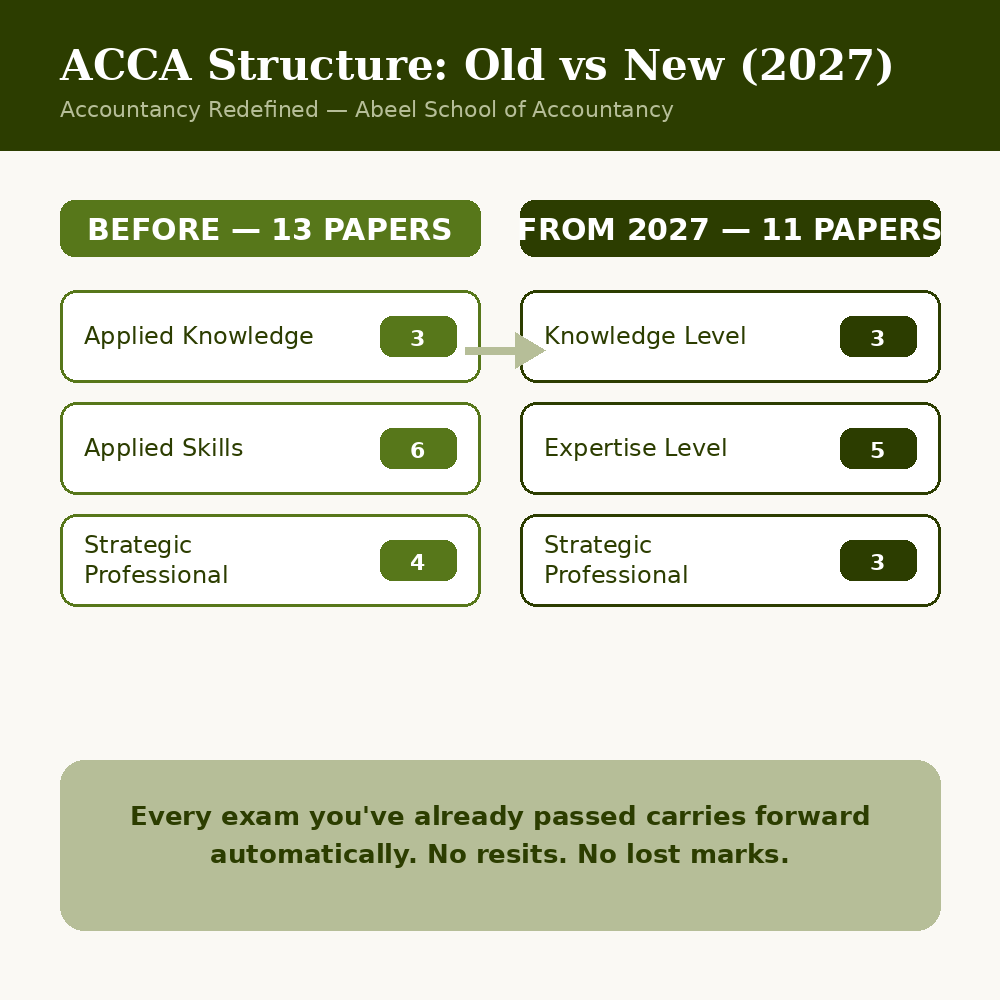
Here’s the headline change everyone’s talking about: the total paper count is dropping from 13 to 11. The three levels are also getting renamed:
- Knowledge Level (replacing Applied Knowledge) 3 papers
- Expertise Level (replacing Applied Skills) 5 papers
- Strategic Professional Level (name unchanged) 2 mandatory + 1 optional paper
Now, before anyone gets excited and assumes “fewer papers = easier qualification” that’s not really the story here. ACCA has been clear that this isn’t about lowering the bar. It’s about cutting out the repetition. If you’ve ever sat two papers back to back and felt like you were re-learning the same concept under a different paper code, you already know the problem this is solving. The new structure consolidates that overlap so you go deeper into fewer papers, instead of spreading the same knowledge thin across more of them.
New Focus: AI, Data Analytics, and Sustainability
This is genuinely the part worth paying attention to, because it reflects where the profession is actually heading not where it was five years ago.
The redesigned syllabus is building in real coverage of:
- AI literacy and how automation is reshaping finance workflows
- Data analytics as a core accounting skill, not an add-on
- Digital finance tools used in modern practice
- Sustainability and ESG reporting, which is quickly becoming non-negotiable for finance professionals
If you’ve spent any time inside an accounting firm recently, none of this will surprise you. ESG disclosures and automated reporting tools aren’t “future trends” anymore they’re just part of the job description in 2026. At Abeel School of Accountancy, we’ve already started weaving these themes into how we teach, because waiting until 2027 to start the conversation would honestly be doing our students a disservice.
What Are the Essential Employability Modules?
This is the genuinely new piece. ACCA is introducing Essential Employability Modules interactive, assessed modules focused on real world career readiness rather than pure technical knowledge. Think communication skills, professional judgement, and workplace readiness: the kind of thing that traditionally got learned the hard way, on the job.
There’s also a practical upside tied to this. Normally, the Practical Experience Requirement (PER) takes three years to complete. Once you finish the Employability Modules, that requirement can shrink to 2.5 years. So in a strange twist, doing this “extra” work can actually get you to membership faster, not slower.
Will You Lose Any Progress You’ve Already Made?
This is, by far, the biggest fear we hear at Abeel School of Accountancy and the honest answer is no.
Every exam you’ve already passed carries forward automatically into the new structure. No resits. No reapplications. No losing marks because the system changed underneath you. ACCA has published an official Transition Tool specifically so students can check exactly how their existing passes map onto the new papers. If you’ve already cleared FA, MA, or any other paper, that pass is safe full stop.
Does It Matter Which Syllabus You Qualify Under?
Not to employers, no. Whether you finish under the current syllabus or the new one, you end up with the exact same three letters after your name: ACCA. Employers hire for the qualification, not the version number behind it. So if you’re already partway through your journey, there’s genuinely no disadvantage to continuing at your normal pace.
Should You Rush to Finish Before 2027?
Honestly no, and ACCA has said as much themselves. There’s no penalty for continuing on your normal timeline, and trying to cram everything in purely out of fear of the deadline usually backfires. You end up under-preparing just to “beat” a change that was never actually a threat to you in the first place.
If you started in 2026, you’ll most likely follow a hybrid path a mix of old and new papers depending on your timing without repeating content unnecessarily. And if you’re starting completely fresh in 2027, you’ll simply begin under the new structure from day one, with no hybrid mapping to worry about at all.
Our Take
Change like this can feel overwhelming when you’re already juggling exams, a job, and everything else life throws at you. But this particular one is designed to work for students, not against them. Fewer papers, sharper real world focus, and zero risk to what you’ve already achieved that’s a genuinely fair trade.
If you’re studying with us, or considering starting your ACCA journey, our advice is simple: keep going at your own pace, trust the transition process, and let us help you map out exactly what your path looks like. That’s exactly the kind of guidance we specialize in at Abeel School of Accountancy helping students cut through the noise and focus only on what actually affects them.
The accounting profession is evolving, and it’s evolving in a genuinely good direction. Better to walk into it prepared than to stay anxious about it.
Frequently Asked Questions
When does the new ACCA syllabus start? The rollout begins in early 2027 with the Essential Employability Modules, followed by the first Foundations and Knowledge level exams in July 2027, and the first Expertise and Strategic Professional level exams in September 2027.
How many ACCA papers will there be after 2027? The total number of papers is reducing from 13 to 11, spread across the Knowledge Level (3 papers), Expertise Level (5 papers), and Strategic Professional Level (2 mandatory plus 1 optional paper).
Will I lose the ACCA papers I’ve already passed? No. Every exam you’ve already passed carries forward automatically under the new structure. ACCA’s official Transition Tool lets you check exactly how your existing passes map onto the new papers.
Should I rush to finish my ACCA before September 2027? No. ACCA has confirmed there’s no penalty for continuing on your normal timeline. Students who started in 2026 will typically follow a hybrid path, combining old and new papers without repeating content.
Does it matter to employers if I qualify under the old or new ACCA syllabus? No. Regardless of which syllabus you complete, you receive the same ACCA qualification. Employers recognize the credential itself, not the syllabus version behind it.
What are the ACCA Essential Employability Modules? They’re new interactive, assessed modules focused on real-world career skills like communication and professional judgement. Completing them can also reduce the Practical Experience Requirement (PER) from 3 years to 2.5 years.
What new topics are being added to the ACCA syllabus? The updated syllabus places stronger emphasis on AI literacy, data analytics, digital finance tools, and sustainability/ESG reporting skills increasingly required in real accounting practice.