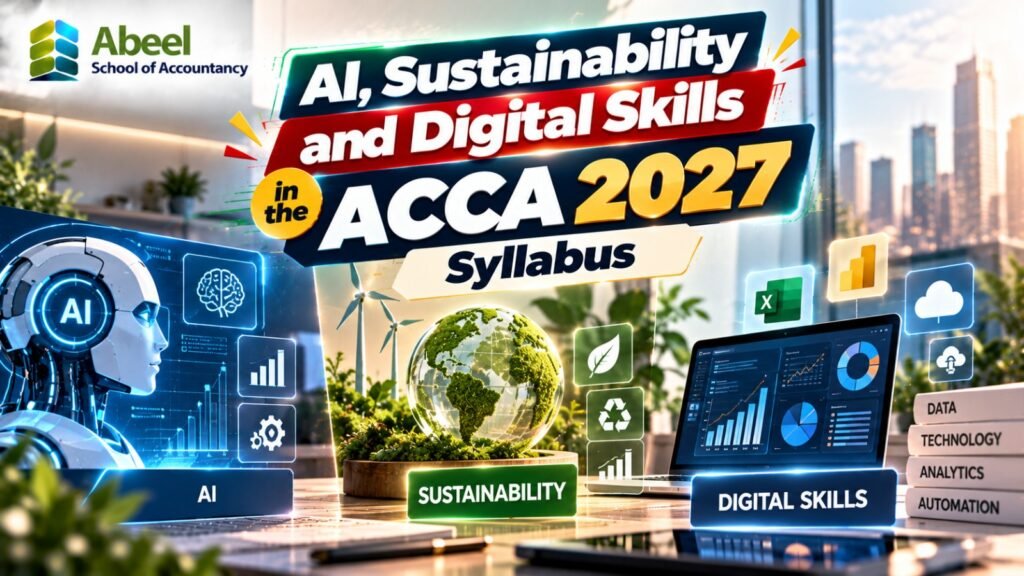
For years, an accountant’s reputation rested on technical accuracy: balancing the books, applying standards, getting the tax right. Those skills still matter. But walk into almost any finance department today and you will hear a different set of words: dashboards, automation, ESG reporting, data models, AI tools. The profession has quietly changed, and ACCA’s 2027 redesign is built to match it.
If you are a current or future ACCA student in Pakistan, this is the part of the new syllabus most worth understanding. It is also the part most likely to make you feel nervous, especially if you have never touched a data tool or written a sustainability report. This guide breaks down exactly where AI, sustainability and digital skills appear in the 2027 qualification, what they mean for your studies, and how to prepare without panic. We will also show how Abeel School of Accountancy helps students build these skills alongside their exam technique.
Why ACCA Is Putting Technology and Sustainability at the Centre
ACCA has said the redesigned qualification brings more focus on sustainability, social impact, AI and technology, woven into the qualification rather than added as an afterthought. It has also been clear that rigor is not being reduced. In other words, these topics are not decorative. They are part of how you will be examined and how you will be assessed as a future professional.
The reasoning is simple. Employers want accountants who understand the numbers and also know how to use data, question automated outputs, report on environmental and social performance, and advise management with confidence. A qualification that ignored these skills would quietly fall behind the jobs it is supposed to prepare you for.
Where Digital and Data Skills Appear in the 2027 Structure
Rather than sitting in one corner of the syllabus, these skills show up across several levels.
Foundations level. The new entry route includes a paper on decision making with data, so students who start here meet analytics ideas early.
Knowledge level. The Knowledge exams and the Responsible Business Management module introduce responsible and sustainable business practice from the very start of the main qualification.
Expertise level. This is where the change is most visible.
- E5 Performance with Data Analysis replaces Performance Management. The data dimension is genuine new content rather than a simple rename, with the published syllabus including areas such as forecasting, regression and time series analysis, plus how data can improve decisions.
- The Digital Tech and Innovation module is the Expertise level employability module. It is non-exam based, with online assessment, and covers areas such as AI, data analytics tools, process automation and digital transformation.
Strategic Professional level. Students take S1 Business and Sustainability Reporting and S2 Strategic Business Leader, plus one option. The options now include a new Data Science Professional paper, which focuses on applying data science skills and professional judgement to business problems, including governance, ethics and communicating insights through visualization.
Where Sustainability Shows Up
Sustainability is not one module. It runs through the qualification.
- S1 Business and Sustainability Reporting is the evolution of today’s Strategic Business Reporting, with sustainability and ESG reporting expanded.
- Responsible Business Management at Knowledge level introduces ethics, sustainability and responsible practice.
- Ethical, Sustainable Leadership at the Strategic Professional level pulls ethics and sustainability together at the stage where students are preparing to lead.
- Sustainability points inside technical papers, such as decision making and costing, are being added to reflect how organizations now measure performance.
If you have studied conventional financial reporting only, the practical takeaway is to get comfortable with sustainability disclosures and ESG language before you reach the professional level.
What About the Employability Modules?
The Essential Employability Modules are mandatory, assessed and chargeable. There is one at each stage: Enterprise and Entrepreneurship at Foundations, Responsible Business Management at Knowledge, Digital Tech and Innovation at Expertise and Ethical, Sustainable Leadership at Strategic Professional.
Students should attempt each level’s module alongside their exams, and can complete it before, during or after the exams at that level. Because they carry real workload, plan time for them rather than treating them as paperwork.
A useful planning point for current students: ACCA has said that students with passes or eligible exemptions across the whole of the current Applied Skills level receive transition credit for the Digital Tech and Innovation module. Students without that credit are advised to start the module as soon as it becomes available in July 2027. Always confirm your own position with ACCA’s transition tool.
Is This Making ACCA Harder?
Not harder in the sense of more content to memorize, but different in the skills it rewards. The technical depth of the traditional papers remains, while new content around data analysis, digital ethics and sustainability adds fresh material. For a deeper look, see our guide on whether the new ACCA syllabus is easier or harder.
Students who rely on last-minute memorization may struggle most, because application-based questions reward understanding and judgement. Those who practice consistently, and who are comfortable interpreting data, tend to be better positioned.
Practical Ways to Prepare for the Digital and Sustainability Side
You do not need to become a programmer. You do need to build habits.
- Get comfortable with spreadsheets. Formulas, pivot tables and basic charts are the foundation for the data-driven papers.
- Learn to read data, not just produce it. Practice spotting trends, outliers and misleading charts.
- Question automated outputs. AI tools can be wrong, so build the habit of checking where a figure came from.
- Read sustainability reports. Look at how companies disclose environmental and social information, and note how it connects to financial performance.
- Follow digital ethics. Privacy, bias and governance are becoming part of professional judgement.
- Practice scenario questions. The newer papers favor application over recall.
- Plan around your transition dates. Knowing when each module and paper becomes available prevents last-minute stress.
Why Employers in Pakistan and Abroad Care
Finance teams increasingly expect accountants to work alongside automation, interpret dashboards and support reporting on sustainability. An ACCA student who can combine strong technical knowledge with these skills stands out in interviews, whether they are applying locally or for roles abroad. The goal of the redesign is that when you qualify, you do not just hold a certificate, you are ready for the work.
How Abeel School of Accountancy Helps You Build These Skills
Adding new content to a qualification only helps if students are supported while they learn it. That is where Abeel School of Accountancy focuses its program.
Weekly live revision with Smart Course Completion. Abeel School of Accountancy is the only institute that conducts weekly live revision sessions together with Smart Course Completion. You revise with a tutor every week, and the tracking system shows exactly which topics are complete and which still need attention. For newer, application-based content such as data analysis and sustainability reporting, steady weekly practice makes the difference between recognizing a concept and applying it under exam conditions.
Direct tutor support. If a data question or a reporting concept is not clicking, you can reach your tutor directly instead of waiting for the next lecture. Unfamiliar topics are exactly where quick clarity saves weeks.
A customized study planner. Every student at Abeel School of Accountancy receives a planner built around their own papers, exam sittings and the 2027 timeline, including when to complete current papers and when to approach the new modules.
Results students can rely on. Abeel School of Accountancy students have secured multiple global and nationwide positions and are known for exceptional pass rates. Those outcomes come from structure and consistent revision, and the same approach prepares students for a syllabus that rewards application.
Frequently Asked Questions
1. Will AI be part of the ACCA 2027 syllabus?
Yes. ACCA has said the redesigned qualification brings more focus on AI and technology, woven through exams and employability modules, including the Digital Tech and Innovation module and the new Data Science Professional option.
2. What is E5 Performance with Data Analysis?
E5 replaces Performance Management at the Expertise level. It keeps performance management foundations and adds a data analysis layer, including areas such as forecasting and regression.
3. What is the Digital Tech and Innovation module?
It is the mandatory employability module at the Expertise level. It is non-exam based, assessed online, and covers areas such as AI, data analytics tools, process automation and digital transformation.
4. How is sustainability covered in the new ACCA syllabus?
Through S1 Business and Sustainability Reporting, the Responsible Business Management module at Knowledge level, the Ethical, Sustainable Leadership module at Strategic Professional level, and sustainability points inside technical papers.
5. Do I need coding or programming skills for ACCA 2027?
You do not need to become a programmer for most papers. Strong spreadsheet skills and data literacy are the practical foundation, while the Data Science Professional option goes deeper for students who choose it.
6. What makes Abeel School of Accountancy different for students facing the new syllabus?
Abeel School of Accountancy is the only institute that conducts weekly live revision sessions together with Smart Course Completion, and it also provides direct tutor support and a customized study planner built around your papers and the 2027 timeline.
7. How do I get started with Abeel School of Accountancy?
You can reach out through the Abeel School of Accountancy admissions page to discuss your entry route and receive a personalized plan. For more on the changes themselves, read our guides on the ACCA 2027 qualification redesign and the ACCA transition timeline.
For official details on the redesigned qualification, modules and transition rules, always check ACCA’s future qualification FAQs and ACCA Global.