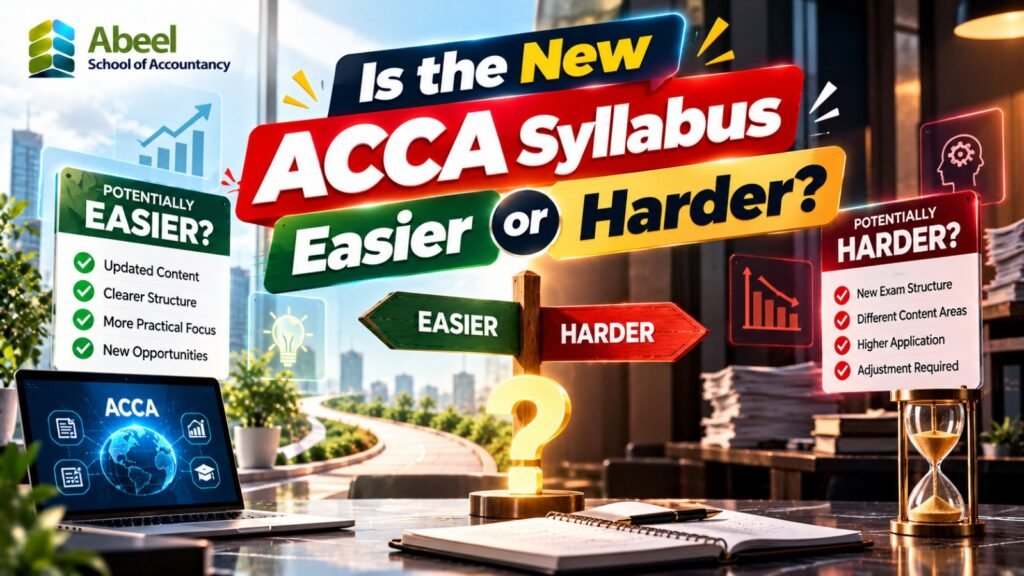
Every time ACCA announces a change, the same question starts circulating in WhatsApp groups, university corridors and comment sections: “Is the new syllabus easier?” With the 2027 redesign, that question has become louder than ever. Fewer exams, new paper names, new modules. It is easy to hear “13 papers become 11” and assume the road just got shorter and softer.
The honest answer is a little more interesting than yes or no. This guide breaks down what is really changing, where the new qualification may feel lighter, where it may feel heavier, and how to prepare without falling for rumors. We will also show how Abeel School of Accountancy helps students move through the transition with a clear plan instead of guesswork.
The Short Answer
The new ACCA syllabus is not easier, and it is not simply harder either. It is differently shaped. ACCA itself has been clear that fewer papers do not mean an easier qualification, and most training providers reading the same material reach the same conclusion: the technical depth stays, while the emphasis moves toward application, judgement, data and sustainability.
Think of it as a shorter road with a few steeper climbs, not a shortcut.
What Is Actually Changing in 2027?
Before judging difficulty, it helps to know what is confirmed.
- The structure moves from 13 exams to 11, and from three levels to four: Foundations, Knowledge, Expertise and Strategic Professional.
- Business and Technology (BT) is retired, and Corporate and Business Law (LW) moves to the Knowledge level as K3 Business Law.
- Applied Skills becomes Expertise, with five exams, including papers such as E1 Taxation, E2 Financial Reporting, E3 Audit, Risk and Control and E5 Performance with Data Analysis.
- Strategic Professional keeps two core papers plus one option: S1 Business and Sustainability Reporting (the evolution of SBR) and S2 Strategic Business Leader, along with a new Data Science Professional option.
- Three Essential Employability Modules replace the single ethics module, assessed at different stages rather than once at the end.
- Key dates: June 2027 is the final sitting under the current Applied Skills and Strategic Professional exams, new Knowledge exams arrive in July 2027, and new Expertise and Strategic Professional exams begin in September 2027.
Some details, such as exact cut-off dates and module pricing, are still being confirmed, so always check the official transition information on ACCA Global.
Where the New Syllabus May Feel Easier
Let us be fair. There are real reasons students feel optimistic.
Fewer exams to sit. Eleven papers instead of thirteen means fewer exam fees, fewer sittings and less time spent in the exam cycle for students who start under the new structure.
A smoother entry point. The new Foundations level is designed for students who are newer to finance, which can build confidence before the technical papers begin.
Clearer progression. Moving from Knowledge to Expertise to Strategic Professional is easier to explain and plan than the older structure, especially for first-year students who often feel lost about what comes next.
Credit for what you have passed. Eligible passes carry across, so students already mid-qualification are not starting over.
Where the New Syllabus May Feel Harder
This is the part rumors tend to skip.
More application, less recall. Papers lean further toward interpreting scenarios and making judgements. Students who survive on memorizing notes the night before may find this uncomfortable.
Data and digital skills are built in. A paper like E5 Performance with Data Analysis signals that analytics is no longer an optional extra. Students who avoided spreadsheets and data tools will need to build those skills.
Sustainability is woven into reporting. S1 expands the sustainability and ESG angle, which means more topics and more reasoning inside a single exam.
Employability modules add workload. They are not exams in the traditional sense, but they are required, chargeable, and need time and attention at each stage.
Fewer past papers early on. Whenever a new syllabus launches, the first cohort has fewer past questions and examiner reports to practice with. Marking patterns are also untested. That uncertainty is a genuine difficulty even if the content is not heavier.
What About the Pass Rates?
Pass rates at the Applied Skills and Strategic Professional levels have historically been tough, with several papers sitting below 50%. It is too early to say how pass rates will behave under the new structure, and anyone claiming certainty is guessing. The safest assumption is that exam technique and consistent revision will matter just as much as before, possibly more, because application-based questions punish shallow preparation.
So Should You Wait for the “Easier” Version?
No, and this is worth saying clearly. Waiting for a version that is not actually easier simply delays your qualification. Current guidance from ACCA is for students to keep progressing, with eligible passes and exemptions converted into credit. A student who finishes papers under the current syllabus gets known exam formats and years of past papers to practice with, which is a real advantage.
There is also a practical point on timing. June 2027 is the last session for current Applied Skills and Strategic Professional exams, so a student who delays a session-based paper until the very last sitting leaves no room for a resit under the old rules. Plan with margin, not hope.
How to Prepare for Either Version
Whether you finish under the current rules or move into the new structure, these habits work:
- Practice application, not just theory. Work through scenario questions and mark them against the examiner’s approach.
- Build basic data comfort now. Spreadsheets and simple analysis are no longer optional skills.
- Revise weekly instead of cramming. Judgement-based exams reward steady practice.
- Track real progress. Know which topics are secure and which are shaky, rather than relying on a general feeling.
- Plan around the transition dates. A personalized timetable prevents last-minute panic.
How Abeel School of Accountancy Helps You Through the Change
Syllabus changes feel stressful mainly because students face them alone. Abeel School of Accountancy builds its program to remove that uncertainty.
Weekly live revision with Smart Course Completion. Abeel School of Accountancy is the only institute that conducts weekly live revision sessions together with Smart Course Completion. You revise with a tutor in real time every week, while the tracking system shows exactly which topics are complete and which still need attention. For application-based exams, that steady practice is what separates a confident attempt from a risky one.
Direct tutor support. When a scenario question or a new concept does not click, you can reach your tutor directly instead of waiting for the next lecture. During a transition, quick clarity saves weeks.
A customized study planner. Each student at Abeel School of Accountancy receives a planner built around their own papers, exam sittings and the 2027 timeline, so you know which papers to complete under the current rules and which to approach under the new structure.
Results students can rely on. Abeel School of Accountancy students have secured multiple global and nationwide positions and are known for exceptional pass rates. Those outcomes come from structure and revision, and the same approach prepares students for a syllabus that rewards application.
Frequently Asked Questions
1. Is the new ACCA syllabus easier or harder than the current one?
Neither, really. It is differently shaped. There are fewer exams, but the papers lean further toward application, data and sustainability, so it should not be treated as a shortcut.
2. Why does ACCA say fewer papers do not mean an easier qualification?
Because the technical depth remains, and the new structure adds employability modules and a stronger focus on judgement. The reduction removes overlap, not difficulty.
3. Will my existing passes still count after the 2027 transition?
Yes. ACCA has said eligible passes and exemptions will be converted into credit in the redesigned qualification, so students should keep progressing.
4. What are the key dates for the 2027 changeover?
June 2027 is the final sitting for current Applied Skills and Strategic Professional exams. New Knowledge exams begin in July 2027, and new Expertise and Strategic Professional exams begin in September 2027. Always verify the latest dates on ACCA’s website.
5. Should I wait for the new syllabus because it might be easier?
No. Waiting only delays your finish date, and the new version is not easier. Finishing papers under the current syllabus also means you have known formats and plenty of past papers.
6. What makes Abeel School of Accountancy different for students facing the syllabus change?
Abeel School of Accountancy is the only institute that conducts weekly live revision sessions together with Smart Course Completion, and it also provides direct tutor support and a customized study planner built around your exam dates and the 2027 timeline.
7. How do I get started with Abeel School of Accountancy?
You can reach out through the Abeel School of Accountancy admissions page to discuss your entry route, exemptions and a personalized planner. You can also read our guides on the ACCA 2027 qualification redesign and the ACCA transition timeline for more detail.
For official dates, transition rules and the transition tool, always check ACCA Global.