
Start by identifying which stage applies to you
A new learner in New Zealand and an experienced ACCA member investigating another professional membership are not making the same decision. Before comparing routes, write down your current status: prospective applicant, student, affiliate or member. List the professional and academic outcomes you want separately. This helps prevent a pathway intended for established members from being advertised or understood as an automatic benefit available immediately after starting tuition.
What the CA ANZ pathway actually refers to
ACCA’s published CA ANZ application guidance describes eligibility for members in good standing who have at least five years of experience after admission to ACCA membership and currently reside in Australia or New Zealand. Read the full current application conditions before relying on the route. It is not a statement that every student or affiliate automatically becomes a CA ANZ member. Do not apply Australian-specific licensing or migration information to New Zealand simply because a webpage discusses both countries.
Keep study, work and regulatory enquiries apart
For study, establish your starting route and any confirmed exemptions. For employment, examine the requirements of the role and the evidence of skills an employer wants. For regulated work, consult the appropriate New Zealand authority or professional body. None of these questions should be answered solely by a tuition advertisement. A helpful planning sheet gives each enquiry its own source, date and next action instead of treating the qualification name as a substitute for every local decision.
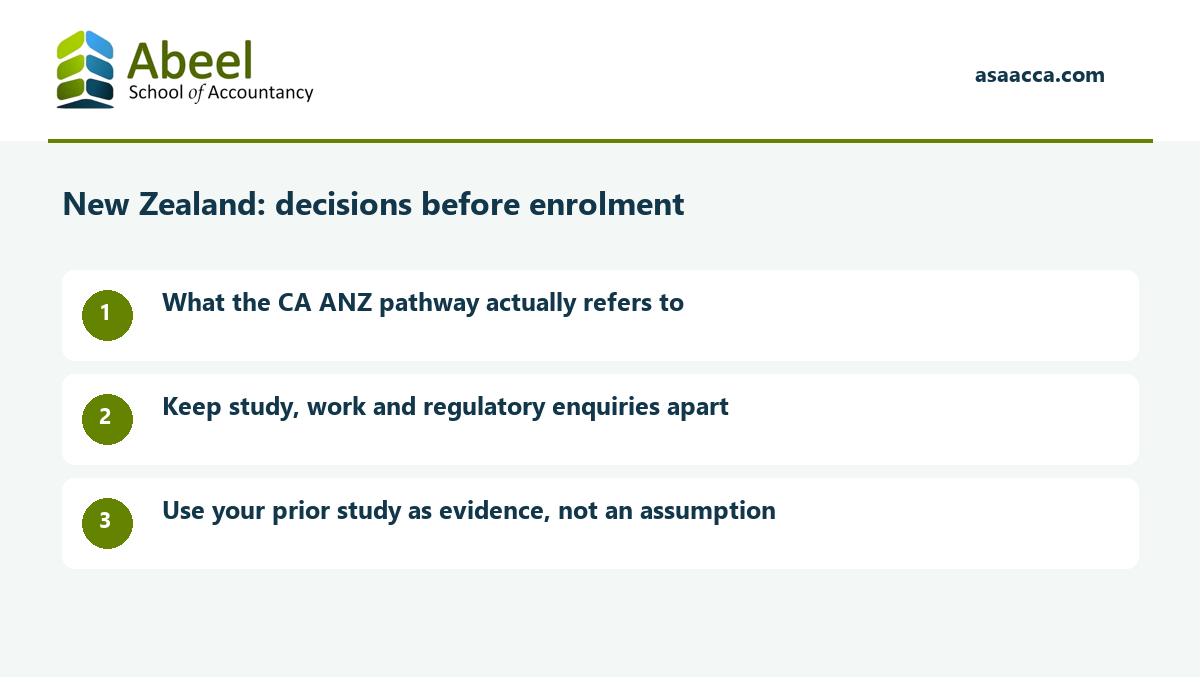
Use your prior study as evidence, not an assumption
If you have school or tertiary qualifications, compare the exact award with ACCA’s entrance requirements and exemption process. Retain results and programme details so that the relevant decision is based on your record. If exemptions are awarded, decide whether you still need a technical refresher before attempting a later paper. That choice is about your preparation, not about giving up legitimate credit. Explain the specific gap to a tutor so that support can be targeted.
Evaluate tuition across your actual week
Check the teaching language, live-session timing, recorded access and feedback arrangements against your own availability. Where teaching is delivered across time zones, confirm the local time for each scheduled session and the policy for missed attendance. Test a demo on your normal device and complete an independent task afterwards. A course with many hours of recordings may still be a poor fit if there is no practical route to resolve the questions you discover while applying the material.
Prepare a career conversation with accurate status
On your CV, explain completed learning, systems used and work you can discuss responsibly. Describe your ACCA status accurately and avoid claiming another body’s membership before admission is confirmed. If you investigate a membership pathway, keep the official response with your professional records. Use the ASA qualification guide and study resources below for the learning plan; use ACCA and CA ANZ’s current instructions for the conditional membership route. No course can guarantee a job, migration result or professional admission.
Build on the ACCA foundations
Official references for this guide
Keep the student pathway separate from a later membership option
Consider a new student who sees information about a membership arrangement between professional bodies and assumes it removes the need to complete the underlying qualification. That conclusion would skip several separate decisions. First establish the normal ACCA pathway applicable to your own record. A later application based on professional membership must then be checked against its own current eligibility conditions. Do not use a summary written for an experienced member as an entry guide for a student. The two readers are at different stages, and the evidence needed for their applications is different.
Create a personal evidence folder for future decisions
Retain official assessment responses, examination results and accurate work-experience records as you progress. If you later explore another professional membership, keep a separate checklist for the applicable conditions and supporting documents. Record the date on which you checked the guidance because a future application may need a fresh assessment. A personal evidence folder is a planning tool, not a prediction of acceptance. It helps you explain your status and identify missing information without relying on a provider’s description of what someone with a different career history was able to do.
Ask employers about duties rather than assuming equivalence
When evaluating a finance role, discuss the actual responsibilities, reporting framework, supervision and development opportunities. Do not assume that an employer will treat every qualification, membership grade and experience record identically. The purpose of the conversation is to understand the role and present your own position accurately. If an advert lists several acceptable qualifications, that does not decide immigration status or regulated practice rights. Keep those matters with the responsible authorities and appropriately qualified advisers. A course can help develop knowledge, but it cannot determine every condition attached to employment or professional practice.
Translate a time-zone difference into a learning arrangement
If your teacher is in another country, request the session time in both locations for the actual teaching period. Ask what happens if a clock change alters the usual difference or if a live session falls during work. Determine whether the recording includes the question discussion and how you can obtain feedback afterwards. Then schedule your own practice before the next lesson. Recorded access can solve a timing problem, but it does not automatically provide a substitute for asking questions. Choose the arrangement by testing how the entire learning cycle works across the two locations.
Judge course progress through one complete practice cycle
Choose a small topic, learn its underlying method and attempt a fresh question without following the teacher’s solution. Review the mistake, request feedback where available, and attempt another question after a short interval. Compare the quality of your reasoning and explanation, rather than simply counting completed videos. This sequence reveals whether the course helps you produce independent answers. It also gives you a practical basis for choosing the next paper or changing your workload. Use free introductory resources for exploration, while keeping examination booking and formal professional assessments on their official routes.