
Treat recognition as a question with a responsible authority
ACCA’s Luxembourg guidance directs readers to the country’s official information on recognition of foreign qualifications. That is a more useful starting point than assuming that every certificate is automatically equivalent for every purpose. Define what you need recognition for: further study, an employment requirement or a regulated activity. The organisation responsible for that decision should provide the answer. A general qualification guide can help you identify the question, but it cannot issue an individual recognition decision.
Read language requirements at the role level
Luxembourg career planning benefits from examining the language requirements of specific vacancies rather than assuming every finance role operates in the same language. Note which skills are essential and which are preferred, and distinguish technical study language from workplace communication. An English-language ACCA lesson can support professional learning, but it does not establish that a particular employer will waive other language requirements. Use actual advertisements and conversations to guide your own preparation.
Match professional learning to a defined responsibility
Choose a responsibility you want to develop, such as explaining a reporting adjustment, reviewing management information or understanding an assurance process. Then identify the relevant syllabus area and the type of question practice it requires. This produces a more useful learning goal than collecting courses without a clear application. Keep confidential employer information out of exercises shared in a public classroom. A fictional example can demonstrate reasoning without exposing a real client or business record.
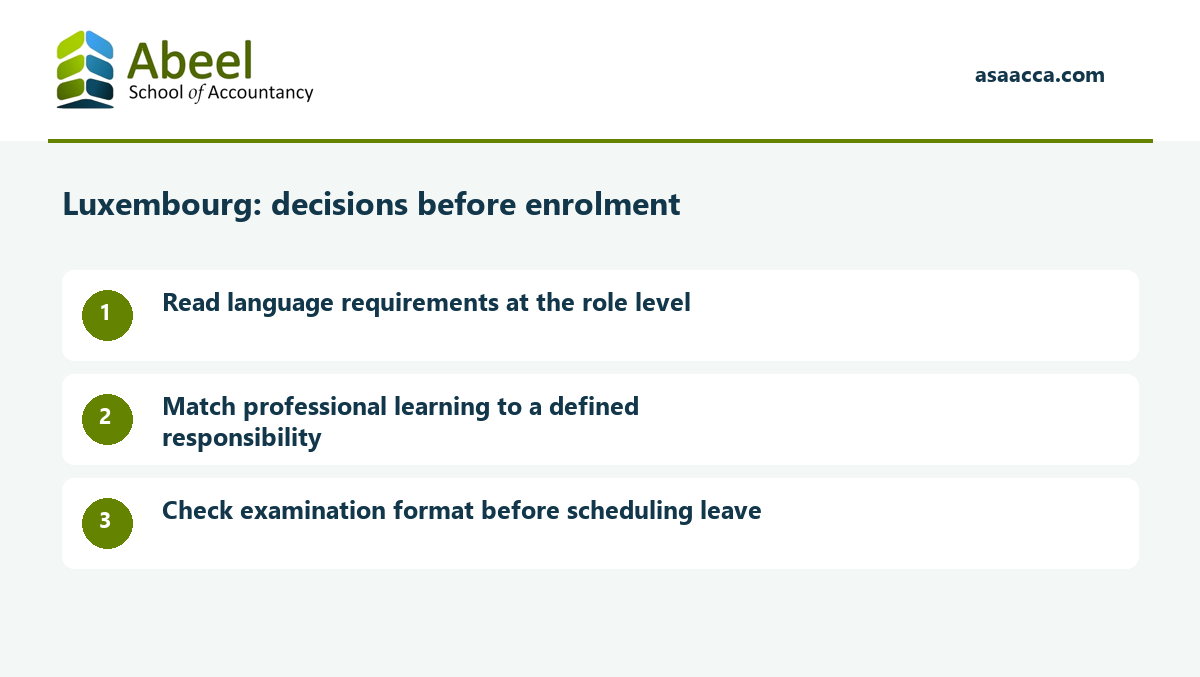
Check examination format before scheduling leave
The reviewed ACCA availability page distinguishes remote on-demand provision from centre-based session provision for Luxembourg. Check your actual paper and current booking options rather than assuming all exams use one format. An availability listing is not an appointment confirmation. Once your booking is complete, use its instructions for location, identification and timing. Organise tuition and revision around that confirmed plan and allow a separate period for practising the response tools relevant to the examination.
Build a study week that survives ordinary disruption
Start with the working week you normally have, including any commuting and regular commitments. Reserve a small number of dependable study periods and decide what each is for: learning, independent questions or reviewing feedback. A plan that relies on ideal conditions is difficult to maintain when work becomes busy. Keep a short list of errors to revisit, so a limited study period can still have a clear purpose instead of becoming another unfocused viewing session.
Keep the sources in their proper roles
Use ACCA’s information for the professional qualification and its guidance on moving to Luxembourg. Follow the linked government routes for recognition or immigration questions, and obtain advice appropriate to your circumstances when necessary. Use ASA tuition to address a specific paper and learning need. These roles complement one another, but none should be presented as a promise of employment, residence or professional permission. An accurate plan records which decisions are confirmed and which still require an official response.
Build on the ACCA foundations
Official references for this guide
Define the recognition question before looking for an answer
Recognition can refer to an employer accepting a qualification, an institution assessing prior education or an authority deciding eligibility for a regulated activity. These are not interchangeable decisions. Write down the exact purpose of your enquiry and the organisation responsible for answering it. Include your current qualification and professional status, not simply the word ACCA. This gives the recipient enough information to distinguish a student enquiry from a member’s professional question. Keep the written answer with its stated limitations instead of turning a response about one activity into a claim that the qualification permits every kind of work.
Build a role-specific language checklist
For each prospective position, note the language requirements actually stated and the tasks that explain them. Internal reporting, client communication and correspondence with authorities may involve different expectations. Avoid generalising from one international employer to every organisation in Luxembourg. If the vacancy is unclear, ask a specific question about the duties rather than assuming the examination language settles workplace requirements. Your learning plan can then combine technical study with the communication skills relevant to the role. This also helps you compare courses by the support you need instead of by a broad promise of international opportunities.
Compare a professional pathway with a job description
Take a vacancy you are genuinely interested in and separate its requirements into qualification, experience, technical tools and communication. Mark which areas your proposed study addresses and which need another form of development. For example, learning a reporting concept is different from demonstrating that you have applied it responsibly in an organisation. This gap analysis prevents a course from becoming a substitute for an entire career plan. It also creates useful questions for an employer or mentor without implying that completion of the qualification guarantees an interview, appointment or particular level of pay.
Reserve time for written application, not only reading
A demanding work schedule can make passive study attractive because a recording fits into short gaps. However, being able to follow an explanation is not the same as producing an answer independently. Reserve longer periods for reading a requirement, selecting relevant information and writing a response. Use short periods for reviewing errors and revising terminology. Ask the provider how written work is assessed and how feedback can be obtained. A realistic combination of these activities is more informative than a timetable that counts hours of exposure to content without checking what the student can do afterwards.
Keep professional advice separate from enrolment advice
An admissions conversation can explain a course’s teaching format and access terms. It should not be treated as an individual ruling on recognition, residence, immigration or a regulated service. Identify the questions that require a competent authority or appropriately qualified adviser and obtain those answers through the proper channel. Keep tuition decisions conditional where an unresolved professional requirement could change your plan. This does not mean postponing all learning; introductory study can help you assess interest. It means avoiding expensive assumptions about what a course purchase will entitle you to do later.