

An ACCA starting-route decision for a learner in China should follow the qualification you can document. Your residence alone does not establish the educational route, and a course advertisement does not replace the official registration assessment.
ACCA’s current entrance table includes China-specific educational routes, including Gaokao and university-matriculation entries. Check the full applicable listing and your own documents. Do not apply a rule for a different award or jurisdiction solely because it also contains the word China.
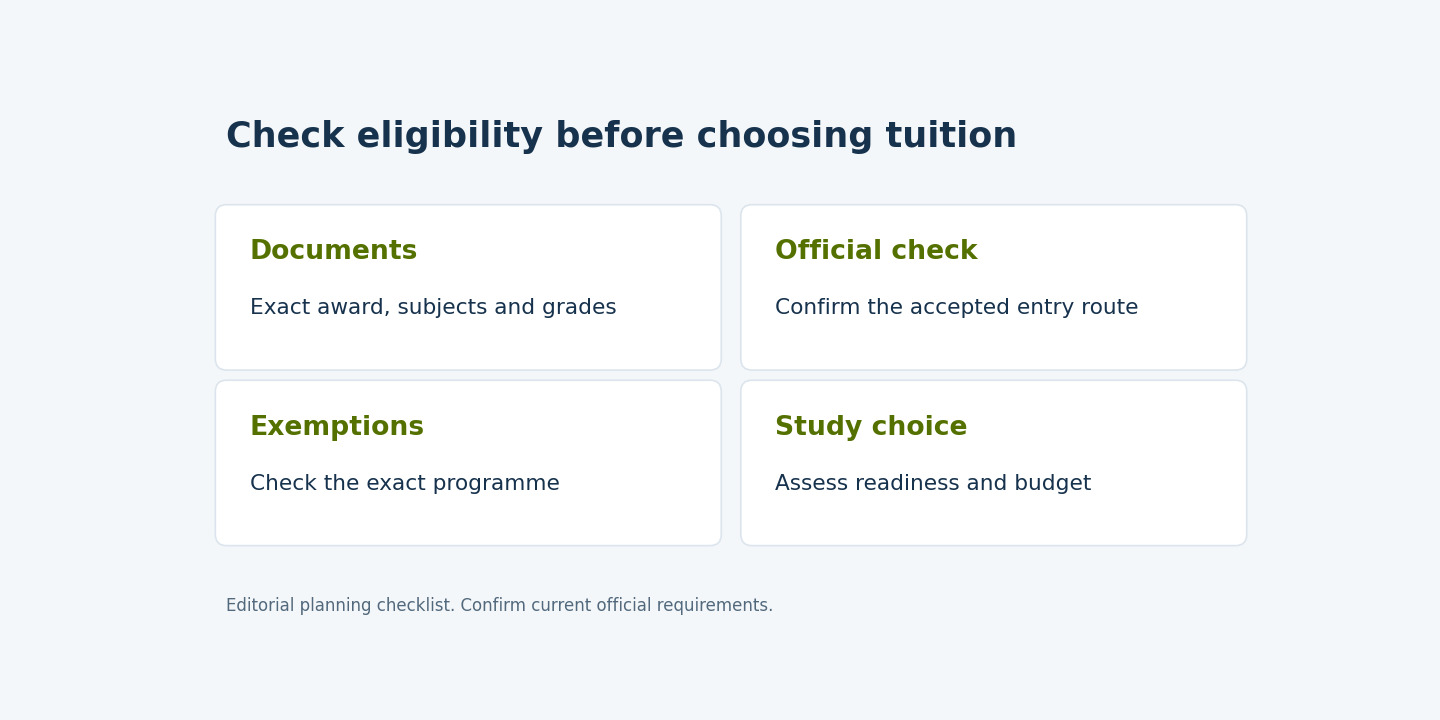
Identify the actual award
Record the qualification name, awarding institution, study period and results. Distinguish the award on your certificate from an informal translated name used in a conversation. If a translation or additional document is required, follow the official current instructions.
A learner who completed education elsewhere should check the qualification actually earned. A national location page is a starting point for research, not proof that every resident holds the same educational award.
Keep registration and exemptions separate
An entry route may support registration while a separate exemption assessment determines which prior learning receives credit. Use the correct institution and programme details and retain the actual exemption result.
If a degree is unfinished, record that status accurately. Do not assume a completed degree’s exemption position applies to partial study. Seek the official guidance for your specific circumstances.
Test your learning needs
Try an accounting lesson followed by independent questions. Evaluate understanding of the explanation, interpretation of the requirement and ability to explain a result. Use the exercise to decide which support is useful.
Where tuition is delivered in a particular language, confirm that language and try the demo before committing. The course’s explanatory language and the language requirements of an assessment should be considered separately under the applicable official rules.
Map university or work commitments
Record fixed commitments and identify reliable study slots. Give each slot a task such as practising a requirement or reviewing an error. Avoid measuring the plan entirely by lecture minutes.
If university assessments or work peaks regularly eliminate practice time, reduce simultaneous papers or revise the timing. A sequence should develop understanding rather than create a growing backlog of recordings.
Resolve access before paying
Ask about the platform, device support, live-session time zone, recording access and included feedback. Test the actual learning environment you expect to use. Verify availability and terms with the provider rather than assuming any overseas platform will suit your location.
Check exam arrangements independently. Online tuition does not establish a remote exam option or a confirmed local venue.
Ask ASA about a suitable course
Explore Abeel School of Accountancy and ASA course options. Contact ASA with your location, qualifications, chosen paper, preferred teaching language and weekly study availability. Confirm the actual course access and delivery terms before paying. This guide does not establish a local ASA branch or exam centre.
Official sources reviewed 13 October 2026: ACCA minimum entrance requirements; ACCA exemption guidance; ACCA tuition options. Examples and worksheets are original editorial guidance. Local availability, fees and individual eligibility must be confirmed through the applicable official process.
For the broader country picture, read the ACCA in China guide.
Build a qualification record before the application
Create one record for the qualifications you actually hold. Include the exact award title, institution or awarding body, completion date, subjects, results and whether a final certificate has been issued. For Chinese documents, keep the original title alongside any official English translation rather than substituting an informal degree description. This makes it easier to compare the evidence with the correct entrance listing. ACCA’s current minimum-entrance guidance says non-English documents require the original-language version and an English translation conducted and stamped by a licensed translator. Check the current submission instructions before commissioning a translation so that the work meets the required standard.
A useful record distinguishes a completed award from current university enrolment. If you have completed secondary education and started a degree, record both facts separately. Do not describe the degree as awarded until you can support that statement with the required documentation.
Use the China listing without mixing jurisdictions
Open the official minimum entrance requirements page and locate the entry applying to your actual educational award. Read the full entry and its conditions rather than extracting one familiar word from a search result. Mainland China, Hong Kong and other educational systems should not be treated as interchangeable simply because their descriptions may appear near one another. Likewise, someone living in China who studied overseas should check the award earned overseas. Your residence helps identify practical study and examination arrangements; your documented education determines the admission check.
If a listing is unclear, prepare a focused question for ACCA. State the award, institution, year and unresolved condition. Ask what evidence is needed. A precise question is easier to answer than whether all students from a particular city can start ACCA.
A fictional document-check example
Consider a learner who has completed a school award and is in the first year of university. They organise their issued results, enrolment evidence and study dates. They then check whether the relevant entrance listing applies to completed school study, university matriculation or another documented route. This is a planning example, not an admission decision for that learner. The next action depends on the official treatment of their evidence.
Now consider someone with an accounting degree earned outside China who has moved to Shanghai for work. Their qualification check should use the institution and award they actually completed. Their exam-location and timetable checks use their present circumstances. Keeping those decisions separate avoids applying a residence-based assumption to an education-based requirement.
When direct entry is not confirmed
If your documents do not establish direct entry, investigate the appropriate foundation route through current official guidance. Do not buy a main-qualification paper course merely because a provider accepts tuition enrolment. Ask which qualification you would register for, which first examination belongs to it and what completion requirements lead to progression. The course plan should explain the preparatory workload rather than hide it in a general total of papers.
Foundation study can develop accounting knowledge and confidence with business questions. Use a short diagnostic to identify learning needs, especially if your previous education was outside accounting. Administrative eligibility and learning readiness are different questions: meeting an entrance requirement does not mean every introductory concept is already familiar.
Turn a lesson into a readiness check
After a sample lesson, attempt a fresh question without copying the demonstrated answer. Explain the method and identify why it fits the requirement. If you calculate correctly but cannot explain the result, include written interpretation practice. If the main difficulty is reading the scenario, ask about support for business vocabulary and understanding requirement verbs. These observations give a tutor something specific to address.
Keep the exercise small enough to complete and review. A diagnostic is not an official exam or a guaranteed prediction of performance. Its purpose is to identify the next learning action. Repeat a related question after acting on feedback to see whether the weakness has improved rather than measuring progress only by videos watched.
Choose a first paper using confirmed information
Once your route is confirmed, list examinations already passed, officially exempted and still required. Mark pending assessments separately. Read the current syllabus for a candidate paper and identify prerequisite topics. Then estimate the work needed for teaching, independent attempts, marking and revision. A feasible first-paper plan can be less ambitious than the maximum permitted examination load.
Check any applicable law or tax variant before selecting resources. If a course is described by an old paper name, ask which current examination and syllabus it covers. The correct starting paper is one that fits your confirmed record and preparation, not simply the course with the nearest advertised start date.
Coordinate application, tuition and exam dates
Keep three administrative tracks in the calendar: professional registration, tuition access and examination entry. They can have different deadlines and confirmation records. If registration or an exemption assessment remains unresolved, ask how that affects your intended examination plan before making related purchases.
For session examinations, check the official dates and the options offered for the intended location. For on-demand examinations, identify the applicable official booking route. A lecture platform functioning on your device does not confirm an examination delivery method. Add travel where the confirmed venue requires it and organise the documents named in the official exam instructions.
Include the 2027 transition in the discussion
ACCA is introducing a redesigned qualification from 2027. Use its official transition tool and guidance with your actual record and intended study dates. Ask the provider which examination the course prepares you for and how its syllabus relates to that timing. Avoid stopping useful preparation merely because an undated headline says the qualification is changing.
A practical transition note records the current paper, intended sitting and question still needing confirmation. Update it after an official decision or result. If you are not yet registered, make clear which parts of your plan are still assumptions. This keeps course advice connected to the actual route rather than mixing current and future requirements.
Questions to resolve before paying
Can my residence alone establish eligibility? No: check the documented qualification. Does a university programme name guarantee exemptions? No: the exact assessed programme and official award matter. Can I treat provisional results as a completed degree? Record their status accurately and follow the current application instructions. Does online teaching establish a remote exam option? No: use the official examination availability information.
Before payment, you should be able to identify your proposed registration route, first paper, course language, syllabus period, access terms and unresolved document questions. Save the relevant written confirmations. For a provider discussion, share a concise summary of those facts; submit sensitive documents through the appropriate official process rather than a public study group.
Continue with the related China guides
ACCA in China overview; entry routes; online course access; university study and exemptions. For a different country route, see our ACCA in Pakistan guide. Return to ASA to explore course options.