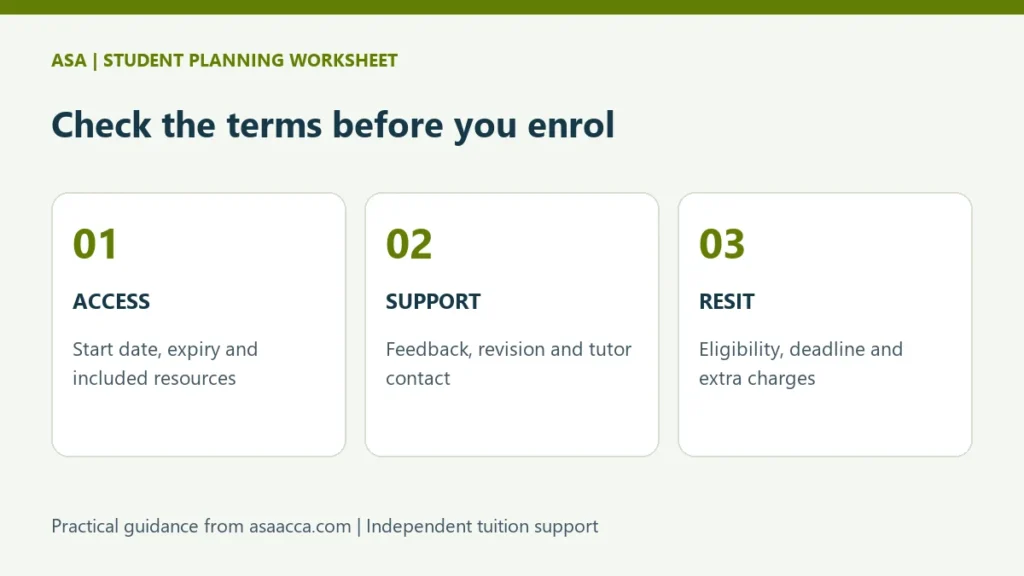
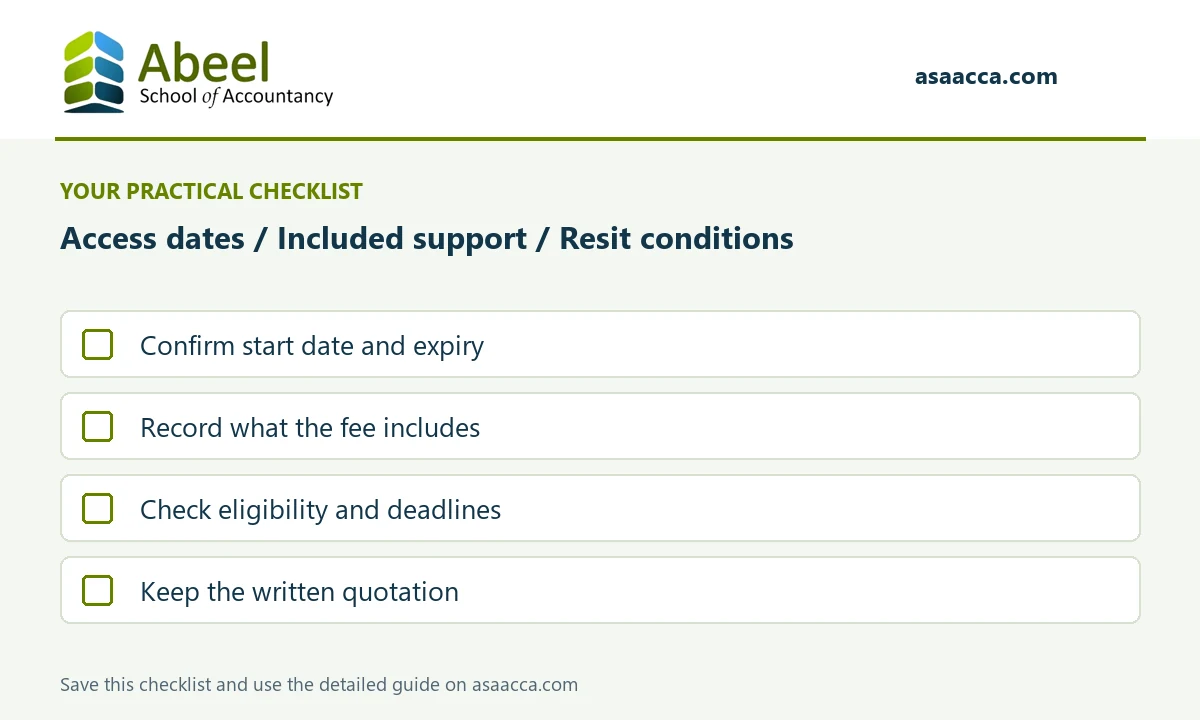
An ACCA tuition price is useful only when you know what it includes and how long the access lasts. Before paying, ask for a written summary of the paper, variant, intended exam session, course access period, support arrangements and any resit conditions. A discount percentage alone does not answer those questions.
Separate the different payments
Tuition is the teaching service you buy from a provider. ACCA registration, subscription and exam-entry charges are separate items unless a written offer explicitly says otherwise. Paying for a revision or resit course does not automatically enter you for an ACCA exam. Check the provider’s invoice against your own ACCA account and exam-entry records.
ACCA’s guidance on tuition charges directs students to their chosen provider for current tuition rates. This article does not set ASA prices or override the terms displayed on a particular course.
Use an access-and-support checklist
| Item | Question to ask | Evidence to retain |
|---|---|---|
| Access period | When does access begin and end? | A dated confirmation for the selected batch. |
| Materials | Which notes, lessons and question resources are included? | The course description and resource list. |
| Support | How are questions submitted and which answers receive feedback? | The stated support channel and marking arrangements. |
| Revision | Is revision included or purchased separately? | A list of included sessions and any additional fee. |
| Resit terms | Who qualifies, by what deadline and for which attempt? | The full offer conditions, not only a banner. |
Clarify what a resit offer actually covers
A resit offer may refer to repeat tuition access, a separate revision batch or a reduced course price. Those are different services. Ask whether the offer is restricted to existing students, requires evidence of an exam result, applies to a specific tutor or language, and has a purchase deadline. Do not assume that one paper’s offer applies to all courses.
Also ask what happens if your intended sitting changes. Access may end before a later attempt; an extension may have separate conditions. Get the answer before choosing a batch rather than relying on an informal assumption after payment.
Compare the amount payable, not just the percentage
For illustration only, a 30% reduction on a hypothetical tuition price of PKR 30,000 gives PKR 21,000: 30,000 × 0.70. This is not an ASA quotation. A percentage has little meaning without the stated base price, included service and expiry date. Keep the currency and any additional charges visible in your comparison.
Use the ACCA budget guide to keep tuition separate from other study costs. For broader local planning, the Pakistan ACCA study guide connects entry routes and city guidance without replacing your individual quotation.
Keep a course comparison record
Create one row for each genuine option, with the exact paper, tutor, language, intended attempt and total price. Record the access end date as a date rather than writing “long access”. If an answer is missing, leave a visible question mark and request clarification. This makes the comparison useful after a promotional banner has changed.
Two courses with the same headline price may include different services. One might include written-answer marking; another may provide only self-review resources. Compare the support you will actually use instead of treating the longer resource list as automatically better value.
Example: a delayed exam attempt
Imagine a student buys tuition for a December sitting and later decides to prepare for March instead. The student should check whether lesson access continues, whether revision sessions change and whether an extension carries a charge. The original payment alone does not answer those questions.
If a provider offers a resit reduction, establish whether that refers to an additional course purchase or renewed access to an existing course. Keep the eligibility evidence and deadline with the written offer. This example illustrates questions to ask; it does not establish ASA’s terms for any individual purchase.
Ask about marking and feedback separately
“Mocks included” can refer to several things: access to questions, automatic marking of objective responses, a model answer, or manual marking of a written script. Ask which applies to your course and paper. A constructed-response exercise should not be assumed to receive a meaningful score merely because it appears online.
Clarify submission arrangements, the number of scripts covered and how comments are returned. If feedback is included, ask what a student normally receives and how unresolved points can be discussed. These details help you budget both money and revision time.
Frequently asked purchase questions
Does buying tuition register me for the official exam?
Do not assume that it does. Confirm any expressly included service and check the official exam-entry position through your ACCA account.
Can the same discount apply to every tutor and batch?
Only if the published offer says so. Check the exact course, price basis, attempt and eligibility rather than transferring another course’s percentage to your own purchase.
What should I save after paying?
Keep the invoice, course description and confirmed terms together. They should identify what was purchased and the questions resolved before payment.
A message you can send before enrolling
“Please confirm the paper and variant, tutor, teaching language, intended sitting, access end date, included revision and feedback, total amount payable, and the eligibility and deadline for any resit offer. Please also confirm whether ACCA exam-entry charges are excluded.”
Keep the reply with your invoice and course description. If anything conflicts, resolve it before paying. You can start with ASA’s course and demo options and ask about the exact course you intend to buy; a general website banner is not a complete individual study agreement.