
Start with the current partnership instructions
A prospective student in Botswana may encounter both ACCA and Botswana Institute of Chartered Accountants information while researching the qualification. ACCA’s current Joint Examination Partnerships page specifically states that a Botswana resident does not need a separate BICA registration after completing ACCA registration. Read that current instruction rather than assuming an old fee sheet or another country’s joint-scheme process still describes your case. This concerns the registration process; it should not be expanded into a claim about every later membership or practice entitlement.
Keep registration and professional permissions separate
Write down which outcome you want: starting ACCA study, entering an examination, eventually applying for membership, or undertaking a particular professional role. Those outcomes involve different checks. If your goal includes a regulated activity in Botswana, obtain the applicable requirements from the relevant body. A training provider should not turn an examination partnership into a blanket promise that every local permission follows automatically. Keeping the outcomes separate also makes your questions more precise when you contact ACCA or BICA.
Match the qualification you actually hold
Use ACCA’s entrance database to identify your award and any attached conditions. A school qualification and an accountancy diploma are not interchangeable simply because both were studied in Botswana. Keep the awarding institution, full certificate name, year and results visible when comparing the database entry. For exemptions, check the exact institution and programme rather than the broad subject name. An entry decision concerns where you can begin; an exemption decision concerns credit for prior study. Do not treat one as a substitute for the other.
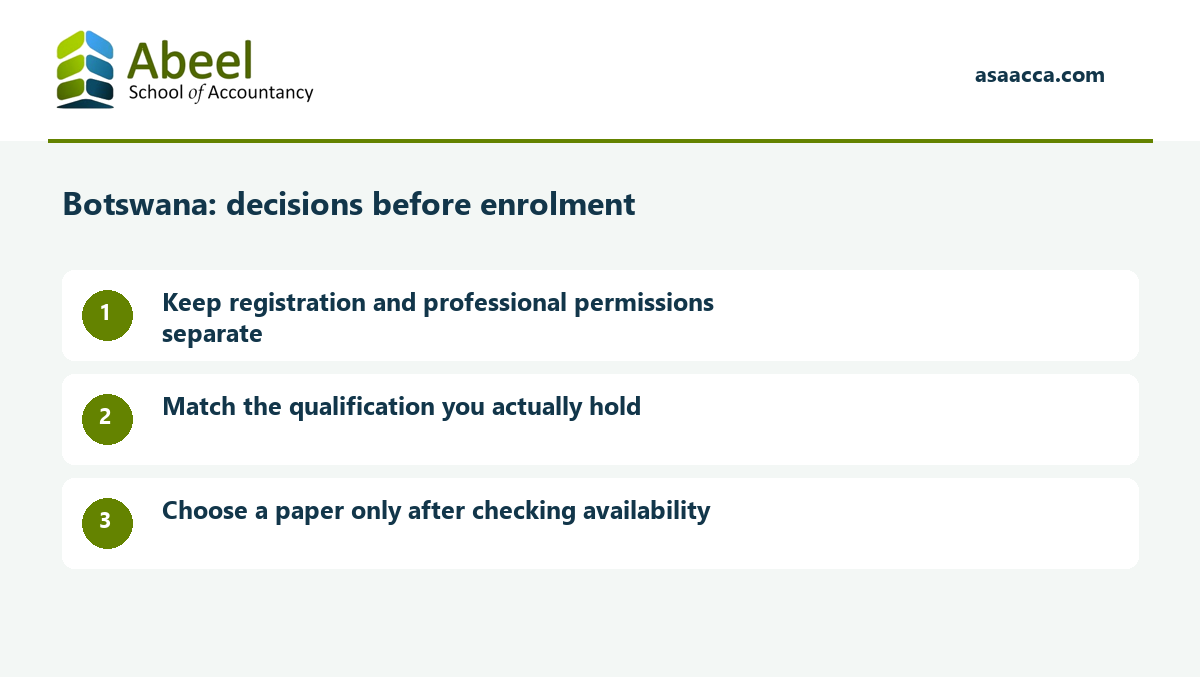
Choose a paper only after checking availability
The ACCA availability information reviewed for Botswana lists examinations in centres. Follow the correct route for your paper and check live availability before arranging leave or committing to travel. A centre’s existence does not prove that your preferred examination, date and appointment remain available. Store the official entry confirmation once the booking has been completed. Tuition enrolment and an examination booking should appear as different items on your planning sheet, with their own recipients and confirmations.
Compare learning support in concrete terms
Ask a provider how technical lessons, question practice, revision and tutor feedback fit together. If a package advertises mocks, establish whether they are original practice papers, how written responses are marked and what feedback you receive. A student preparing for an applied written task needs more than access to a multiple-choice score. Use a sample lesson and a small independent answer to test whether the learning format suits you. Review the teaching language and access period for the actual batch rather than relying on a general course advertisement.
Budget for timing as well as price
Put recurring ACCA charges, individual examination entries, tuition and incidental costs on a calendar. This is particularly useful when a course instalment and an official payment fall close together. If you convert a foreign-currency amount into your personal budget, label the assumption and check the payment provider’s actual terms before paying. Do not repeat an old local-currency equivalent as a current official price. A reliable budget records where the figure came from and when it was checked.
An example of a better comparison
Suppose two tuition offers show different prices. One includes only recorded technical lessons, while the other also describes scheduled revision and review of written attempts. Instead of deciding from price alone, prepare a comparison showing access duration, teaching language, question support and marking arrangements. Then ask which features you will use consistently. This example does not rank providers or imply that either package guarantees a pass; it shows how to make a purchase decision against your actual study needs.
Build a first-paper review point
After a few weeks, review whether you can explain the main ideas without replaying the lesson and whether feedback is helping you correct mistakes. If progress is slow, identify whether the issue is knowledge, answer method, timing or access. Adjust the learning plan before adding more papers. Use the foundational ASA guides below to connect the local registration and exam checks with the wider qualification structure. Keep confirmation of your official status and decisions in your own ACCA record.
Build on the ACCA foundations
Official references for this guide
Resolve conflicting registration advice with a written question
Suppose a prospective student finds an older document mentioning a separate professional-body step while a current official page describes a different registration sequence. Paying both charges immediately is not a good way to resolve that conflict. Save the two references, identify the qualification route each describes, and ask the relevant organisation which instruction applies to the proposed application. Include the document dates and your intended route. This avoids treating a historical instruction as a present requirement, while also avoiding the opposite mistake of assuming that a statement about student registration removes every later professional obligation.
Assess a job opportunity by responsibilities and supervision
A trainee considering an accounting vacancy should investigate more than the job title. Ask what work the position involves, how responsibilities develop, who reviews that work and whether the employer can support appropriate professional experience records. A role dominated by routine administration may offer a different learning opportunity from one involving reconciliations, reporting or analysis. Do not assume that the word accountant in an advert settles experience eligibility. Keep a factual description of the proposed duties and discuss the professional requirements through the official experience guidance before making claims about qualifying time.
Make the tuition comparison specific to your first paper
Request a sample timetable for the actual paper you intend to take. Compare teaching hours, question practice, access duration and the route for obtaining help after a missed lesson. If you work, map the busiest reporting days against the proposed revision period. A timetable that looks manageable in an ordinary week may fail during a demanding work cycle. Choose the smallest sustainable commitment first, with a review point after several lessons. Expanding a study load after demonstrating that you can practise consistently is safer than purchasing several courses on the assumption that motivation will create additional time.