Three decisions that should come before a course purchase
If you are considering ACCA from The Gambia, start with three separate questions: can your existing qualification support the intended entry route, how will you book the relevant examination, and which tuition arrangement will help you prepare? A useful answer to one question does not settle the other two. This guide is a decision worksheet for a prospective student, rather than a claim that every Gambian school or college award leads to the same starting point.
Read the complete award name
ACCA’s entrance database distinguishes between different Gambian awards, including qualifications whose names contain similar technical-training terms. Use the precise certificate title, awarding institution and results. Do not shorten a technician diploma to diploma and assume the database entry still applies. Put the certificate and transcript beside the official database result, and note any subjects or grade conditions. If your award is unclear, request an individual decision from ACCA before buying a package described as starting at a particular level.
Make an exam-access check while the plan is still flexible
The reviewed ACCA availability table lists centre-based options for The Gambia. That is a starting point for checking the booking route, not a reservation at a particular centre or a guarantee of a seat. Identify whether your intended paper is on-demand or session based, follow the relevant official booking link and check current availability. Then consider the travel, identification and scheduling requirements attached to that actual booking. Online tuition should not be advertised as proof that the examination can be taken from your home.
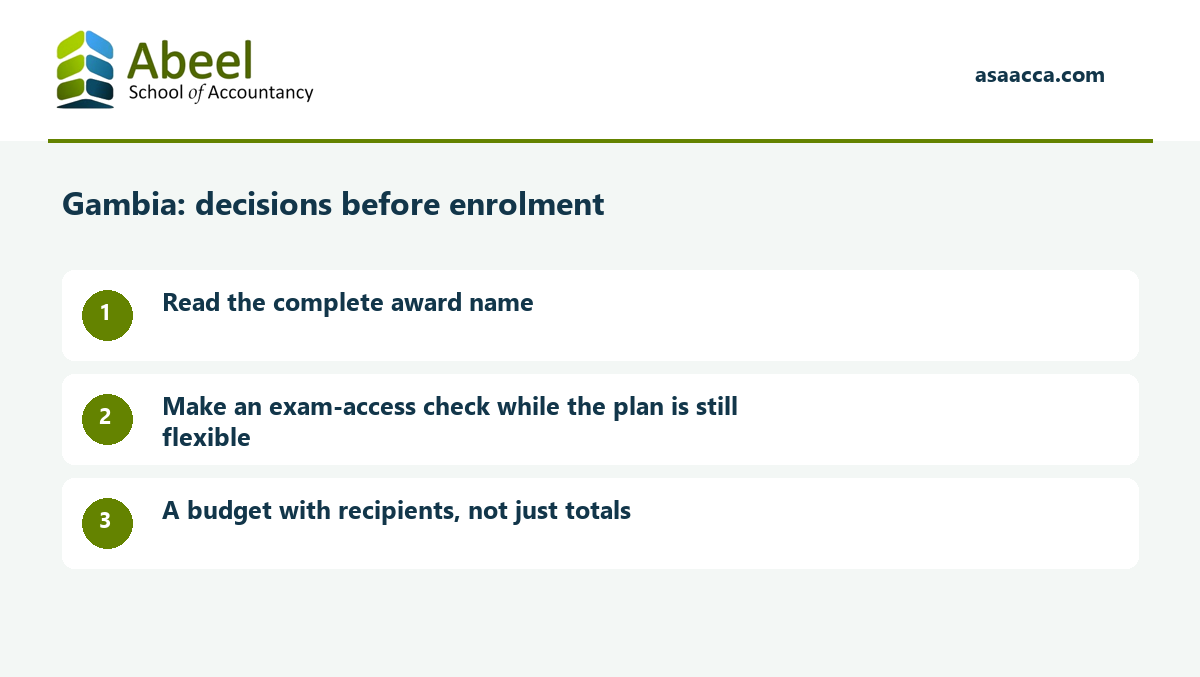
A budget with recipients, not just totals
Create separate rows for ACCA charges, examination arrangements, ASA tuition and any equipment or travel you may need. Record who receives each payment and the source of the price. For a foreign-currency charge, use a clearly dated conversion estimate rather than presenting a fixed local total as guaranteed. Ask whether the learning package includes revision, mock attempts and written feedback. A low headline course price may be difficult to compare with a package covering a different access period or a different set of services.
Try the learning process before committing
Use a free orientation or demo lesson to test explanation, language and access on the device you will actually study with. Next, attempt a small question independently. Can you write a response and send it for feedback using the proposed setup? This practical test reveals more than watching a promotional video on a different device. If your study depends on recorded lessons, ask about access terms, playback requirements and what happens when a concept remains unclear after the first viewing.
A first-month example
Consider a learner who has collected a technical qualification and wants to start immediately. A sensible first week is spent confirming the exact entry decision and checking the examination route. The second week can test learning access and compare tuition terms. The remaining time can be used to build a paper plan and complete initial practice tasks. This is an illustrative sequence, not a required timetable or an assurance of admission. The value is that each purchase follows a confirmed decision rather than an assumption.
Keep a short evidence folder
Retain the qualification decision, the current course terms, relevant receipts and any exam-entry confirmation. Organise them by purpose so that a tuition payment is not mistaken for an exam booking. For study, keep an error log with the question attempted, the reason for a mistake and the correction to practise. If you later change your paper or attempt, review which documents and access arrangements are affected. Share private identity documents only through the appropriate official process, rather than a public course enquiry.
Where this fits in the wider ACCA route
Once entry and practical access are clear, learn how examination progress, ethics learning and relevant experience fit together. Use ASA’s qualification explanation and syllabus-reading guide as foundations, then choose tuition for a defined paper and intended attempt. The next useful conversation is specific: explain your confirmed starting route, the paper you want to study and the feedback you need. That makes it easier to evaluate a course than asking for a universal promise about how quickly anyone can finish.
Build on the ACCA foundations
Official references for this guide
Turn your certificates into an application checklist
Consider two prospective students who studied at different technical institutions. Both describe their qualification informally as a diploma, but their certificates show different awarding bodies and levels. They should not assume that one successful application proves the other person’s eligibility. Each should record the complete award title, institution, completion year, subjects and results before asking for an assessment. This is an illustrative comparison, not an ACCA admission decision. A short, precise enquiry supported by the correct documents is more useful than several messages asking whether a generic diploma is accepted.
Compare the cost of reaching the exam, not tuition alone
Build a personal budget with separate lines for the qualification account, the intended examination, learning materials, tuition and travel. Leave amounts blank until you have a current quotation or an official charge applicable to your own situation. If an examination requires a journey, include the practical cost of arriving reliably and returning afterwards. A discounted course can still be an unsuitable purchase if its schedule conflicts with the booked examination or if essential feedback costs extra. Keep dated quotations so that you can compare what each provider actually includes rather than comparing headline prices alone.
Use a short trial before committing to a full study block
Before paying for several papers, use one demonstration lesson to test your learning process. Pause the explanation, attempt a related question without looking at the solution, and write down the point you could not explain. Ask how that question would be handled in the paid course. Does the teacher discuss your reasoning, offer a scheduled question session or only supply a recording? This trial helps distinguish access to content from access to support. Once you have an entry decision, a realistic examination arrangement and a workable feedback routine, choosing the first course becomes a much clearer decision.