

ACCA practical experience in Pakistan deserves a place in your plan from the beginning. Exam preparation measures what you can demonstrate in an assessment; workplace evidence shows how you apply skills and professional judgement in a relevant role. Completing one does not automatically complete the other.
ACCA’s current Practical Experience Requirement guidance describes 36 months of relevant experience and nine performance objectives: five Essentials and four Technical. Use the current guidance and the record for your own route to confirm what you still need. This is a membership requirement; local audit or public-practice licensing is a separate question.
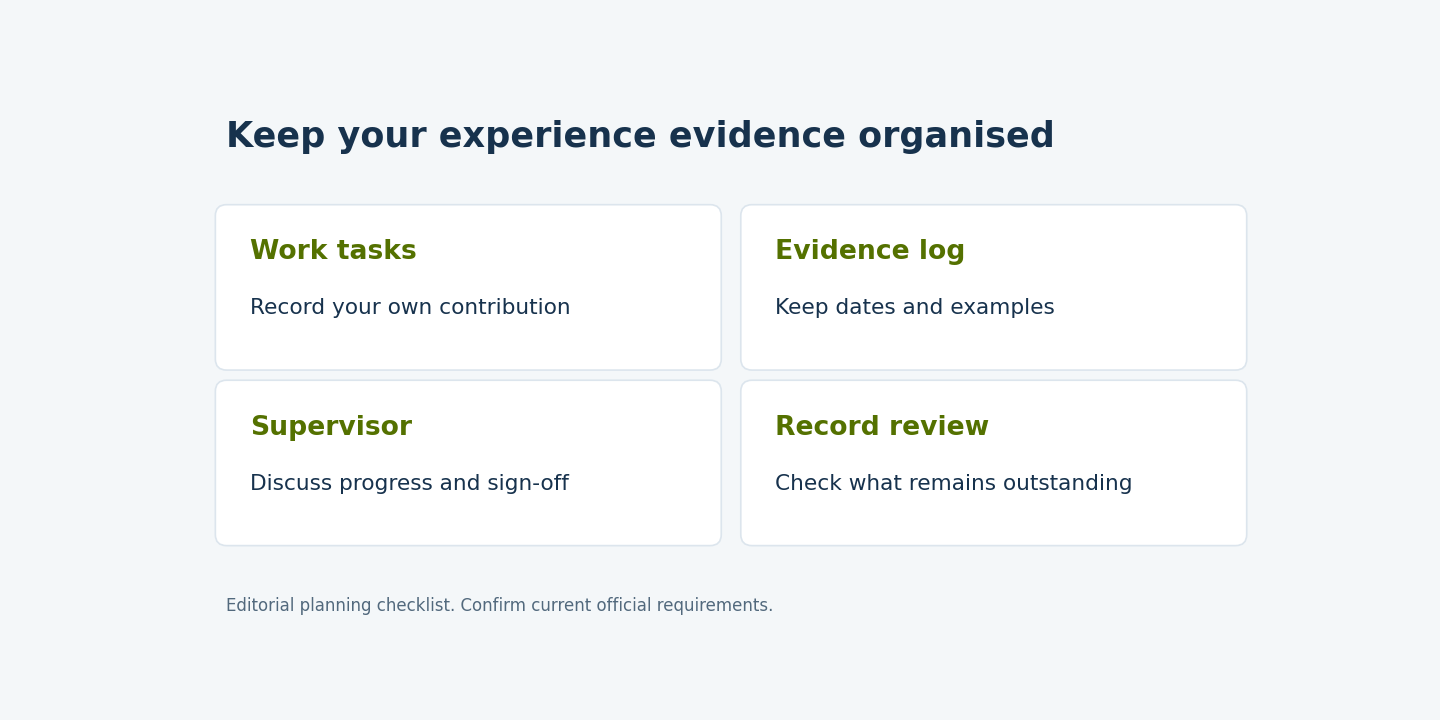
Check the work rather than the job title
A title such as accounts assistant, finance officer or analyst does not describe every task in a role. List the accounting and finance activities you actually perform. Separate relevant activities from unrelated duties and discuss the appropriate recording with your supervisor.
For example, a role involving transaction checks, reconciliations and reporting may provide different evidence from a role limited to general administration. Do not assume all elapsed employment time counts in full. ACCA’s practical-experience guidance explains how relevant time is assessed.
Arrange a supervisor discussion early
Before relying on a role for your experience plan, establish who can review your work and what they can sign off under the current rules. Time sign-off and performance-objective sign-off should be understood separately. If the appropriate supervisor is not clear, use ACCA’s current guidance rather than inventing a substitute.
Discuss how often you will review progress, what evidence is appropriate and how to raise questions when a task does not map neatly to an objective. Keep a record of the agreed process. A regular review is easier to manage than reconstructing several years of work when you leave a job.
Keep an evidence log without exposing employer data
For each useful activity, record the date range, your responsibility, the judgement involved and what you learned. Describe your own contribution. A generic description of what the whole finance department does does not establish your individual experience.
Respect employer confidentiality. Use anonymised descriptions in personal notes and follow workplace policies on access, copying and storage. Do not upload client ledgers, payroll files or confidential reports into public study groups to demonstrate a task.
Turn routine work into reflective evidence
Suppose you investigate a bank-reconciliation difference. Your reflection might cover how you identified the issue, which evidence you checked, who reviewed the proposed correction and how you improved the process afterwards. The useful part is the reasoning and professional behaviour, not simply the statement “I prepared a reconciliation”.
Ask your supervisor whether your explanation accurately represents the task and your contribution. Avoid claiming responsibility for work you only observed. Where you still need exposure to another area, discuss an appropriate opportunity rather than manufacturing an example.
Review before changing roles
When a move is likely, update your records and resolve outstanding discussions while the relevant people can still review your work. Keep legitimate contact arrangements for future queries, within the employer’s policy. If a supervisor becomes unavailable, seek official guidance about your options.
Use your experience log to improve your CV as well. A truthful explanation of a task, review process and result is more useful than a long list of software names without context.
Sources checked 13 October 2026: ACCA practical experience and ACCA student PER FAQs. The record-keeping examples are illustrative.
Plan your next step with ASA
Read the ACCA in Pakistan guide for the broader route, budget and city planning picture. Explore Abeel School of Accountancy and ASA courses. When you contact ASA, explain your starting qualifications, intended paper, city and available weekly study time. Ask about current teaching and access arrangements before enrolling.
Build a more detailed personal plan
Map a role to the work you actually perform
Start with a list of recurring responsibilities and identify the accounting or finance contribution in each one. Preparing a reconciliation, reviewing a variance and assisting with a report involve different skills and evidence. Record the tasks you personally completed, the information used and the review received. A job description can support this discussion but does not prove every listed duty was performed. If your role combines relevant and unrelated work, ask how relevant time should be recorded under current ACCA guidance. Keep the distinction between elapsed employment and qualifying experience clear from the outset.
Separate relevant time from performance objectives
Relevant time and performance objectives are related but distinct parts of the experience record. Completing a number of months does not by itself explain how you demonstrated the required behaviours and technical skills. Likewise, a strong example for one objective does not create the missing relevant time. Review both progress records during supervisor discussions. Identify the work already done, what remains incomplete and which upcoming tasks could provide suitable evidence. Avoid writing a generic statement that every requirement has been achieved simply because your role is busy. The record should support each requirement with the appropriate facts.
A reconciliation example without confidential data
Imagine you reconcile an account and identify a difference caused by a transaction recorded in the wrong period. A useful reflective record explains your responsibility, the checks performed, the issue identified, how you raised it and what you learned after review. It does not need to reproduce a client bank statement or private account number. This is an illustrative writing approach, not a declaration that one reconciliation automatically completes an ACCA objective. Discuss the relevance of the example with your supervisor. Use approved descriptions and keep employer records in the systems where they belong.
Write about your own contribution
Team results can be impressive, but the experience record needs to make your contribution clear. Describe the task you were responsible for and the judgement you exercised. If a senior colleague made the final decision, say how you supported it and what review occurred. Avoid copying a supervisor’s achievements into your own account. A concise explanation with a clear outcome is more useful than a long list of software and processes without context. Discuss whether the work demonstrates the intended objective and revise the record using actual feedback. Honest scope makes the evidence easier to assess.
Arrange supervision before a deadline
Identify an appropriate practical experience supervisor and discuss the relevant responsibilities early. Current ACCA rules determine who can sign off different elements, so a line manager’s job title alone does not settle eligibility. If the person reviewing your day-to-day work cannot sign off a particular element, investigate the permitted arrangement through official guidance. Schedule discussions while your work is recent and accessible to the reviewer. Waiting until you are about to leave a role can make clarification difficult. Keep the planned reviewer, next discussion date and unresolved questions in your tracker.
Use a monthly evidence routine
At a regular review point, note the tasks completed, problems encountered and lessons learned. Identify potential evidence for objectives and the questions you want to discuss. Keep notes proportionate: a useful record does not require a diary of every minute. Distinguish facts from interpretations, and avoid including sensitive documents merely to make the entry look substantial. Before recording a final statement, check whether it explains the situation, your contribution and the result. This routine can make later reflection more reliable because you are less dependent on memory from many months earlier.
Plan carefully when changing jobs
Before leaving a role, discuss outstanding time records and objective reviews with the relevant supervisor. Confirm what has been completed and which entries need further evidence. Retain permitted confirmation records through the official process. Do not copy confidential employer files to a private account as a precaution. At the new role, review the tasks and potential supervision again rather than assuming the previous arrangement continues. Different employers can offer different opportunities for experience. A job change may be beneficial, but the effect on your record depends on actual responsibilities and the current professional-body rules.
Choose development tasks with your manager
If your role provides limited variety, discuss whether appropriate additional responsibilities could support development. For example, supervised work on a reporting review or internal control issue may help you practise different skills. The task should be useful to the employer and within your competence, with suitable review. Do not take on access or responsibilities you have not been authorised to perform. Agree the expected output and feedback arrangement. Development is strongest when it connects real business work, learning and supervision rather than treating objectives as a checklist to be completed through invented projects.
Keep experience, ethics and licensing separate
Practical experience supports the professional membership route; it should not be described as automatically granting statutory audit or public-practice rights in Pakistan or another jurisdiction. Local licensing and regulatory conditions require their own checks. Ethics study is also a separate requirement under the current qualification. Maintain a clear record of examinations, ethics and experience so you can identify the remaining professional work. If a future role requires an academic degree or a particular licence, investigate that requirement directly. A professional designation can support career development without replacing every rule that applies to regulated work.
Frequently asked experience questions
Does an accounts job automatically satisfy PER? Review the actual tasks, relevant time and supervision. Can a course provider sign off work it has never supervised? The arrangement needs to meet official requirements; teaching alone does not establish oversight of your employment. Should I upload confidential client documents as evidence? Use permitted reflective descriptions and the official process while respecting employer confidentiality. Does passing the final examination complete membership? Examinations, ethics, experience and the membership process remain distinct. Use the current ACCA guidance when a case involves mixed duties, a supervisor change or uncertainty about the record.
More ACCA planning guides for Pakistan
- ACCA After Matric or O-Levels in Pakistan: Plan Your Starting Route
- ACCA Exam Booking in Pakistan: A Checklist Before You Pay
- ACCA Study Timetable for Working Students in Pakistan
- How Long Does ACCA Take in Pakistan? Build a Realistic Timeline
- Choosing Your Next ACCA Paper in Pakistan: A Practical Decision Worksheet