

An ACCA timeline in Pakistan should show more than an expected exam-completion date. Your entry route, confirmed exemptions, study capacity and progress towards membership all affect the plan. Two learners starting in the same month can finish different stages at different times.
This article offers a planning method rather than a guaranteed completion period. ACCA’s current qualification information separates exams, ethics and practical experience. Check the requirements that apply to you, including any transition guidance affecting your study plan.
Define the milestone you mean
Write down whether your target is your first exam pass, completion of a level, completion of the exams or membership. These milestones are different. A timetable labelled “finish ACCA” is hard to evaluate until you specify what completion means.
If you are comparing providers’ advertised timelines, ask which milestone the advertised period describes. Also ask what starting qualifications, exemptions, paper load and uninterrupted study assumptions it uses. A short advertised period may not describe the route you will actually follow.
Build from the confirmed starting route
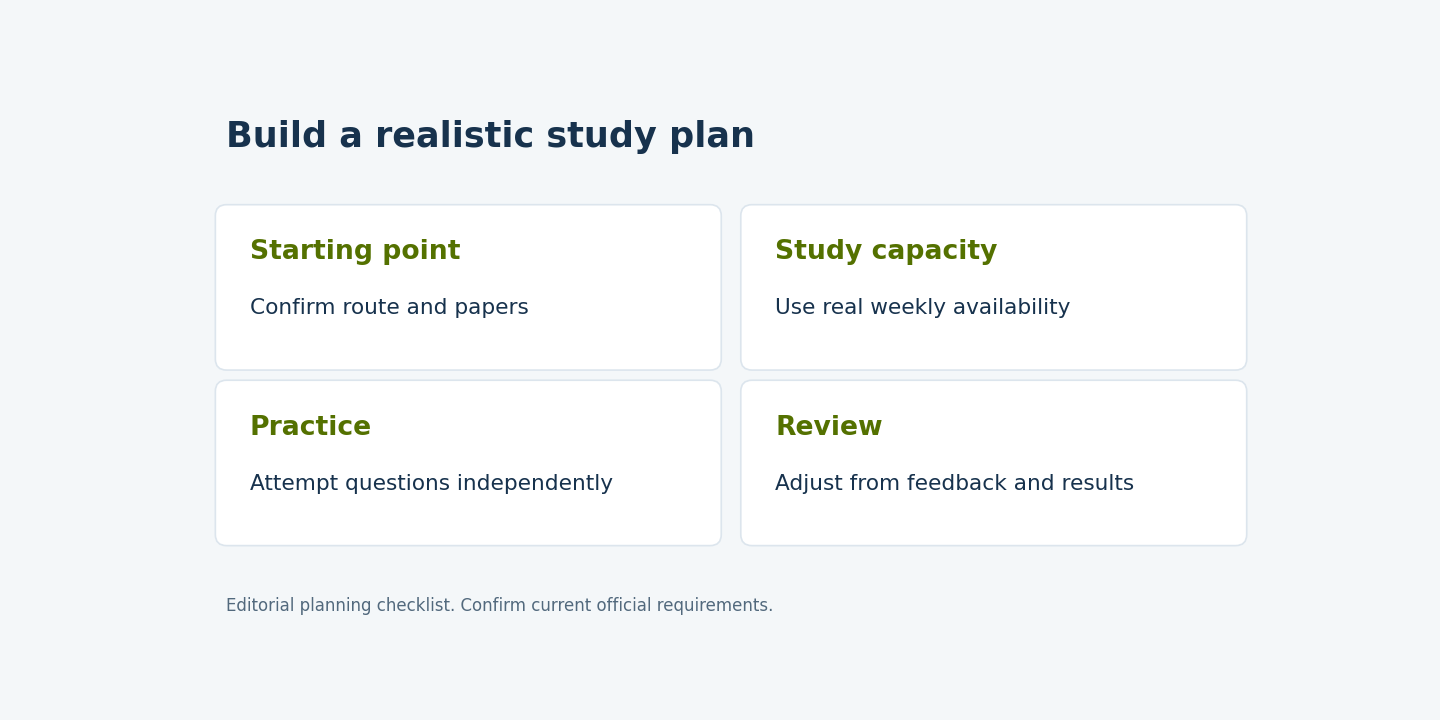
List the exams you need after your registration route and any exemptions have been confirmed. Mark where a decision is still outstanding. Do not remove a paper from your plan just because another graduate of a similarly named programme received an exemption.
For each remaining paper, identify the syllabus areas, tuition access period and practice work you expect to complete. Your first version can be provisional. Update it after an independent question attempt reveals how much preparation you need.
Use your real weekly capacity
Measure what you can complete over two ordinary weeks. Record learning, independent questions and review separately. If work travel or college assessments reduce your available sessions, reflect that reduction in the next part of the calendar.
For example, a working learner might discover that the planned weekend session is repeatedly lost to overtime. Moving that session to a reliable morning slot may improve the plan. If no replacement slot exists, taking fewer simultaneous papers may be more realistic than expecting an expanding backlog to disappear.
Add review points and recovery space
A useful plan contains dates on which you assess progress, not just dates on which you hope to sit exams. At a review point, look at coverage, independently attempted questions, repeated errors and feedback. Decide what needs to change before you commit to the next milestone.
Leave room for a resit, illness, work peak or family commitment. This does not mean expecting failure. It means recognising that a qualification is a sustained project and that a single interruption should not invalidate the entire plan.
Track practical experience separately
If membership is your objective, use ACCA’s current practical-experience guidance alongside the exam calendar. Relevant work, documentation and appropriate supervisor sign-off need their own tracking. Do not equate time in any job with approved relevant experience.
A simple timeline can therefore have three tracks: exam preparation and booking; ethics or other required development; and practical experience and evidence. Identify the person or official process that can confirm each requirement.
Questions to ask when a timeline changes
Which milestone moved? Was the cause workload, exam readiness, booking availability or an unresolved requirement? What is the next achievable checkpoint? Answering those questions turns a delay into a revised plan rather than an unsupported promise to catch up immediately.
Sources checked 13 October 2026: ACCA qualification structure and ACCA practical experience. The timeline method and examples are editorial guidance.
Plan your next step with ASA
Read the ACCA in Pakistan guide for the broader route, budget and city planning picture. Explore Abeel School of Accountancy and ASA courses. When you contact ASA, explain your starting qualifications, intended paper, city and available weekly study time. Ask about current teaching and access arrangements before enrolling.
Build a more detailed personal plan
Build two timelines instead of one
Keep an examination timeline and a membership timeline. The first shows study and intended sittings; the second also shows ethics, relevant work and the evidence needed for experience. If the two are merged into a single finish date, it is easy to overlook a requirement that does not involve an exam. Write the assumptions beside each date so a change can be traced. For example, a proposed exam date might depend on completing tuition and receiving feedback by a particular week. A membership estimate might depend on obtaining relevant work and arranging supervision. These assumptions need separate reviews.
A fictional examination planning example
Imagine a student with six confirmed examinations remaining who intends to attempt one paper in each quarterly sitting. Six consecutive sittings are roughly eighteen months of examination opportunities. That arithmetic is only an illustration, not a claim about how long this person will take: readiness, progression rules, results and any transition can change the sequence. If one sitting is missed, the plan needs revision. If a resit is needed, decide how it fits alongside the remaining work. Do not schedule a second paper merely to restore the original headline date without checking whether the combined preparation is realistic.
Account for the foundation stage
A school leaver using the Pakistan Foundation Diploma has preparatory study before the main qualification progression. Record that stage explicitly rather than describing the main examination count as the complete journey from school. Confirm the award requirements and transfer arrangements, then plan the initial papers around current readiness. Some learners need additional practice with numerical work, English comprehension or basic accounting. Those sessions belong in the timeline. A route can be administratively available while still requiring a careful learning plan. Review progress after the first independent attempts instead of assuming everyone completes the preparatory stage at the same speed.
Use learning evidence to estimate preparation
Estimate preparation from the syllabus areas remaining and the quality of recent attempts. If you have not yet tried representative questions, the estimate is provisional. A learner who remembers lecture examples may need substantial practice with unfamiliar scenarios. Record separate tasks for concept learning, basic questions, mixed practice and timed work. Ask how long marking feedback takes and include time to act on it. The timetable should end with evidence of readiness, rather than the last video in a course. This method does not predict a guaranteed pass; it makes the assumptions visible enough to improve the plan.
Check the effect of exemptions
Confirmed exemptions change the examination list, but their effect on time depends on the papers remaining and prerequisite knowledge. A graduate with several exemptions may still need targeted revision before advanced study. Put that revision in the calendar instead of treating credited subjects as knowledge that cannot fade. If a degree programme is also a goal, check its eligibility requirements before making an exemption decision. The University of London route has conditions different from the professional examination route. Review the relevant guides and official decisions together so a fast examination plan does not accidentally conflict with an academic objective.
Fit employment and experience alongside study
Working while studying can allow relevant experience to develop during examination preparation, but the role must actually provide relevant tasks and appropriate recording. Discuss responsibilities and supervision before treating a job as a complete experience plan. Work can also reduce available study hours, especially during deadlines and reporting periods. The combined plan should reflect both effects. Protect a smaller dependable routine when necessary, and keep an evidence log of your own work contribution. Do not assume an employment start date is automatically the same as a date from which every month counts in full toward professional experience.
Include financial timing in the calendar
A study timeline is also a payment timeline. Registration, subscriptions, tuition and examination entry can fall at different points. If the intended sitting depends on funds that are not yet available, record that dependency rather than hiding it in a target date. Compare the due dates with your expected income or sponsorship arrangement. Allow for foreign-currency payment changes where relevant and use current quotations. A longer preparation period can add recurring costs, but a rushed sitting may also lead to further expense. Use the fee guide to compare realistic routes instead of assuming the shortest calendar is always the cheapest option.
Review after a result or a missed study period
After a result, identify what it changes. A pass may allow progression to the intended next paper; an unsuccessful attempt needs analysis before another booking. Review missing knowledge, application, timing and examination technique separately. After illness, overtime or a family interruption, revise the remaining tasks against the weeks available. Keeping the original date can be sensible only if the revised work still fits. A plan should explain the next decision and its evidence, rather than label every delay as failure. Discuss the new workload with a tutor using actual attempts and feedback instead of an unsupported promise to catch up.
Questions about completion dates
Can a provider guarantee that every student finishes in the same period? A shared teaching schedule does not establish identical individual progress. Does finishing the exams mean experience is complete? No: the experience record needs a separate check. Do exemptions remove every other requirement? They affect specified examinations, not the entire membership process. Should I postpone all study for the 2027 changes? Use the official transition tool and your actual record to decide. Keep the current syllabus, intended sitting and recognised credit clear. The useful output is a revisable personal timeline with assumptions, costs and review points, not one universal duration claim.
More ACCA planning guides for Pakistan
- ACCA After Matric or O-Levels in Pakistan: Plan Your Starting Route
- ACCA Exam Booking in Pakistan: A Checklist Before You Pay
- ACCA Study Timetable for Working Students in Pakistan
- ACCA Practical Experience in Pakistan: Keep Evidence and Supervisor Sign-Off on Track
- Choosing Your Next ACCA Paper in Pakistan: A Practical Decision Worksheet