
Quick answer: Use AI for ACCA revision to explain a difficult idea, ask follow-up questions and organise errors. Verify technical answers against your current syllabus, study materials and ACCA guidance, then prove understanding through an independent attempt.
Reviewed 14 November 2026. This is an ASA study method, not a claim that a general chatbot is an official examiner or approved marking service.
Give the tool a precise learning task
Begin with the paper, syllabus period, topic and the point you cannot explain. A broad request to “teach me ACCA” produces a different result from asking why a particular adjustment affects profit. Use the ACCA modules overview to identify your paper before choosing study support.
Example prompt: “I am revising ACCA FR. Explain the difference between an accounting policy and an accounting estimate using an original short scenario. Ask me to decide first. Then explain the reasoning and identify which details I should verify in my current materials.”
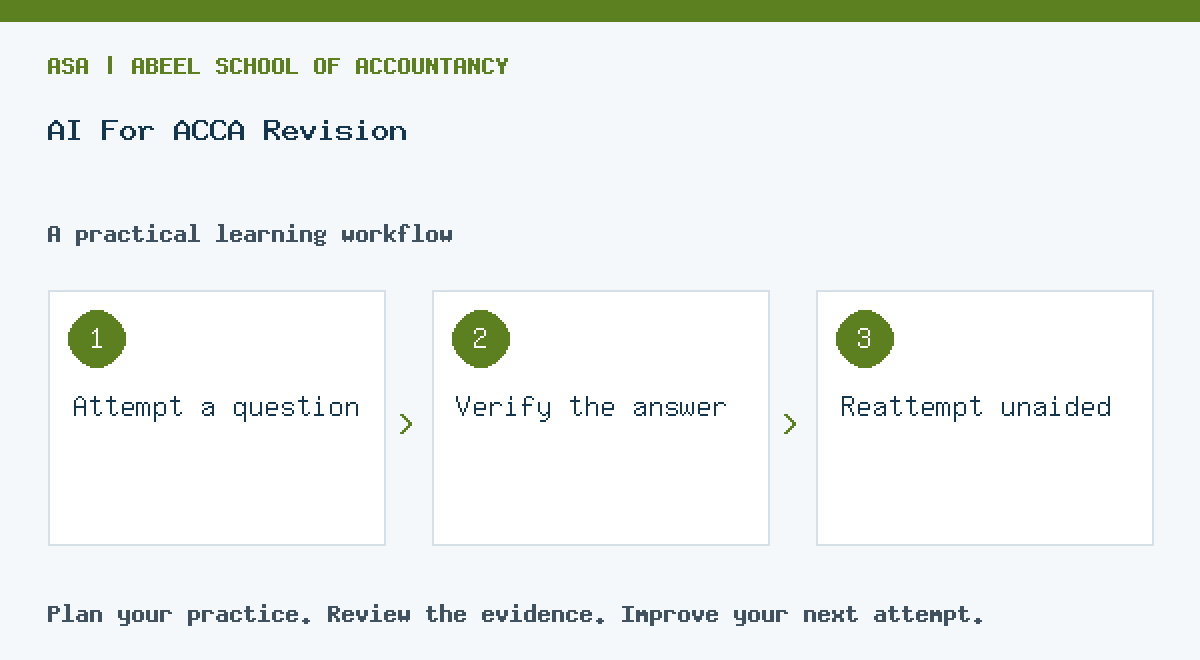
Use an attempt–explain–verify–reattempt cycle
- Attempt: answer a question independently and save your workings.
- Explain: describe the step you found difficult and ask for a focused explanation.
- Verify: compare the explanation with the relevant syllabus, reliable study text and official guidance.
- Reattempt: solve a different question without the chatbot or model answer.
Do not treat a confident explanation as evidence that a calculation or accounting treatment is correct. Check assumptions, dates, units, sign conventions and omitted facts. If a claimed source cannot be located, keep the point unverified and ask a tutor.
Build an error log that leads to action
| Error | Diagnostic question | Next action |
|---|---|---|
| Wrong calculation | Was the rule or the input wrong? | Rework from the original facts |
| Generic written answer | Which scenario detail supports this point? | Rewrite with a clear business implication |
| Slow completion | Where did the time go? | Practise one timed requirement |
Ask AI to classify your own notes into these headings, but review its classification. Avoid uploading employer records, confidential client material or restricted question-bank content. Use an invented example when you only need help with a concept.
Example: challenge the answer, not just its wording
Suppose an explanation says every favourable variance means good performance. Ask for a counterexample: cheaper material may reduce purchase cost while increasing waste or rework. Then identify what information a manager would need before judging performance. The learning goal is to test the reasoning rather than memorise a polished sentence.
Keep official resources in the process
Use ACCA Study Hub and the exam-support resources for your paper. ACCA has published information about an AI assistant trial in PM for September 2025–June 2026; that historical trial does not establish availability for every paper or current session. Check the tools actually available in your account.
Follow your examination regulations. Revision with AI does not authorise assistance during an exam. For independent practice, check the papers available in ASA mock practice.
Plan the qualification as well as the next question
Students following ACCA in Pakistan or studying from the Gulf should keep a record of passes, exemptions and intended sessions. Use our 2027 qualification changes guide alongside ACCA’s official transition resources; asking AI to invent your paper mapping is not a reliable plan.
Can AI mark my answer accurately?
It can suggest issues to investigate, but its score is not an official result. Compare feedback with the marking guide and seek tutor review for unresolved technical points.
Explore Abeel School of Accountancy for tuition and paper-specific guidance.
Source: ACCA’s published Study Hub AI trial announcement.
Choose practice for your ACCA paper
Use the ASA course study guides to turn your revision error log into a subject-specific practice plan. Start with Financial Reporting preparation, Audit and Assurance answer practice, Financial Management study methods or Performance Management interpretation. Each guide links to the relevant original course for tuition and enrolment details.