
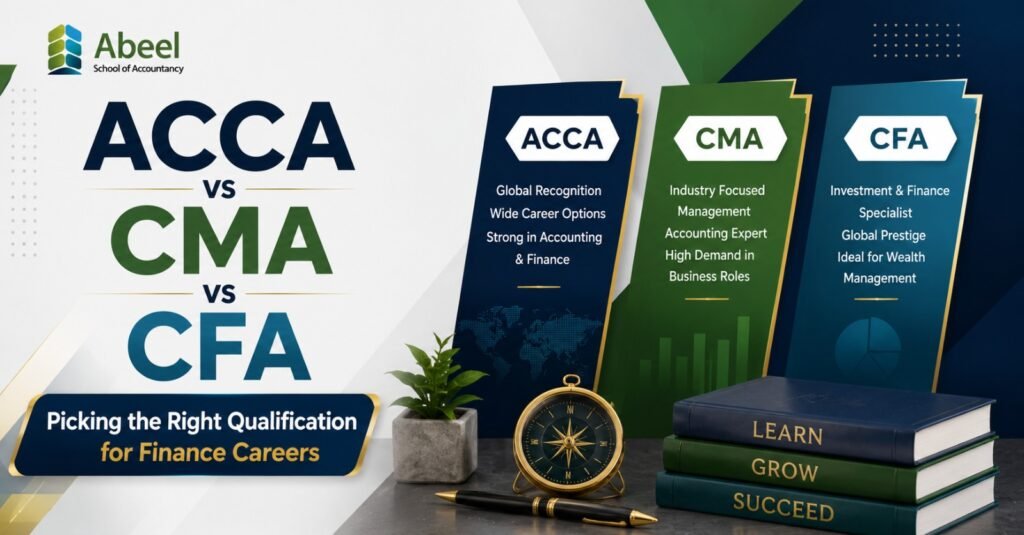
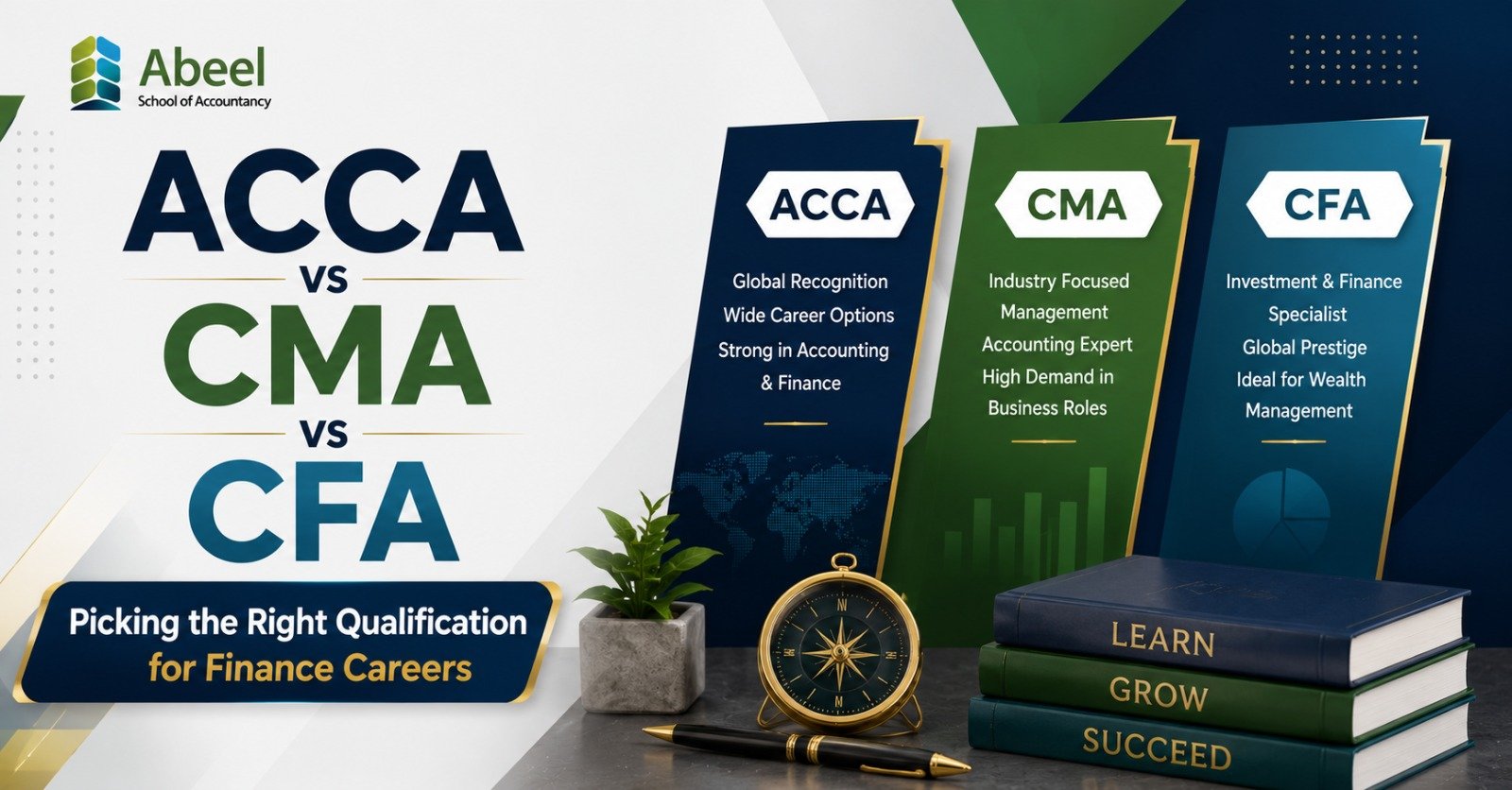
ACCA vs CMA vs CFA Three letters, three completely different careers, and one genuinely confusing decision. ACCA, CMA, and CFA all get lumped together in “best finance certifications” listicles as though they’re interchangeable options competing for the same job, when in reality they’re built for three distinct corners of the finance world. Picking based on which one sounds most prestigious, rather than which one actually matches your career direction, is one of the more expensive mistakes a finance student can make.
At Abeel School of Accountancy, we specialize in ACCA, and we’ll be upfront about that. But a genuinely useful comparison means being honest about where ACCA is the right fit and where CMA or CFA might actually serve you better. This guide breaks all three down fairly, so you can choose based on your actual career goal, not marketing.
What Each Qualification Actually Focuses On?
ACCA (Association of Chartered Certified Accountants) is built around broad accounting and finance competence: financial reporting, audit and assurance, taxation, corporate law, and strategic business leadership. It’s designed to produce well-rounded finance professionals capable of working across accounting, audit, and corporate finance functions.
CMA (Certified Management Accountant, administered by the Institute of Management Accountants) focuses specifically on management accounting and internal strategic decision-making: cost management, budgeting, financial planning and analysis, and risk management, aimed squarely at professionals who’ll influence how a business makes internal financial decisions rather than external reporting.
CFA (Chartered Financial Analyst, administered by the CFA Institute) goes deep into investment analysis, portfolio management, and valuation. It’s built for people who want to work directly with markets, securities, and investment decisions, not general accounting or business finance.
Structure and Duration Compared
ACCA currently runs 13 papers across three levels (dropping to 11 under ACCA’s confirmed 2027 restructure), typically completed in three to four years, with four exam sittings a year offering genuine scheduling flexibility. CMA is comparatively the fastest and most streamlined of the three, just two exam parts, Financial Planning, Performance, and Analytics, and Strategic Financial Management, which can realistically be completed in under a year of focused study, though most candidates take two to three years when factoring in the required work experience. CFA is the most demanding structurally: three sequential levels, each requiring a full exam window to attempt, generally taking two to four years minimum, plus a separate requirement of four years of relevant professional experience before the charter is actually awarded.
Cost Compared
Costs vary by currency and region, but the relative comparison holds fairly consistently. ACCA’s total cost, combining global registration and exam fees with tuition, typically runs in a moderate-to-mid range depending on your tuition provider and any exemptions claimed. CMA is generally the least expensive of the three to sit, with IMA membership and exam fees for each part coming in comparatively lower, particularly for students or academic members. CFA sits at the higher end once you account for registration and exam fees across all three levels, plus the substantial cost of prep materials most candidates invest in given how rigorous the exams are.
Difficulty and Pass Rates
This is genuinely where the three diverge most sharply. CFA has a well-earned reputation as the most academically demanding of the three, with historically low pass rates across all levels and a curriculum that rewards deep, sustained study over a long runway. ACCA’s pass rates vary considerably by paper, generally sitting in a moderate range, with the qualification’s real difficulty concentrated at Strategic Professional level rather than spread evenly throughout. CMA, with only two parts, is often considered the most accessible structurally, though its content on strategic financial decision-making is far from trivial, it’s simply concentrated into fewer, more focused exams.
Where Each Is Recognised Most
Geography matters more than most comparisons admit. ACCA carries particularly strong recognition across the UK, the EU, Singapore, the UAE, and a wide range of Commonwealth and African markets, alongside strong local demand in Pakistan specifically. CMA is most strongly recognized in the United States, the Middle East, and India, making it a genuinely strong choice for students specifically targeting those markets. CFA’s strongest recognition sits within the global investment management industry itself, concentrated heavily in financial hubs like the US, Canada, and Hong Kong, regardless of which country you’re based in, since the charter is respected specifically within investment circles worldwide.
Which Career Paths Actually Fit Each Qualification
If your goal is audit, financial reporting, broad corporate finance, or a career that could plausibly move between countries and industries, ACCA’s breadth is a genuine advantage, it opens roles across accounting firms, multinational corporations, and tax advisory work. If your goal is management accounting, cost control, budgeting, and internal strategic decision-making, often on a track toward a controller or finance director role focused on how a business runs internally, CMA is built specifically for that. If your goal is investment banking, asset management, equity research, or portfolio management, work that lives and breathes markets and valuation, CFA is the qualification employers in that specific world actually expect to see.
Can You Combine Them?
Yes, and it’s genuinely common among ambitious finance professionals. ACCA plus CFA is a frequent pairing, ACCA builds strong financial reporting and business fundamentals first, with CFA adding analytical depth in valuation and investment decision-making afterward. CMA plus CFA is another common combination for professionals who want both internal strategic finance skills and investment analysis capability. Attempting two simultaneously is genuinely demanding and best avoided unless one foundation is already solid, but sequencing them thoughtfully over a career is a well-worn, sensible path for people aiming at senior finance leadership.
So Which Should You Actually Choose?
Ask yourself honestly: Do you want broad exposure across accounting, audit, and corporate finance, with genuine international mobility? ACCA. Do you want to specialize specifically in internal strategic and management accounting, particularly if you’re targeting the US, Middle East, or Indian markets? CMA. Do you want to work directly in investment markets, valuation, or portfolio management, and you’re prepared for a genuinely rigorous, multi-year commitment? CFA. There’s no universally “best” answer here, only the answer that matches where you actually want your career to go.
Why We Focus on ACCA at Abeel School of Accountancy
For students whose goal aligns with ACCA’s strengths, broad accounting competence, audit, financial reporting, and genuine international career flexibility, particularly relevant given the qualification’s strength across Pakistan and a growing footprint of African markets, this is exactly where our expertise is concentrated. It’s also worth knowing that ACCA is undergoing a significant restructure from September 2027, reducing from 13 papers to 11 with deeper integration of AI, data analytics, and sustainability, current exams remain valid through June 2027, which is worth factoring into your timeline if ACCA is the direction you’re leaning toward.
Customised Planning, Whichever Path Fits You
Every student at Abeel School of Accountancy gets a customised study planner built around their specific goals, exemptions, and timeline, including how the 2027 ACCA changes affect their sequence, so your decision to pursue ACCA is backed by a plan mapped to you specifically, not a generic timetable.
The One Feature No Other Institute Offers
Abeel School of Accountancy is the only institute that runs a dedicated weekly live revision session for every paper, combined with a smart course completion system and direct tutor support, a structure not currently offered by any other ACCA tuition provider. The completion tracker monitors genuine topic mastery based on mock exam performance, the weekly revision session targets exactly what’s weak, and direct tutor access means your questions, including whether ACCA genuinely fits your goals compared to CMA or CFA, get answered by someone who actually understands your situation.
A Genuinely Global Presence
Abeel School of Accountancy supports students through multiple nationwide and global positions, spanning Pakistan and a fast-growing footprint across African markets including Nigeria, Kenya, Tanzania, Zimbabwe, South Africa, Egypt, and beyond, all built on this same structured system, with a consistent track record of exceptional pass rates.
Getting Started
If you’ve decided ACCA is the right fit after weighing it against CMA and CFA, the next step is a direct conversation about your exemptions, timeline, and a customised study plan. You can learn more about our teaching approach and faculty, read about our lead instructor, or visit the Abeel School of Accountancy website directly to book a free consultation before enrolling.
Frequently Asked Questions
What’s the main difference between ACCA, CMA, and CFA?
ACCA covers broad accounting, audit, and financial reporting; CMA focuses on management accounting and internal strategic decision-making; CFA specialises in investment analysis and portfolio management.
Which is the fastest to complete: ACCA, CMA, or CFA?
CMA is generally the fastest structurally, with just two exam parts, while ACCA typically takes three to four years and CFA usually takes at least four years including the required professional experience.
Can I combine ACCA with CFA or CMA?
Yes, this is a common and sensible pairing for professionals aiming at senior finance roles, though it’s usually best to build one qualification’s foundation before layering on another.
Which qualification has the best global recognition?
It depends on region. ACCA is particularly strong across the UK, EU, Africa, and Pakistan; CMA is strongest in the US, Middle East, and India; CFA is respected globally specifically within investment management circles.
Is ACCA changing in 2027, and does that affect my decision?
Yes. ACCA is reducing from 13 to 11 papers from September 2027, with deeper AI, data analytics, and sustainability integration. Current exams remain valid through June 2027, worth factoring in if you’re choosing ACCA now.
What makes Abeel School of Accountancy different for ACCA students specifically?
Abeel School of Accountancy is the only institute offering weekly live revision sessions combined with a smart course completion system and direct tutor support, backed by a customised study planner, multiple nationwide and global positions, and a track record of exceptional pass rates.
How do I know if ACCA is genuinely the right choice for me?
You can book a free consultation through Abeel School of Accountancy to discuss your career goals honestly and get guidance on whether ACCA fits, along with a customised study plan if it does.
Weighing ACCA against CMA or CFA and want honest guidance rather than a sales pitch? Abeel School of Accountancy offers a customised study planner and the only weekly revision system with smart course completion and direct tutor support for ACCA students, backed by exceptional pass rates across our nationwide and global positions.