

A Ghanaian applicant comparing WASSCE, SSSCE, advanced-level study or university-related routes should use the exact current ACCA entrance entry. Subject combinations and results can matter. A certificate label or a friend’s successful application should not replace the check for your own documents.

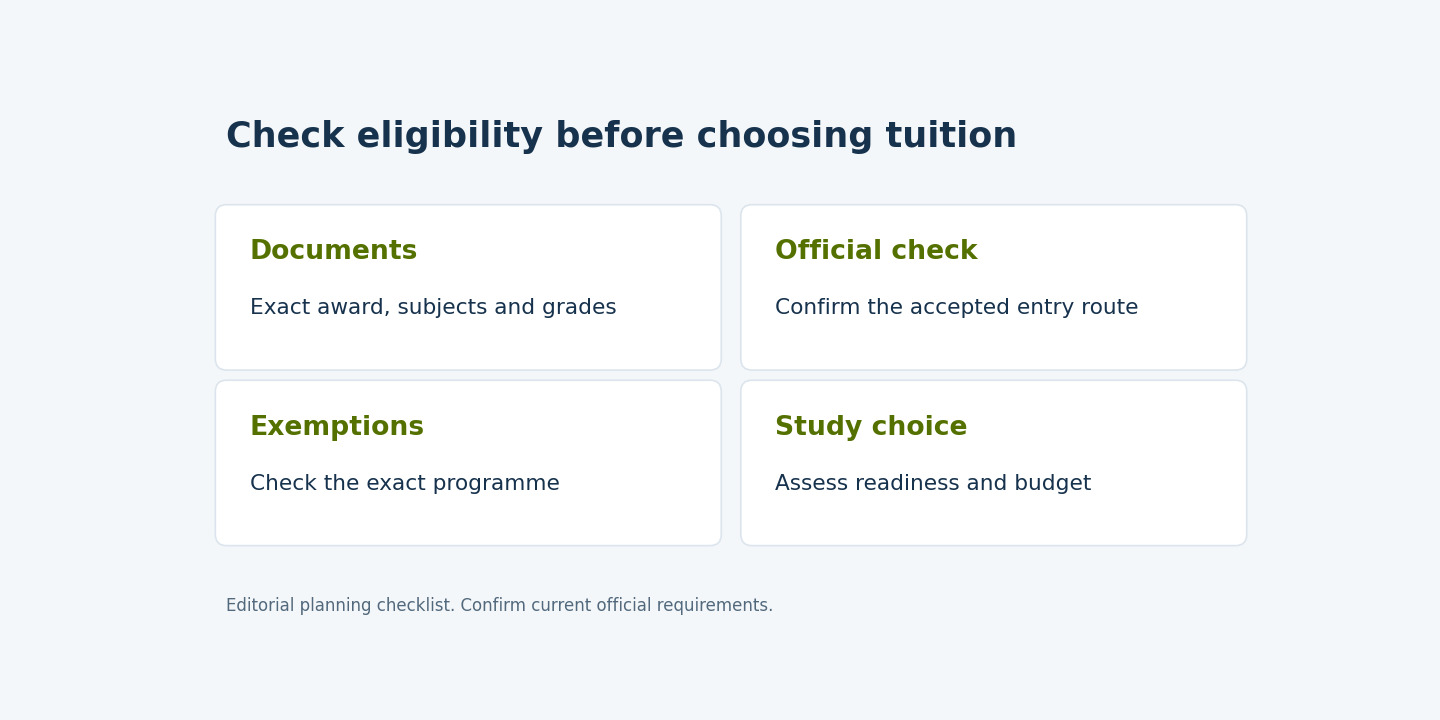
Build the record before choosing a course
Gather the certificate, detailed results and awarding information. Record the completion date and any document still pending. Use the full names shown on the documents instead of an informal qualification nickname.
If part of your education was completed in another system, check that award on its own terms. Your present residence does not turn an overseas qualification into a local school certificate. Ask for official clarification when a combination does not clearly match a published route.
Make unresolved questions visible
Keep a short list of decisions still needed: document completeness, qualification match, registration route, exemption position or intended paper. Mark each item as confirmed, pending or requiring clarification. Do not build the first tuition purchase on the most favourable possible answer to every pending item.
A learner can make a private sheet listing the award, subjects, grades and the official conditions they are trying to match. Any uncertain equivalence should remain a question for official clarification rather than a grade conversion invented for the application.
Separate registration from exemptions
An entry decision and an exemption decision answer different questions. Where relevant prior study may attract exemptions, use the correct institution, programme and completion details in ACCA’s official process. Keep the actual outcome rather than relying on a maximum-exemption advertisement.
An exemption can remove an exam requirement while leaving a need to refresh supporting knowledge. Try a short independent accounting question and identify what you can explain without the solution. Discuss the weak area with a tutor before selecting a heavier paper load.
Plan a realistic first study period
Put work, college, travel and family commitments on the calendar. Protect separate time for learning, active questions and reviewing mistakes. Include a recovery slot so one interrupted evening does not move the whole plan indefinitely.
Use a demo lesson to test the teaching language, pace and format. Then attempt a task independently. If following the lecturer is easier than answering a fresh requirement, ask about the course’s practice and feedback arrangements.
Compare costs and access terms
Request the current tuition charge, currency, payment recipient, access duration and included services. Keep external qualification charges separate. Read any transfer, deferral or refund conditions before paying.
For online tuition, test the actual platform on your normal device and connection. Confirm live-session times and recording access. For a classroom option, verify the actual address and timetable. Do not assume a local ASA branch follows from a country guide.
Check exams independently
Use ACCA’s current exam availability and booking instructions for the intended paper and location. Tuition enrolment does not complete exam entry, and online lectures do not establish remote exam eligibility. Keep the confirmed booking, payment record and reporting instructions with your private study files.
Discuss the next decision with ASA
Explore Abeel School of Accountancy and ASA course options. Contact ASA with your qualification details, location, intended paper and dependable study sessions. Confirm the actual course format and access terms before enrolling.
Sources checked 13 October 2026: ACCA minimum entrance requirements, exemption guidance and exam booking. Examples are illustrative planning suggestions. Editorial draft: verify the matching ASA country hub, overlapping posts and local delivery before publication.
Read Ghana’s subject conditions carefully
The official ACCA entry table treats Ghana’s school qualifications with specific subject and grade conditions. Its SSSCE and West African Senior School Certificate Examination entry describes six distinct subjects and includes English Language and Mathematics, with additional grade and alternative conditions in the full listing. Read that complete entry against your certificate. A general claim that every WASSCE holder qualifies would leave out important information.
The same table distinguishes the Basic Education Certificate Examination from later educational routes and lists university-related and advanced-level entries separately. This means an applicant should identify the actual award before discussing tuition. A broad statement such as “I finished school” is a useful starting point for a conversation, but it is not enough evidence for a qualification assessment.
Make a subject-by-subject comparison
Start a private results sheet with the full qualification name and examination year. Record each subject and its grade exactly as awarded. Identify English Language and Mathematics clearly, then compare the whole set with the applicable official conditions. If a row in the table contains an alternative or exception, read it in full rather than borrowing a single phrase that appears to support your preferred answer.
Do not invent a conversion between letter and numerical grades. If you have a mixed educational record, present the documents and ask ACCA which combination can be assessed. This is especially useful when qualifications were obtained in different systems. Your current residence in Ghana does not make an overseas award identical to a Ghanaian certificate.
| Information | What to record | Why it helps |
|---|---|---|
| Award | Exact certificate and awarding organisation | Identifies the official entry to compare |
| Results | Each subject and original grade | Supports a complete subject-condition check |
| Dates | Examination year and any separate awards | Keeps different records distinguishable |
| Uncertainty | The specific condition you cannot match | Makes the official enquiry focused |
A fictional example of a useful enquiry
Akosua is a fictional learner comparing study options after school. She writes down her subjects and results and notices that she cannot confidently interpret one part of the current entry listing. Instead of asking “Am I eligible?” without context, she identifies the qualification, examination year and precise condition she needs explained. She asks through ACCA’s official support route and retains the response with her planning notes.
While that question is pending, Akosua can test demonstration lessons and compare teaching styles. She avoids a large non-refundable purchase whose paper list assumes a particular outcome. When the starting stage is confirmed, she asks for tuition that matches that stage. This example illustrates an enquiry process; it does not describe a real ASA student or guarantee that any particular result combination will be accepted.
A second fictional learner, Kwame, has university study and asks about exemptions. His useful record includes the institution, programme and relevant completion details. He should not take Akosua’s school-entry comparison as his exemption decision. Their questions concern different evidence, even if they eventually attend a similar class format.
Separate three decisions before planning the first paper
The first decision is your starting route. The second is whether earlier learning attracts exemptions. The third is how to study the papers you actually need. Keeping them separate helps you avoid buying tuition for a paper that may not belong in your final plan. It also prevents a provider’s course-access policy from being confused with official registration or exemption rules.
Use a decision log with the date, evidence and next action for each question. A pending exemption check should stay pending until the relevant outcome is available. A tuition offer should record its own access duration and services. An exam booking should have its own confirmation. When something changes, revisit the affected decision rather than assuming the entire route has been settled by one conversation.
Compare study options with the same questions
Ask each provider which exact paper and syllabus period the course covers, how lessons are delivered and how you can obtain help. Request an example of the practice and feedback process. A course with individual marked answers offers a different service from one that mainly supplies recordings and model solutions. Either description should be clear enough for you to decide whether it matches your needs.
For live online classes, confirm the actual local start time and recording access. For classroom options, verify the actual address and timetable. This article does not establish a local ASA branch in Ghana. If you are considering ASA teaching, ask which formats are currently available to you and test the platform before enrolling.
Use a demonstration lesson actively. After watching, attempt a fresh task without keeping the model solution open. Write down what you could explain independently and where you became stuck. Ask how the provider would help with that specific difficulty. “Can you mark my written answers?” is a more useful question than “Are the lectures good?” when written feedback is the support you need.
Build a first-stage budget rather than guessing a lifetime total
Start with the next confirmed stage and list tuition, external qualification charges, materials, connectivity and any confirmed exam travel separately. Put a date and currency beside every amount. A fee quotation is only meaningful when you know what it includes, who receives payment and how long the access lasts. Keep exchange-rate assumptions visible if more than one currency is involved.
Ask what happens if your paper list changes after an official decision, if you miss live lessons or if your work timetable makes attendance difficult. Record the transfer, deferral and refund conditions before paying. These conditions are provider-specific; an old blog statement should not be treated as a current contract term.
Use a weekly cycle of learning, practice and review
Protect a learning session, an independent-question session and a review session each week. The exact hours should reflect your actual commitments. A learner working irregular shifts may need flexible sessions; a full-time college learner may need to avoid examination clashes. Add a recovery slot rather than assuming every planned evening will remain free.
Keep an error log with the question attempted, the reason for the mistake and the next action. For example, a calculation error may need a method check, while an incomplete explanation may need practice interpreting the requirement. Review the log before the next task. This turns a mistake into a targeted practice decision rather than simply repeating the same lesson.
Frequently asked questions
Can I check ACCA entry from the certificate name alone?
The certificate name identifies the route to investigate, but subject and grade conditions can also matter. Compare the full Ghana entry and obtain official clarification for an uncertain match.
Does a foundation route mean I cannot progress?
ACCA identifies foundation-level awards as a starting option for people who cannot enter the ACCA Qualification directly. Ask for the current starting and progression information before selecting tuition.
Is tuition enrolment the same as exam entry?
No. Confirm the current booking procedure and examination options for your paper and location. Keep the actual exam confirmation separately from course enrolment.
What should my ASA enquiry include?
Use the page’s enquiry form for teaching questions, describing your qualification, current stage, intended paper, location and reliable study hours. Do not share passwords or publish identity documents in a comment. ACCA handles official admission and exemption assessment. Visit the ASA home page for teaching information and ask about the course format and terms available to you.