
Name the learning and career outcomes separately
A learner considering ACCA in Saudi Arabia should be able to explain both what they want to study and why the learning matters for the role they want. A broad qualification label is not enough to describe either decision. List the target responsibilities, your current knowledge and your official qualification status. This creates a basis for choosing a paper without assuming that tuition enrolment resolves employment, professional-registration or other local requirements.
Match the exact diploma or school qualification
ACCA’s entrance database differentiates between Saudi awards, including technical-college and secondary vocational qualifications. Do not shorten those names until they appear equivalent. Keep the awarding institution, programme, duration and results available for the official assessment. For university study, check any exemption decision against the exact programme and relevant year. An entry assessment, an exemption award and your readiness for a more advanced paper should be recorded as distinct questions.
Confirm a centre appointment before arranging your attempt
The reviewed ACCA availability table lists centre-based examination options for Saudi Arabia. Check the current route for your intended paper and the appointments available in the official booking process. Country-level provision does not reserve a place or establish that every paper is offered at every centre. Once booked, follow the actual instructions for identification, timing and attendance. Keep the exam-entry confirmation apart from any course invoice or tuition-access message.
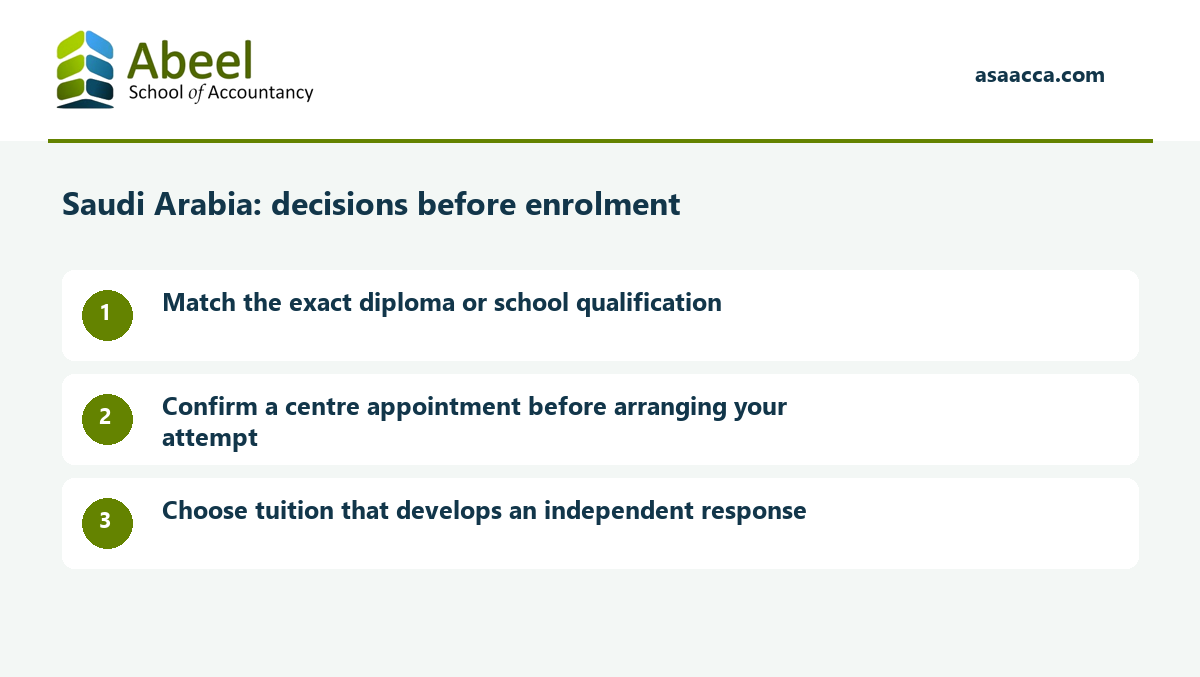
Choose tuition that develops an independent response
Use a demo lesson to assess explanation and language, then attempt a related question without the tutor’s answer in front of you. Ask how written work is reviewed and what support is available when you misunderstand a concept. Compare access duration and revision arrangements for the exact batch. If a provider advertises professional skills or mock practice, clarify how those elements are taught and assessed rather than treating a long list of features as proof of learning quality.
Build a role-based development record
For a reporting or finance role, note the tasks you can perform and the systems or evidence that support your description. Keep confidential business information out of any portfolio or public enquiry. If your goal involves a regulated accounting activity, use the relevant Saudi authority’s current requirements rather than relying on the status of a professional qualification alone. This article does not make a claim that an ACCA student, affiliate or member automatically receives every local professional permission.
Review the plan when your circumstances change
Your paper sequence, work commitments and official status may change over time. Review the timetable and budget at each meaningful decision point instead of continuing with an old package assumption. Separate recurring official fees, examination entries and optional tuition costs. Use the ASA foundation and career guides below to organise your questions, and take eligibility or booking matters to ACCA through the official routes. A clear record of decisions is more useful than a promise of a universal completion time or salary.
Build on the ACCA foundations
Official references for this guide
Separate the examination decision from the professional-role decision
A student choosing an ACCA paper and a professional assessing eligibility for a particular job are asking different questions. For the first, establish entry status, the correct examination and the available booking arrangement. For the second, investigate the employer’s requirements and any relevant local registration or regulated-activity conditions. Do not treat a tuition provider’s acceptance of an enrolment as confirmation of either matter. Write the two questions separately so that each can be directed to the organisation responsible. This prevents a broad statement about studying ACCA from becoming an unsupported claim about professional rights.
Match the learning language to the task, not the advertisement
Before enrolling, confirm which language the teacher uses for explanations, the language of the materials and how technical terms are introduced. If you prefer bilingual teaching, test whether the lesson helps you write an independent English answer rather than simply follow a familiar explanation. Ask a question that requires applying the topic. The response will tell you more than a general promise that a course suits everyone. Choose the teaching arrangement that supports your understanding while keeping the actual examination requirements clear. A comfortable lecture experience is useful, but it is only one part of preparation.
Protect practice time during demanding work periods
Build a timetable from the commitments you actually have, including reporting work, travel and family responsibilities. Place complete practice attempts in periods you can protect, and use smaller gaps for reviewing mistakes. Ask how the course accommodates a missed live session and whether feedback is available later. If the schedule depends on several ideal weeks in a row, reduce the initial commitment. A manageable first paper gives you evidence about your study capacity. Increasing the workload after a successful routine is established is a stronger decision than assuming every future week will be less demanding.
Collect exemption evidence before selecting advanced tuition
If previous study may support exemptions, assemble the exact programme name, awarding institution, graduation year and supporting results. Use the official assessment route and retain the outcome. Do not infer entitlement from a classmate’s experience unless the official record confirms your own circumstances. After an exemption decision, check whether you need to refresh any underlying topic before starting a later paper. Formal permission to skip an assessment and practical readiness for advanced study are related but different. A diagnostic question can help identify the revision needed without turning an informal opinion into an exemption claim.
Keep career promises out of the course comparison
A sensible comparison describes teaching, materials, practice and support. It does not rely on guaranteed appointments, immigration outcomes or a fixed income after passing. Ask for the included service in writing and use a demonstration to test whether it addresses your learning needs. Investigate career requirements separately through current vacancies and appropriate official sources. Present your progress accurately when contacting employers. This keeps the study decision grounded in what a course can deliver, while allowing you to develop a professional plan that also accounts for experience, local conditions and the requirements of the specific role.