
Search for ACCA remote jobs by the work you can perform, then check the employer’s permitted location, required experience and contract terms. “Remote” does not automatically mean work from any country, and ACCA study or membership does not guarantee an offer.
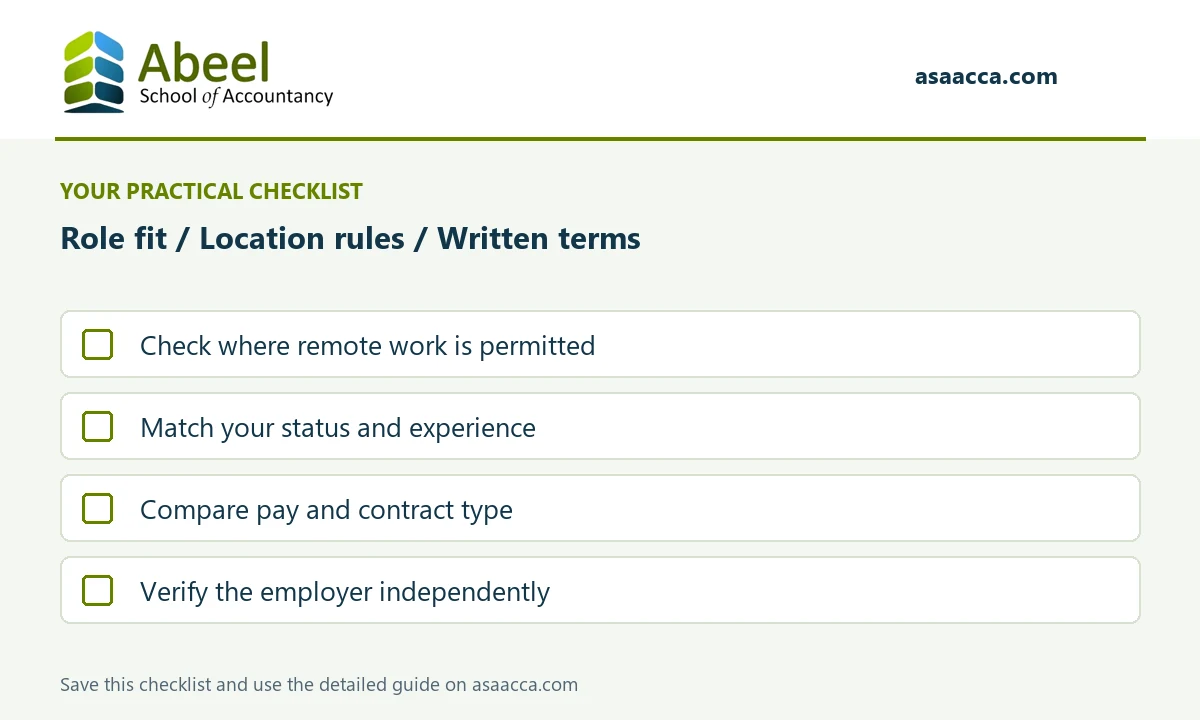
Search by role and qualification stage
Use role descriptions such as accounts assistant, reporting accountant, management accountant, finance analyst or audit support, alongside your actual qualification stage. A student should not present themselves as a member. A member should still explain the practical experience relevant to the vacancy rather than relying on the designation alone.
Begin with ACCA Careers and employers’ own careers pages. This guide is a search method, not a list of verified open vacancies. Check the posting date and apply through the employer’s current recruitment route.
Read what remote means in the advert
| Term | Question to settle |
|---|---|
| Remote within a country | Must you already live and have permission to work there? |
| Hybrid | How often must you attend the office? |
| International contractor | What services, hours, payment currency and responsibilities does the contract specify? |
| Time-zone overlap | Which meetings and deadlines must you attend in the employer’s working hours? |
For a Pakistan-based applicant, a UK employer’s remote vacancy may still require UK residence. Ask before spending hours on an unsuitable application. Do not confuse remote employment with permission to relocate.
Show evidence of independent work
Prepare a concise example of a reconciliation you investigated, a reporting deadline you met or a variance you explained. Describe your own contribution and checks. Use fictional or properly anonymised work samples; do not share a former employer’s confidential accounts or client records.
A remote-work discussion can also cover version control, secure file handling, escalation of unanswered questions and communicating progress. These are practical topics to prepare, not claims that every employer uses the same interview process.
Compare salary and total terms
Record whether the quoted amount is monthly or annual, gross or net, and for employment or contracting. Note working hours, paid leave, equipment, transfer costs and payment timing. A larger foreign-currency figure is not automatically a better package. This article does not invent a universal ACCA remote salary.
Keep an application log with the role, employer, permitted country, experience requirement and follow-up date. Verify the recruiting organisation independently before sharing sensitive documents or making any payment.
Build a remote-job comparison sheet
Use one row per vacancy and keep the source link, date checked, location restriction, duties, required qualification stage and application status. Add a separate column for questions that the advert does not answer. This prevents a long list of bookmarks from being mistaken for a focused job search.
For example, one advert might require preparation of monthly management accounts and a fixed daily overlap with a European team. Another might offer bookkeeping services on a contractor basis with deliverables agreed each month. Both could use the word remote, but they create different expectations about supervision, hours and responsibility.
Prepare a small evidence portfolio
A useful work sample should show a skill without exposing confidential data. You might create a fictional reconciliation, a short variance explanation or a simple spreadsheet with checks clearly identified. Explain the task, the method and the reason for each control. Avoid presenting a template copied from a former employer as your own unrestricted work.
If an employer requests an assessment, clarify the expected length and purpose. Keep a copy of the instructions. A sample that tests a defined skill is different from an open-ended request to complete substantial unpaid client work. Decide what is reasonable using the actual request rather than assuming every test has the same format.
Questions to ask about the working arrangement
- Which country must the worker live in, and can that location change?
- What hours or meeting overlap are essential?
- Who supplies equipment and approved software?
- How are tasks reviewed and questions escalated?
- How are payment, leave and any contract termination conditions documented?
These questions do not replace professional advice about a contract or cross-border obligations. They identify missing information before you decide whether to pursue the role. Keep any legal or tax questions separate from assumptions made in a general job advert.
Set a weekly application routine
Choose a small set of suitable roles and tailor the evidence in each application. Check the employer independently, adapt the CV summary to the responsibilities and record the next step. Reviewing why applications fail is more useful than increasing the number of unrelated applications indefinitely.
If several appropriate adverts ask for a skill you lack, turn that into a learning task. For instance, practise explaining an unexpected movement in a balance rather than merely naming spreadsheet software on your CV. Distinguish skills that can be demonstrated now from training you are still completing.
Frequently asked remote-work questions
Can an ACCA student apply for remote accounting work?
Apply where the employer’s requirements match your actual status and experience. A student role and a qualified accountant role are not interchangeable. Describe completed exams and practical work accurately.
Does a remote role guarantee a foreign-currency salary?
No. The contract determines the payment basis. Confirm the currency, gross amount, working hours and any relevant charges rather than inferring them from the employer’s location.
Can I work from Pakistan for every overseas remote advert?
No. Some adverts restrict residence or work location. Ask the employer if the advert is unclear; remote working is not a promise of worldwide eligibility.
What should I do after a rejection?
Compare the rejection with the original specification, note any feedback and adjust the next application. Do not change your qualification status or claim experience you do not have merely to match a vacancy.
Connect the job search to a development plan
Read ACCA career paths to choose a direction and use the CV checklist for new applicants if you are early in your career. For study alongside work, explore ASA’s flexible learning options and confirm the terms for your chosen paper. Tuition supports learning; it is not a placement or salary guarantee.