
M-PESA till reconciliation is a useful original accounting practice task for Kenyan ACCA learners. Separate customer receipts, refunds, charges and transfers before explaining the closing balance. The fictional example below teaches a method; it is not a live account statement, a fee quotation or tax advice.
Reviewed by ASA · 15 November 2026
In this guide
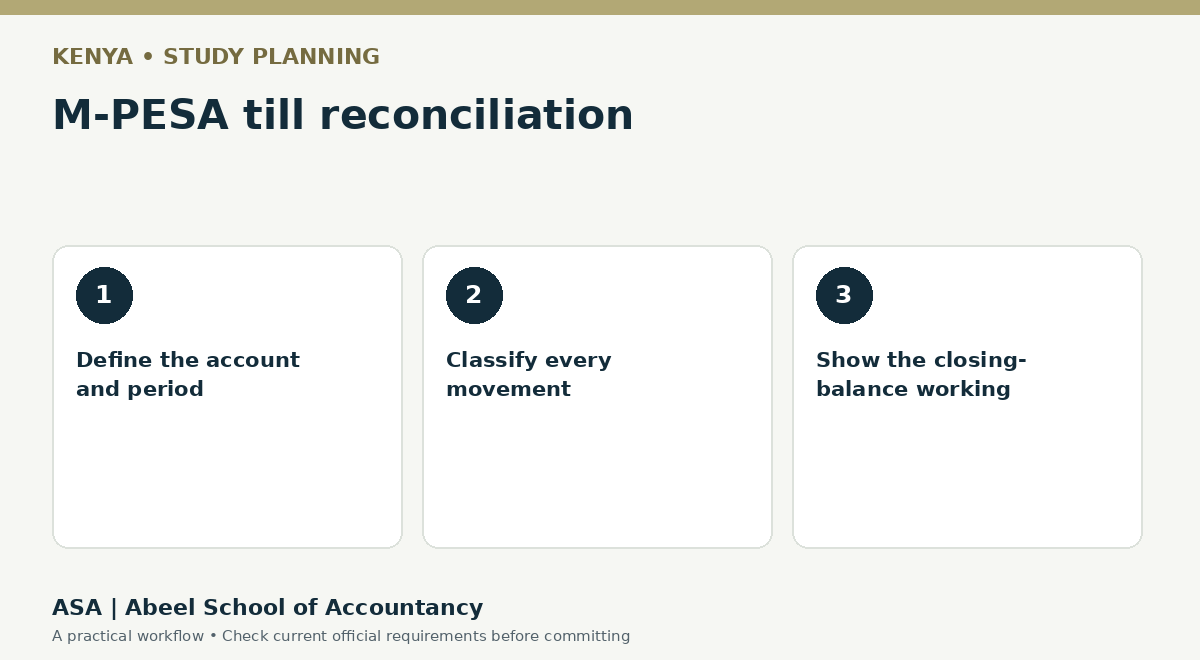
M-PESA till reconciliation: define the account and the period
Begin with the account being reconciled, the period and the opening balance. A till statement, a bank statement and a sales ledger describe different records. Decide which one each item belongs to before trying to make their totals equal.
Safaricom’s official Business Till information explains statement access through its services. For real work, use authorised records for the correct account and period. Do not share customer transaction information in public study groups or general AI tools.
Classify the movement before posting it
A customer receipt may relate to a sale or the settlement of an existing receivable; the facts determine the accounting. A transfer from the till balance to a bank account is not automatically another sale. A charge or refund also needs its own classification.
Write a short reason beside each item in an exercise. That makes a repeated posting error easier to identify than a worksheet containing unexplained totals. Do not infer a universal provider tariff or tax treatment from the invented amounts in this case.
Reconcile balances without double-counting revenue
For this exercise, assume an opening till balance of KES 1,200, customer receipts of KES 8,000, refunds of KES 300, an explicitly given charge of KES 50 and a transfer to the bank of KES 7,000. The expected closing till balance is KES 1,850.
The transfer explains a movement between accounts. Counting it as another KES 7,000 sale would overstate revenue in this simplified case. Keep the cash-movement reconciliation separate from any conclusion about which receipts represent revenue for the period.
Investigate differences with references, not guesses
Compare dates, amounts and transaction references. Look for an omitted item, duplicate entry, timing difference or incorrect classification. A reconciliation difference should lead to a documented investigation rather than a forced balancing entry with no explanation.
State what evidence you would inspect and what result would resolve the issue. For an ACCA answer, show the working clearly and explain the business effect. A correct closing number without a defensible method is difficult to reproduce on a different scenario.
Try the working before reading the answer
Use the fictional figures to calculate: KES 1,200 plus KES 8,000, less KES 300, less KES 50, less KES 7,000. The result is KES 1,850. Now assume that the ledger shows KES 1,900. The KES 50 gap is a prompt to investigate whether the given charge was recorded, not proof that it is the only possible cause in every real account.
Finally, explain why the bank transfer should not be recorded as a second sale under the exercise assumptions. Keep your explanation distinct from any actual business policy or tax conclusion.
Your practical checklist
- Define the account and period
- Classify every movement
- Show the closing-balance working
- Investigate differences using evidence
- Explain the result without duplicate revenue
Frequently asked questions
Are the amounts in this M-PESA example current provider charges?
No. All amounts are fictional teaching inputs. Check the current official provider information for real charges and conditions.
Is every till receipt automatically current-period sales revenue?
No. Classification depends on the underlying transaction, such as a sale or settlement of an existing receivable.
Does a till-to-bank transfer create another sale?
Not under the stated practice assumptions. It moves funds between accounts and should not duplicate revenue.
Related study guides
- ACCA in Kenya: 10 Essential Decisions for Confident Study Success
- ACCA PER in Kenya: 7 Essential Checks for Stronger Monthly Reviews
- Online ACCA Classes in Kenya: 5 Essential Tests for Better Study Decisions
Plan your next learning step with ASA
Explore Abeel School of Accountancy and compare the current ASA courses. For help matching tuition to your confirmed starting point, send ASA a course enquiry with your country, intended paper and study window. Confirm the selected course’s current price, language, access and support before enrolment.
Official references
Administrative rules, fees and delivery arrangements can change. Use the linked official service for the decision applicable to your own record.