

An ACCA practical-experience plan while based in Sri Lanka should focus on the work you actually perform and how it is reviewed. A job title alone does not describe every activity in a role, and exam progress does not automatically complete a work-experience record.
Use the current ACCA practical-experience guidance for your route. Treat any local practising or audit permission as a separate matter which requires the appropriate current professional requirements.
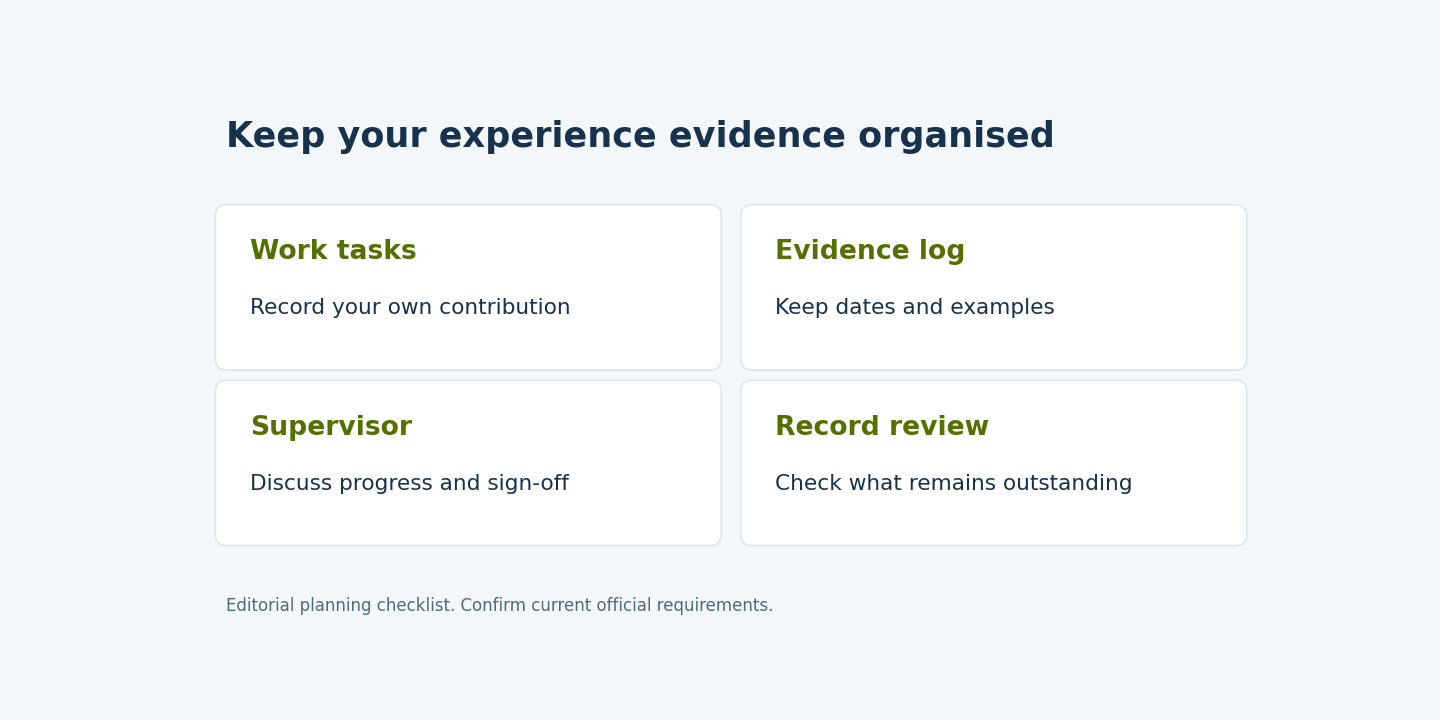
Describe relevant activities
List the accounting and finance tasks in your role and separate them from unrelated duties. Identify which tasks you perform, which you assist with and which you only observe.
This distinction makes a supervisor discussion more useful. It also prevents a general description of the department from being presented as evidence of your own responsibility.
Establish the review arrangement
Confirm who can review your work and which sign-off they can provide under the applicable guidance. Understand the difference between relevant time and evidence for objectives. Ask about unresolved questions before relying on a future review.
Agree a practical review rhythm. Keeping a record up to date is easier than reconstructing several years of tasks when a supervisor or employer changes.
Record evidence without disclosing confidential files
Use a log of dates, activity, your contribution, judgement and review. Follow workplace policies on access, copying and storage. Do not place client ledgers or payroll files in public study groups.
For a reconciliation example, describe how you identified a difference, checked the evidence, proposed an action and obtained review. The reasoning is more informative than a statement that you prepared a reconciliation.
Ask for appropriate development opportunities
When your current work does not expose you to a needed area, discuss a legitimate opportunity with your supervisor. Avoid manufacturing examples or claiming responsibility for tasks completed by other people.
Connect work development with study where useful. A syllabus concept may help you understand a workplace control, but the learning activity and the workplace responsibility should remain accurately described.
Review before changing roles
Update your records and resolve outstanding discussions while the people involved can assess your work. Keep appropriate contact arrangements in line with employer policies. If a reviewer becomes unavailable, seek the current official guidance on your options.
Maintain separate tracks for exam preparation and experience. This helps you see the next concrete action instead of relying on an unqualified statement that the qualification is almost complete.
Ask ASA about a suitable course
Explore Abeel School of Accountancy and ASA course options. Contact ASA with your location, qualifications, chosen paper, preferred teaching language and weekly study availability. Confirm the actual course access and delivery terms before paying. This guide does not establish a local ASA branch or exam centre.
Official sources reviewed 13 October 2026: ACCA practical experience; ACCA PER FAQs. Examples and worksheets are original editorial guidance. Local availability, fees and individual eligibility must be confirmed through the applicable official process.
For the broader country picture, read the ACCA in Sri Lanka guide.

A fictional reconciliation example: describe your contribution
Consider a fictional learner, Dilani, who helps investigate differences between a cashbook and a bank statement. The example is an editorial exercise, not an actual employer record or evidence of a completed ACCA performance objective. It shows how a learner can move from a broad task description to a clear account of their own work, while keeping confidential information out of a personal planning document.
The broad description is “I helped with bank reconciliations.” That leaves several questions unanswered. What did she compare? Which difference did she identify? What did she do when the information did not agree? Who reviewed the result? A clearer account identifies the task, her own steps, the reason for the investigation, the review process and what she learned. It does not claim that she approved something another person approved.
In this scenario, Dilani compares the two records, separates timing differences from items needing investigation, and raises an unexplained entry with her supervisor. She records the method used and the response received. Her account also explains the limit of her responsibility: she investigated and proposed an explanation, while the supervisor made the final review decision. The learning point is the reasoning and escalation, not the use of an impressive job title.
Use an evidence note with five distinct parts
| Part | Question to answer | Example of useful detail |
|---|---|---|
| Context | What task were you assigned? | A reconciliation difference needed investigation |
| Action | What did you personally do? | Compared records and identified items requiring explanation |
| Reasoning | Why did you choose that approach? | Separated timing items from unexplained entries |
| Review | Who checked the work and what changed? | Supervisor feedback led to a clearer supporting note |
| Learning | What would you improve next time? | Ask earlier for missing information and explain the method precisely |
The table is a writing aid, not an official sign-off template. Use ACCA’s current recording requirements for the actual submission. Before keeping or sharing any work-related material, follow your employer’s information-handling rules. A private learning note can explain a process without including customer names, bank details, account balances or proprietary documents.
A monthly experience-review meeting
A short regular meeting can make progress easier to assess. Prepare an agenda with the tasks completed, the questions still open, feedback you received and one development opportunity to discuss. Ask the reviewer to distinguish what they directly observed from what needs more evidence. Retain a record of agreed next actions in the format permitted by your employer and the official process.
Use specific questions. Instead of asking “Is my experience good enough?”, ask which part of your explanation needs more detail, whether your recorded contribution matches the work observed, and what legitimate task could help you develop a missing skill. If a responsibility was shared, explain your part honestly. A persuasive statement should be accurate, not inflated to make the task appear more senior.
Review the next month against those agreed actions. If you were asked to improve your written explanation, bring an example showing the change. If access to a task was unavailable, keep that limitation visible and discuss an appropriate alternative. Do not manufacture an assignment or copy another learner’s experience statement to fill a gap.
Keep experience planning separate from exam scheduling
A learner in Sri Lanka may be studying while working, searching for suitable work or combining several responsibilities. Record exam preparation and experience development on separate tracks. For exams, track the paper, practice tasks and booking confirmation. For experience, track work performed, feedback and official recording actions. Progress on one track should not be presented as completion of the other.
A weekly timetable should protect both study and any permitted record-review time. Use a small recurring slot to update notes while the work is still clear in your memory. Keep a recovery slot for an interrupted study session. If employer deadlines temporarily increase, adjust the academic workload rather than assuming that every planned class and practice task will fit unchanged.
When your role changes or a reviewer leaves
A change of employer, responsibilities or reporting arrangement can create a record-management question. Before the change, review which work has been recorded, which feedback remains outstanding and what information you are permitted to retain. Ask ACCA about the current arrangements relevant to your actual situation rather than assuming an old colleague’s process is still applicable.
If someone who reviewed your work becomes unavailable, do not obtain an informal signature from a person who cannot properly assess it. Use the official guidance to understand the options and qualification requirements for the relevant supervisor. Maintain a factual history of the tasks and dates, and keep uncertainty visible until it is resolved.
Questions to ask when comparing an employment opportunity
Read the actual job description and ask what responsibilities a beginner would perform, how work is supervised and whether there is an appropriate development process. A role advertised with an accounting title may involve a narrower set of tasks than you expect. Compare the work available with the skills you need to develop, while checking the official experience guidance separately.
Do not treat a vacancy as a guarantee of employment, a salary outcome or acceptance of every task as relevant experience. Educational progress, ACCA membership and permission to carry out regulated activities are different matters. If a career goal involves a regulated role, check current official requirements independently. This article does not provide professional practice permission in Sri Lanka.
Frequently asked questions about experience planning
Can I write about a task completed by my team?
Describe your own contribution accurately, including the limits of your responsibility and the review process. Do not claim another person’s decisions or actions as your own.
Should I attach confidential employer documents to an enquiry?
Follow the employer’s information-handling rules and ACCA’s designated process. A general ASA teaching enquiry does not require customer records, bank details or an account password.
Can ASA decide whether my experience is accepted?
ASA can discuss available teaching support and study planning. The official recording, supervision and assessment requirements should be checked through ACCA’s current guidance.
Where should I go for the wider study overview?
Use the main ACCA in Sri Lanka guide for the country overview and the ASA home page for teaching information. For a course enquiry, describe your intended paper, available hours and preferred lesson format through the existing page form. Confirm actual access terms before enrolling.