

An ACCA entry enquiry in Nepal is easier to resolve when your educational record shows the exact awards, examination dates, subjects and results. School-certificate terminology has changed over time, and an informal description such as “plus two completed” may leave out the evidence needed for a useful assessment. This guide focuses on organising that record and preparing a precise enquiry before choosing your first tuition course. For the wider study picture, read the main ACCA in Nepal guide.

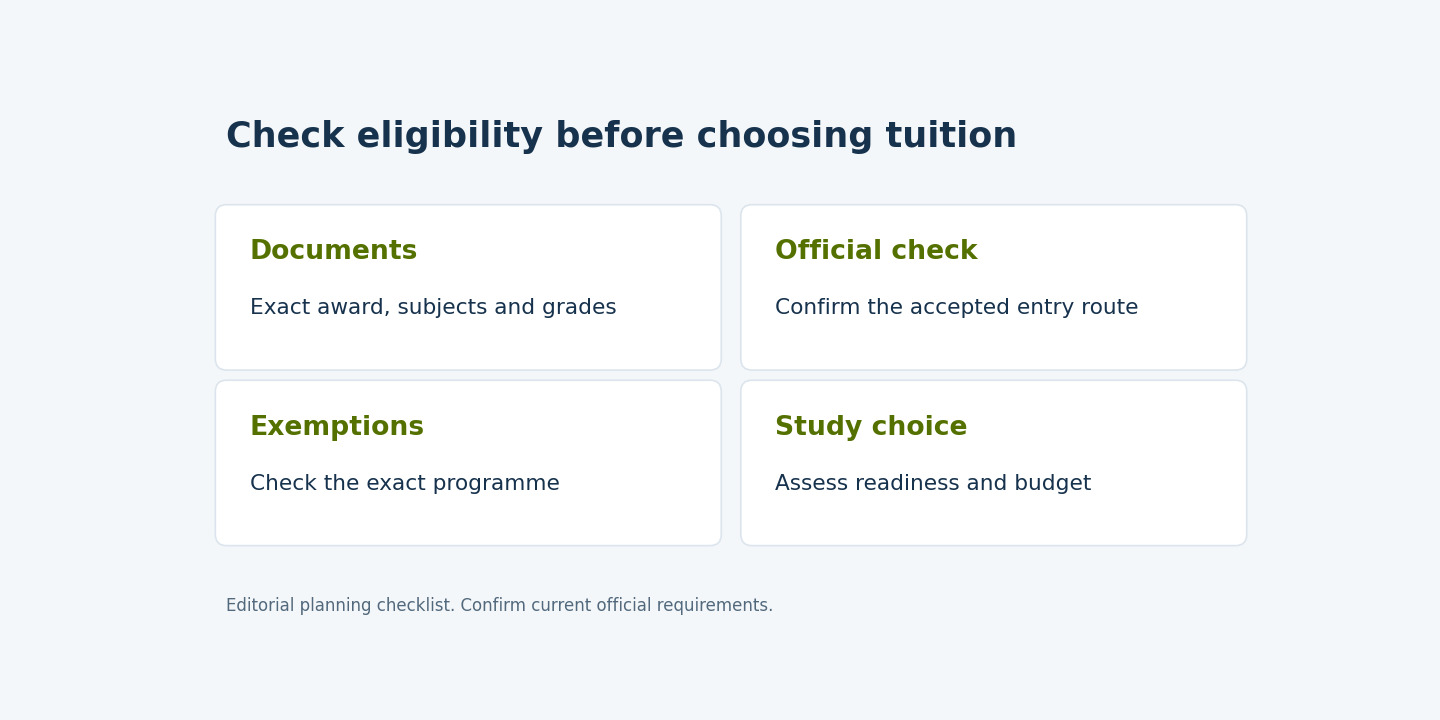
Why award dates and certificate names matter
The current ACCA minimum entrance table refers to several Nepal school-award names and dates, including older School Leaving Certificate and Higher Secondary Education Board examinations and later school records. Its entry describes combinations of passes and separate subjects, including Mathematics and English. Read the complete current row against your documents. Do not assume one certificate nickname captures every condition or use an old award name for a different document.
This guide does not issue an admission decision. Its practical purpose is to help you present your record clearly enough for an official comparison. If a document name, result category or combination is uncertain, ask ACCA about that specific uncertainty. A tuition provider can explain course options, but an informal teaching discussion should not be treated as a substitute for the relevant qualification assessment.
Create a chronological education record
Start with the earliest school award relevant to your application and work forward. For each stage, write the certificate title exactly as printed, the issuing organisation, examination year, subjects and original results. Keep Grade XI and Grade XII evidence distinguishable where your record includes both. If you later completed a diploma or degree, give that award its own section rather than replacing the earlier record with the word “graduate.”
Chronology helps someone understand which documents belong together. It also identifies a missing record before you make a time-sensitive application. If a result has been revised or you hold a later resit record, make the relationship visible. Do not delete the context from your planning sheet simply because one later result looks more favourable. The official application channel should determine which evidence is required.
| Record item | What to write | What to avoid |
|---|---|---|
| Award title | The exact wording on the document | Using one informal nickname for different awards |
| Date | Examination year and issue information | Guessing the category from your age |
| Results | Original subject names and grades | Inventing a grade conversion |
| Additional education | Separate programme and institution details | Assuming all graduates have identical exemptions |
Read a qualification combination as a whole
When an entrance listing describes more than one stage, check the whole combination. Count distinct subjects only in the way the official entry requires, and identify English and Mathematics clearly. A repeated subject in more than one record should not automatically be counted as two separate subjects. If you cannot confidently match your record, leave the issue open and request clarification.
Do not convert a numerical result into a letter grade based on an unrelated table found online. The wording in ACCA’s listing and the documents you hold should guide the enquiry. If a particular award’s grading system or date differs from the example you are comparing, explain that difference. A clear question about the mismatch is more useful than a confident but unsupported equivalence.
A fictional example of organising mixed school records
Sushma is a fictional learner who has school records from more than one stage and wants to compare ACCA tuition. She starts by writing the official name and date of each award. Her first planning sheet has one row saying “school completed,” which is too broad. She replaces it with separate sections for the actual certificates and results. This reveals that one document is still missing from the folder she intended to use.
She then compares the subject combination with the current entry listing and marks a question about how her records fit together. Instead of asking a provider to confirm eligibility from a photograph of a partial result, she prepares a focused official enquiry. While waiting, she explores demonstration lessons and records the course terms. She avoids buying several papers on the assumption that the most favourable possible starting route will apply.
This is an original teaching scenario, not a real ASA testimonial or admission outcome. It illustrates an information problem: an incomplete summary can make a potentially assessable educational record difficult to understand. Better organisation does not guarantee acceptance; it helps the relevant organisation assess the evidence actually available.
A separate folder for exemption questions
If you have higher education relevant to exemptions, keep that question separate from school-entry planning. Record the institution, programme title, completion information and the documents requested by the official process. Ask about the actual programme rather than relying on a claim that “a degree gives exemptions.” Different educational records can lead to different outcomes.
Retain the decision before finalising a large tuition purchase. If a paper is exempted, consider whether you need to refresh knowledge that supports later study. A short independent task can reveal a weakness even when you no longer need to sit that particular exam. Discuss the learning need with a tutor without confusing refresher study with the official exemption outcome.
Write an enquiry that has a clear answer
A good enquiry identifies the decision you need. State your exact qualification, awarding organisation and relevant dates. Explain the specific part of the current entry that you cannot match, and ask which starting route should be considered. Avoid a long message that mixes admission, salary, course discounts and exam booking without identifying the immediate question.
For ASA teaching enquiries, describe your current stage, intended paper, dependable study hours and preferred lesson format. Ask what support is currently available and request the terms in writing. Official eligibility and exemptions should be resolved through ACCA’s designated channels. Keep passwords and identity documents out of public comments or informal study-group discussions.
A tuition comparison after the route is confirmed
Once you know the starting stage, compare courses that prepare for the same paper and relevant syllabus period. Request the timetable, access duration, feedback arrangements and process for asking questions. A recording collection and an individually marked practice course provide different services. Compare the service description with the difficulty you actually need help solving.
Use a demonstration lesson actively. After watching, attempt a fresh question without keeping the worked answer open. Record whether the problem was terminology, calculations, interpreting the requirement or explaining your answer. Ask the provider how its support addresses that problem. This makes the comparison more specific than judging a course by the lecturer’s presentation alone.
For live classes taught from another location, confirm the actual lesson time in Nepal. Do not rely on the word “evening” without a time-zone explanation. Test the platform and device you will use for questions as well as lectures. Ask about recordings and the revision period before paying. This article does not establish a physical ASA branch in Nepal; confirm the available delivery format directly.
Keep the first study commitment manageable
Protect time for learning, independent practice and reviewing mistakes. Put college, work, travel and family commitments on the calendar first. Then choose a first-paper workload that fits the hours you can maintain. Buying several subjects does not create more available evenings. Include a recovery session so an interrupted task has somewhere to go.
Review the plan after two ordinary weeks. Compare planned study sessions with actual practice completed. If watching lessons is consistent but independent answers are missing, change the task plan and ask about feedback. If most sessions are interrupted, reduce or rearrange the workload. The useful measure is work completed and understood, not the number of videos in the course library.
Budget and examination records belong in separate sections
Record dated tuition quotations with their currency, recipient and included services. Keep external qualification charges, materials and any confirmed exam travel separate. Ask what happens if your paper list changes after an official decision. Obtain transfer or cancellation conditions before a purchase that cannot easily be changed.
Examination arrangements need their own confirmation. Tuition enrolment does not complete exam entry, and online lessons do not establish permission to sit an exam remotely. Check the current process for your intended paper and location. Retain the actual booking details and reporting instructions privately, and raise incorrect information through the appropriate support channel.
Frequently asked questions
Can I use an informal school-stage name in an application?
Use the exact award and issuing organisation shown on your documents. An informal label can help start a conversation, but a clear qualification record is needed for a meaningful comparison.
Should I combine grades from different systems myself?
Do not invent an equivalence. Present the original records, identify the uncertainty and ask ACCA which combination and requirements apply to your case.
What if one document is missing?
Identify the missing record before applying and check the current document instructions. Organising the evidence is a practical next step; guessing the result is not a substitute.
Where can I compare the wider study route?
Use the main ACCA in Nepal guide for the country overview and the ASA home page for teaching information. This article focuses on the narrower document-planning question and does not promise acceptance, examination success or employment.