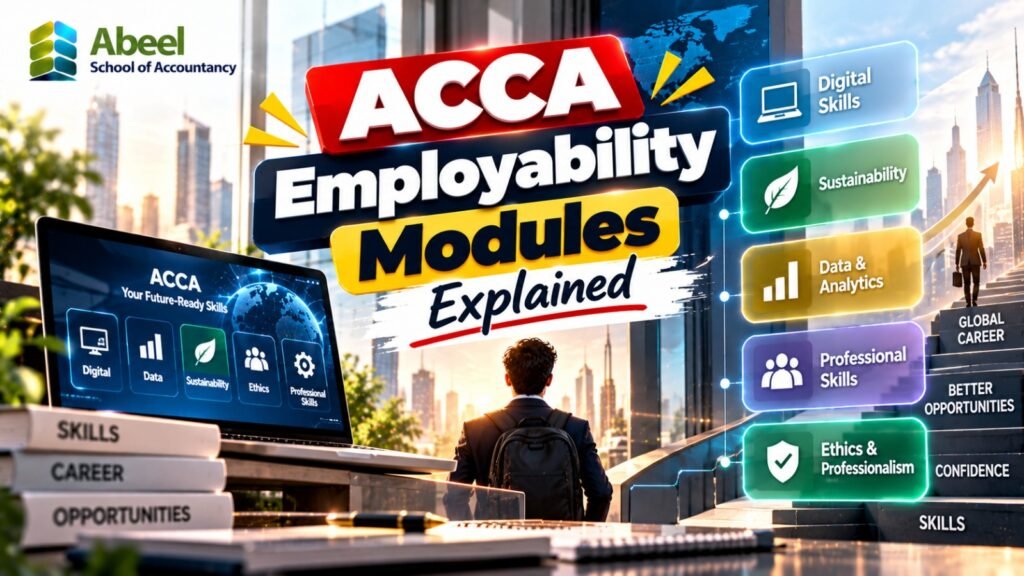
Of all the changes in the ACCA 2027 redesign, the Essential Employability Modules cause the most confusion. Everyone understands “fewer exams.” Hardly anyone can explain what an employability module actually is, whether it is an exam, how long it takes, what it costs and whether they can skip it.
If that sounds like you, you are in good company. This guide explains the modules in plain language: what they are, how the four of them fit into the qualification, how many hours each is expected to take, who receives credit, and how to plan around them so they do not catch you out. We will also show how Abeel School of Accountancy helps students fit these modules into a realistic study plan.
What Are ACCA Essential Employability Modules?
Essential Employability Modules, usually shortened to EEMs, are mandatory online learning modules built into every level of the redesigned ACCA Qualification. They are not exams. Instead, they offer an integrated learning and assessment experience that builds technical expertise and professional skills in key areas such as ethics, technology and sustainability.
Students are assessed through a combination of formative and summative assessments as they work through each module. Importantly, ACCA says the modules should not be seen as a direct replacement for the current Ethics and Professional Skills Module (EPSM). The content, learning experience, time required and progression rules are all significantly different.
The Four Modules at a Glance
There is one EEM at the Foundations level and one at each of the three main levels of the qualification.
| Level | Module | Approximate hours (per ACCA) |
|---|---|---|
| Foundations | Enterprise and Entrepreneurship | 40 hours |
| Knowledge | Responsible Business Management | 60 hours |
| Expertise | Digital Tech and Innovation | 100 hours |
| Strategic Professional | Ethical, Sustainable Leadership | 70 hours |
These hour figures are ACCA’s estimates and are indicative, so treat them as planning guides rather than guarantees. Some training providers quote slightly different numbers for the final module, which is another reason to check ACCA’s official pages for your own plan.
What Each Module Covers
Enterprise and Entrepreneurship (Foundations). This introduces what a business enterprise is, the purpose of business and entrepreneurial thinking. It is relevant only to students who take the Foundations route, and ACCA offers no exemptions from it.
Responsible Business Management (Knowledge). This builds early understanding of ethics, sustainability and responsible business practice. Students with relevant prior learning may be eligible for exemption from it.
Digital Tech and Innovation (Expertise). This looks at how technology is advancing and changing business, including digital tools, data and innovation, with a focus on responsible and ethical practice around data. ACCA offers no exemptions through prior learning because it considers this a new and emerging area that every student must develop.
Ethical, Sustainable Leadership (Strategic Professional). This explores leadership styles, ethical principles and how sustainability is shaping business. No exemptions are available.
How the Modules Work in Practice
A few rules shape how you plan.
- You must pass each level’s module to progress. Students complete the module alongside their exams to move on to the next level.
- You choose when to do it within the level. You can complete the module before, during or after the exams at that level.
- They are chargeable. ACCA has confirmed there is a fee for the Essential and Optional modules, with prices to be confirmed in January 2027.
- There are no regional variants. The content is globally relevant, so Pakistani students take the same module as students anywhere else.
- Digital Tech and Innovation becomes available in July 2027, according to ACCA’s current guidance.
Who Gets Credit and Who Does Not
Because the modules replace parts of the current system, ACCA has built transition credit rules. These matter a great deal for current students, so read them carefully.
Responsible Business Management. A pass in Business and Technology (BT) gives credit for this module. Students who have not passed BT but who have completed the Foundations in Professionalism module receive credit for the first 12 units. If you do not complete BT before transition, you will need to complete the module in the redesigned qualification.
Digital Tech and Innovation. Students who complete all the current Applied Skills exams, including Corporate and Business Law, before transition are not required to take this module. If you do not complete the full set, you will need to complete it. Since it is the longest module, this is the credit most worth planning for. It is also the reason you should not leave Law as the last paper.
Ethical, Sustainable Leadership. Students who complete the current Ethics and Professional Skills Module ahead of transition receive credit for this module. ACCA has set a mid-July 2027 cut-off for EPSM, with the exact date still to be confirmed, so finishing it early is sensible.
Enterprise and Entrepreneurship. Students who have already completed Foundations in Professionalism do not need to take this Foundations level module.
Always confirm your own position in ACCA’s official transition tool, because it reflects your actual record and exemptions.
Optional Employability Modules: Do They Matter?
Alongside the mandatory modules, ACCA will offer Optional Employability Modules covering areas such as accounting software, cloud accounting, personal effectiveness, leadership and AI. They are not required to qualify.
There is one interesting future feature. ACCA plans to allow up to six months of the Practical Experience Requirement to be met through certain optional modules that provide simulated experience. ACCA has said this will not take effect immediately from September 2027 and that timing will be announced closer to the date. The 36-month supervised experience requirement itself remains.
Common Mistakes With the Employability Modules
- Treating them like paperwork. The modules are assessed, chargeable and carry real hours, so schedule time for them.
- Leaving Law until last. Because Law is part of the full Applied Skills set, delaying it can cost you the Digital Tech credit.
- Putting off EPSM. If you are close to finishing, completing it before the cut-off protects your credit.
- Ignoring the budget. Fees are still to be confirmed, so allow room in your plan for them alongside exam fees.
- Assuming the module will be quick. The Expertise level module is the heaviest at around 100 hours, so do not leave it to the last week.
How Abeel School of Accountancy Helps You Plan Around the Modules
Knowing the rules is useful. Fitting them into a real study timetable is where students need support, and that is what Abeel School of Accountancy is built for.
A customized study planner. Every student at Abeel School of Accountancy receives a planner built around their own papers, exam sittings and the 2027 timeline. It shows when to finish the current papers, how to protect your credit and where the employability modules fit, so nothing arrives as a surprise.
Weekly live revision with Smart Course Completion. Abeel School of Accountancy is the only institute that conducts weekly live revision sessions together with Smart Course Completion. You revise with a tutor every week, and the tracking system shows which topics are complete and which still need work. When your time is split between exams and modules, that steady structure keeps you from falling behind on either.
Direct tutor support. If you are unsure how a credit rule applies to you or a concept is not clicking, you can reach your tutor directly instead of waiting for the next lecture.
Results students can rely on. Abeel School of Accountancy students have secured multiple global and nationwide positions and are known for exceptional pass rates. Those outcomes come from structure and consistent revision.
Frequently Asked Questions
1. What are ACCA Essential Employability Modules?
They are mandatory, non-exam online modules at each level of the redesigned ACCA Qualification, assessed through formative and summative assessments and designed to build professional skills in areas such as ethics, technology and sustainability.
2. How many employability modules are there?
There are four: Enterprise and Entrepreneurship at Foundations, Responsible Business Management at Knowledge, Digital Tech and Innovation at Expertise and Ethical, Sustainable Leadership at Strategic Professional.
3. Are the modules the same as EPSM?
No. ACCA says they should not be treated as a direct replacement for EPSM, because the content, learning experience, time required and progression rules are significantly different.
4. Do I have to pay for the employability modules?
Yes. ACCA has confirmed the modules are chargeable, with pricing to be confirmed in January 2027, so check ACCA’s official pages for current fees.
5. Can I avoid the Digital Tech and Innovation module?
Students who complete all the current Applied Skills exams, including Law, before the transition are not required to take it. Others will need to complete it at the Expertise level.
6. What makes Abeel School of Accountancy different for students facing these modules?
Abeel School of Accountancy is the only institute that conducts weekly live revision sessions together with Smart Course Completion, and it also provides direct tutor support and a customized study planner that fits the modules and the 2027 timeline into your schedule.
7. How do I get started with Abeel School of Accountancy?
You can reach out through the Abeel School of Accountancy admissions page to review your current progress and receive a personalized plan. For more on the changes themselves, read our guides on the ACCA 2027 qualification redesign and the ACCA transition timeline.
For official module details, credit rules and the transition tool, always check ACCA’s transition guidance for students and the future ACCA Qualification FAQs.