If you’re studying ACCA right now, you’ve probably heard the buzz about 2027. Some students are excited. Others are quietly panicking and wondering whether to rush their exams or wait for the new syllabus.
Here’s the calmer way to look at it: the changes are a signal of what employers already want. At Abeel School of Accountancy, we talk to students about this every week, and the same question keeps coming up: “Will ACCA still get me hired?” The short answer is yes, as long as you understand what hiring managers are looking for. Let’s break it down.
What’s Actually Changing in ACCA 2027?
ACCA is redesigning its qualification after consulting employers, members, learners and training providers. The goal is to link what you learn in exams more closely to what you do at work.
According to training providers such as BPP, the key points are:
- Renamed levels and a streamlined structure, with one fewer exam at the Expertise stage
- Simpler options, so you choose one optional exam instead of two
- New employability modules that build career readiness alongside technical knowledge
- Greater focus on AI, sustainability and leadership
- Key dates: the first teaching window opens in January 2027, Knowledge-level exams begin in July 2027, and Expertise and Strategic exams begin in September 2027
Two pieces of good news: you won’t need to resit exams you’ve already passed, and ACCA’s transition tools will map your progress onto the new structure. For official details, always check ACCA Global.
What Employers Want From ACCA Students in 2027
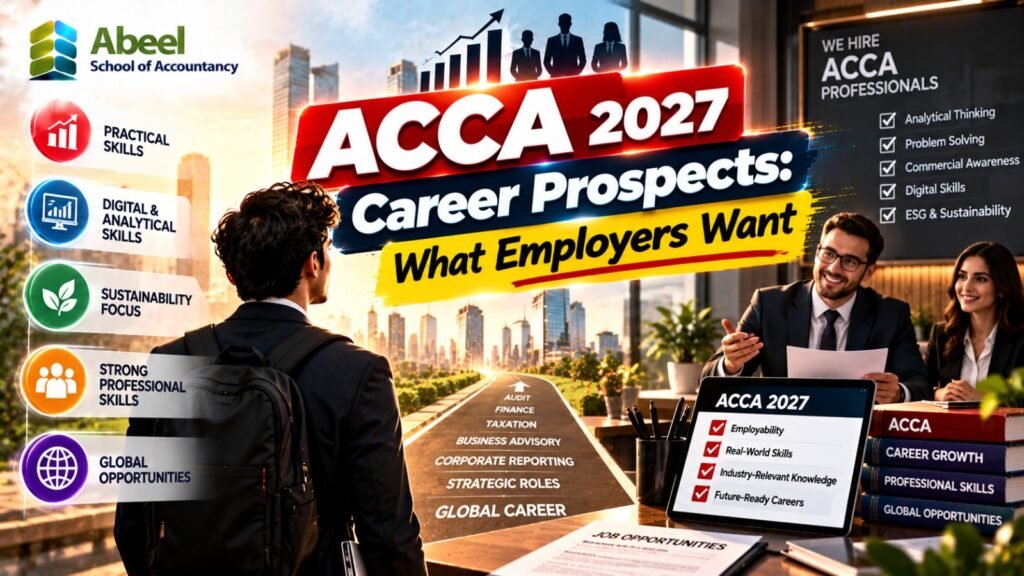
The updated syllabus reflects a shift hiring managers have been asking for. Technical accuracy still matters, but it’s now the starting point rather than the whole package. Here’s what’s rising to the top.
1. Digital and Data Confidence
Employers don’t expect you to be a programmer. They do expect you to be comfortable with data: reading dashboards, spotting patterns in numbers, and using tools like Excel, Power BI or accounting software without hand-holding. If you can turn a messy spreadsheet into a clear insight, you instantly stand out.
2. Comfort With AI
AI is already handling repetitive tasks like reconciliations and first-draft reports. Employers want accountants who can work with these tools, check the outputs and question the results. The human skill is judgement, and ACCA’s new direction rewards it.
3. Sustainability and ESG Awareness
Sustainability reporting is moving from “nice to have” to a regulatory expectation in many markets. Companies need finance professionals who understand ESG disclosures, carbon accounting basics and how non-financial risks affect the bottom line. Mentioning this in an interview now gives you an edge.
4. Communication and Business Storytelling
Ask any finance director what they wish junior accountants did better, and “explain the numbers clearly” tops the list. The new employability modules exist because employers kept saying the same thing: technically strong candidates who can’t communicate their findings are hard to promote.
5. Ethics and Professional Judgement
Trust is the whole business of accounting. Employers look for people who raise concerns early, handle gray areas carefully and stay objective under pressure. ACCA’s ethics framework has always been strong, and in a world of automation it matters even more.
6. Leadership Potential Early On
You don’t need a title to show leadership. Employers notice trainees who take ownership, support teammates and manage deadlines without being chased. With leadership content moving into the qualification, expect interviewers to probe for real examples.
7. Practical Experience
ACCA’s Practical Experience Requirement (PER) has always mattered, and employers still weigh it heavily. A student who has passed exams and built real workplace experience will almost always beat one with only exam results.
Career Paths That Look Strong After 2027
The restructured qualification keeps the door open to a wide range of roles:
- Audit and assurance, including Big 4 and mid-tier firms
- Financial reporting and corporate finance
- Tax advisory
- Management accounting and FP&A
- Risk, compliance and internal audit
- Finance analytics and business partnering
- Sustainability reporting and ESG finance
Some training providers also point out that students will be able to specialise at the Strategic Professional stage, for example in areas like data or tax, so choose electives that match the job you want in three to four years, not just what seems easiest.
Should You Wait for the New Syllabus?
Almost certainly not. Kaplan’s guidance, quoted from ACCA, recommends that you keep progressing toward membership, because employers tend to offer more recognition in pay and progression once you’re a member than when exams are still outstanding.
In practice:
- If you’re mid-qualification, keep going and your passed exams carry over.
- If you’re just starting, begin now. Entry requirements and exemptions are not changing, and most of your early study will be under the current syllabus.
- If you’re finishing soon, aim to complete under the current structure, since you’ll have no gaps to explain.
How Abeel School of Accountancy Prepares You
Passing exams is only half the job. At Abeel School of Accountancy, our approach is built around being employable, not just exam-ready:
- Teaching that mirrors the workplace, using real-world case studies instead of only theory
- Digital skills woven into lessons, so you’re comfortable with data and tools before your first job
- Career guidance and CV support, helping you present your ACCA progress to employers
- Transition planning, so no student feels lost between the current and new syllabus
Explore our ACCA courses, see how our career support works, or contact our admissions team to talk through your own timeline. Our advisers at Abeel School of Accountancy will map your path exam by exam.
A Simple Action Plan for the Next 12 Months
- Pick your exam timeline and stick to it, since momentum beats perfection.
- Build one digital skill such as advanced Excel or Power BI.
- Learn the basics of ESG reporting from a reliable source.
- Practise explaining numbers in plain English, to a friend if need be.
- Start logging PER experience early.
- Follow official updates at ACCA Global as dates are confirmed.
Frequently Asked Questions (FAQs)
1. When does the new ACCA syllabus start?
Teaching begins in January 2027. Knowledge-level exams start in July 2027, and Expertise and Strategic exams in September 2027. Confirm final dates on ACCA’s official website.
2. Will I have to resit exams I’ve already passed?
No. Passed exams will be mapped to the new structure through ACCA’s transition tools.
3. Is ACCA still worth it in 2027?
Yes. The redesign aims to make the qualification more relevant to the skills employers want, including data, AI, sustainability and leadership.
4. What skills do employers want most from ACCA students?
Digital and data confidence, AI awareness, sustainability knowledge, clear communication, ethics, leadership potential and practical experience.
5. Should I start ACCA now or wait for 2027?
Start now. Entry requirements and exemptions are unchanged, and early progress counts toward the new qualification.
6. How can Abeel School of Accountancy help me with the transition?
We offer exam preparation, digital skills integration, career guidance and personalised transition planning. Contact us to build your study timeline.
7. Will the new ACCA exams be harder?
Not necessarily. The focus is on integrating skills like data analysis and ethics rather than simply adding difficulty, and your preparation should reflect real work more than before.
Final Thoughts
The ACCA 2027 changes aren’t something to fear. They push the qualification toward what employers have been asking for: technical skill plus digital fluency, sound judgement and clear communication. Build those habits now, keep your exam momentum, and you’ll be well placed whichever syllabus you finish under.
Ready to plan your ACCA journey? Reach out to Abeel School of Accountancy today and let us help you turn your qualification into a career.