
ACCA December exam tips are most useful when they change what you do in your next practice session. For December 2026, focus on finding recurring errors, correcting them and checking the improvement under time pressure. This guide explains nine preparation mistakes and gives you a practical action for each.
Reviewed by ASA · 15 November 2026. The centre-based December 2026 ACCA exams are scheduled for 7–11 December. Check your own paper and local arrangements in the official ACCA timetable and your personal booking. This guide is for preparation; it does not imply that exam entry is still open.
Already following a revision calendar? Keep it beside this guide. The aim is to improve the quality of each attempt, especially if you are balancing work, a resit or more than one paper. The examples and repair routine below are ASA’s suggested learning tools, not official marking rules or a promise of a pass.
In this guide
1. ACCA December exam tips start with a diagnosis
The mistake: judging readiness by how many lessons you have watched. A finished playlist can hide gaps that appear as soon as you have to choose a method or explain a conclusion without help. Your first useful check is a short, closed-book attempt using material appropriate to your paper and current syllabus.
The fix: make a small evidence sheet with three columns: what the requirement asked, what you actually produced, and what stopped you. Write “could not explain the business implication” rather than “bad at written questions”. That description gives you a task you can practise tomorrow. A diagnostic attempt is a planning tool, not a prediction of your final result.
If you already have a timetable, keep it. Use these findings to improve the work inside each block. For the wider calendar, follow ASA’s three-week December revision plan. This article focuses on fixing the mistakes that the timetable exposes.
2. Counting mock scores without reviewing lost marks
The mistake: completing a mock, checking the total and immediately starting another one. A score does not explain whether the problem was understanding, question interpretation, application, execution or time. Two learners with the same total may need completely different next steps.
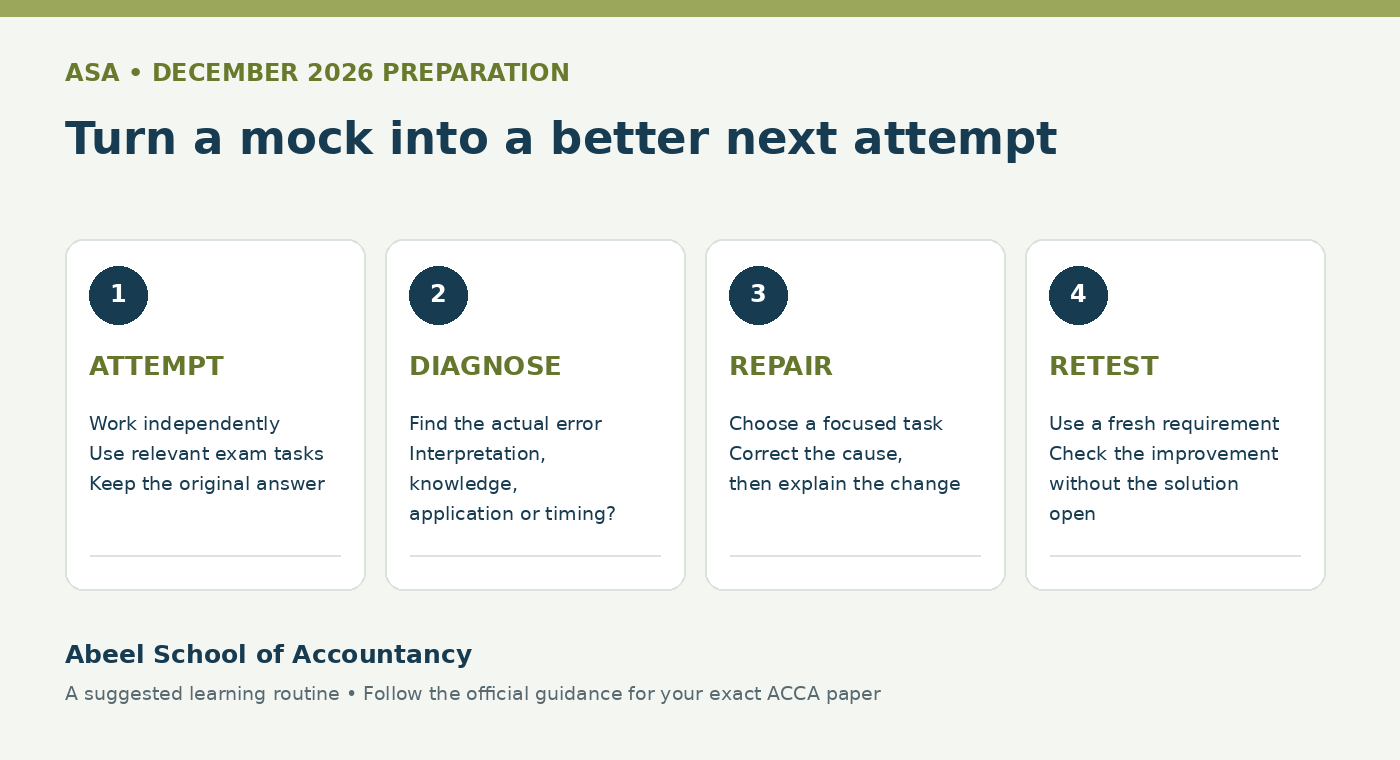
The fix: choose three lost-mark patterns and attach one repair action to each. If your calculation used the wrong input, trace the source data. If your explanation repeated the scenario, write the missing consequence. If you ran out of time, identify where the planned stopping point was ignored. Keep your original answer beside the correction so you can see the difference.
Use the relevant official ACCA practice resources for your paper. You can also explore ASA mock practice, checking the papers and formats currently available. ASA practice is an independent learning resource; it does not replace the official examination or imply that every paper has an equivalent mock available.
3. Treating topic predictions as a revision syllabus
The mistake: allowing an online “important questions” list to decide what you will stop studying. A persuasive prediction may encourage confidence without giving evidence that you can handle a different scenario. It can also pull you towards a favourite area while an unfamiliar requirement remains untouched.
The fix: keep broad syllabus coverage and use your diagnostic results to decide which areas need extra repair. Make a simple coverage map: attempted independently, attempted with help, and not yet attempted. Put the last two categories into your remaining study blocks. The map should represent your work, not the number of pages in your notebook.
For ACCA December exam tips, the useful question is “What can I now answer independently?” A tutor’s explanation, an examiner resource or a technical article can help with a gap, but the next step is still a fresh attempt. No list of expected topics can guarantee what will appear in your exam.
4. Using one timing rule for every ACCA paper
The mistake: borrowing a minutes-per-mark calculation from another paper and applying it without checking your own format. Objective tests, longer responses, case tasks and professional-skills assessment do not all work in the same way. Even a sensible allocation is useless if you never practise moving on when the time ends.
The fix: read the current instructions for your exact paper and variant. Where time allocation by marks is appropriate, calculate a working budget from that format and rehearse it. Decide in advance what you will do if one requirement exceeds its allowance: leave a clear working or answer point, move on, and return if time remains.
A practical rehearsal is to mark your intended stopping times before an attempt, then record actual stopping times afterwards. The gap tells you whether the plan was unrealistic or you ignored it. These ACCA December exam tips support a personal timing decision; they are not an official universal allocation.
5. Writing everything you remember instead of answering the task
The mistake: beginning a long explanation as soon as you recognise a topic. Recognition can tempt you to produce a memorised definition even when the requirement asks for an evaluation, a recommendation or a calculation with an explanation. More writing does not automatically mean more relevant work.
The fix: before answering a written requirement, identify the instruction, the subject and the scenario evidence. For example, if a fictional company is considering a new control, describe how that control addresses the stated weakness and what limitation remains. Do not invent a benefit unsupported by the case simply to make the answer sound complete.
Use headings that reflect the requested tasks. For numerical work, make your method traceable and explain the conclusion when the requirement asks for one. After marking, test each paragraph: which part of the task does this answer? If you cannot identify one, rewrite it more directly.
6. Learning the answer but avoiding the CBE workspace
The mistake: doing every longer answer in a comfortable notebook and leaving the examination workspace unfamiliar. Knowing the subject and being able to organise an answer on screen are related but separate skills. Last-minute uncertainty over basic navigation can consume attention you need for the requirement.
The fix: use the official practice environment appropriate to your paper. Rehearse opening the requirement, organising workings, entering explanations and reviewing your output. Check that you can see the whole answer and follow the logic after a short break. Avoid relying on shortcuts or functions until you have confirmed that they exist in that environment.
ACCA’s official FR revision guidance, for example, recommends a full mock with careful debriefing in the CBE environment. Follow the corresponding guidance for the paper you are taking rather than assuming that FR’s format applies to every subject.
7. Repeating the same revision routine after a previous fail
The mistake: a resit plan that simply adds more viewing hours to the routine used for the previous attempt. Familiarity with the notes can feel reassuring while the same weak answer habits survive. A previous result is useful evidence only when it changes the work you now do.
The fix: select one recurring error and design a small retest. Suppose a fictional learner repeatedly lists audit procedures without showing their purpose. The repair is to rewrite a short set of procedures against the facts of a fresh scenario and check whether each has a clear action and objective. Replaying the entire course is a different task and may not address this specific gap.
Use your available performance feedback and your own marked practice, without assuming that either reveals a secret prediction. Ask a focused question when you need tutor help: “Why does this sentence fail to address the requirement?” produces a more useful conversation than “Please explain everything again.”
8. ACCA exam preparation: protect the final 48 hours
The mistake: abandoning a working approach because another student shares a longer checklist, a new resource pack or a dramatic late-night schedule. A sudden increase in inputs can leave you with less time to retrieve the knowledge you already have and correct a manageable weakness.
The fix: make the last two days a consolidation window. Review the errors you have already repaired, attempt a small selection without notes, and check your examination arrangements. Choose a realistic finishing time for study. If an important gap remains, define it precisely and work on that task instead of restarting your entire preparation system.
Students balancing employment in Pakistan or the Gulf should protect the actual hours they have agreed around work and travel. A recorded lesson may help with a specific explanation; confirm its language, access and relevance before relying on it. Compare current ASA course options only when you know which gap the tuition needs to address.
9. Leaving the docket and exam-day instructions until the last minute
The mistake: using a general timetable screenshot as if it were confirmation of your own booking, local start time, location and instructions. Another student’s arrangements may be different. Travel, document preparation and check-in rules need their own check, separate from subject revision.
The fix: open your own myACCA record and read the current docket and instructions when available. Confirm the paper and variant, local start time, venue or approved delivery arrangement, and the documents and equipment required for your circumstances. Follow ACCA’s instructions on printing and identification. Do not assume that remote examination delivery is available in your country.
Save a personal logistics checklist and resolve a discrepancy through the official support route. The ACCA attendance-docket guidance is the starting reference. These ACCA December exam tips complement those instructions; they do not override them.
A worked example: turn lost marks into a repair plan
Imagine a learner who completed a practice paper but cannot decide what to revise next. Rather than treating the total as the whole story, they record three observations. The table is a fictional teaching example: use the method with your own paper and feedback.
| Observed problem | Repair task | Evidence to look for in the retest |
|---|---|---|
| Recognised the topic but answered a different task | Underline the instruction and restate the required output before writing | Each answer section addresses a requested output |
| Correct approach, incorrect input from the scenario | Label the source of each figure and repeat one calculation from a fresh case | Inputs can be traced to the correct facts |
| One answer consumed time needed for later work | Rehearse a stopping decision using the current paper format | More of the paper receives a genuine attempt within the planned time |
Do the retest before declaring the issue fixed. A correction that makes sense while the solution is open is not the same as an independent answer. If you still make the error, narrow the repair task or ask for targeted feedback.
Your final-week action checklist
- Confirm the paper, variant, current syllabus and official booking.
- Keep one short error log containing specific answer problems.
- Use practice that matches the actual paper and delivery environment.
- Give each full mock a debrief and a small set of follow-up tasks.
- Retest repaired weaknesses using different requirements.
- Check your local exam time, required documents and route or approved delivery instructions.
- Keep the final evening’s plan manageable.
If you need help choosing targeted tuition, ask Abeel School of Accountancy about your paper and the exact task you find difficult. Explore ASA’s ACCA paper overview and free demo lectures and orientations before deciding which learning resource fits. You can send ASA a course enquiry with your intended paper and study window.
Frequently asked questions
When are the December 2026 ACCA exams?
The published ACCA centre-based session runs from 7 to 11 December 2026. Confirm your own paper, local start time and arrangements in the official Exam Planner and attendance docket. On-demand exams are a separate arrangement.
What are the most useful ACCA December exam tips if time is short?
Attempt relevant questions independently, identify a few specific recurring errors, repair them and retest on a fresh requirement. Keep broad syllabus coverage and protect time to review your work instead of only adding more lectures.
How many mock exams should I complete?
A fixed number is not a complete preparation strategy. Plan a suitable full mock using your paper’s official guidance, leave time for a detailed debrief, and add further attempts when they test a clear improvement. Repeating mocks without reviewing errors gives you little direction.
Can I rely on predicted questions for the December attempt?
No prediction can guarantee the paper you will receive. Use the current syllabus and evidence from your own practice to plan revision rather than dropping whole areas because of an online tips list.
What should I do after a disappointing mock result?
Separate the score into the reasons you lost marks. Pick a small number of repair tasks, complete them and attempt different requirements that test those skills. Seek focused feedback where the reason remains unclear.
Does buying a December crash course enter me for the ACCA exam?
No. Tuition and official ACCA exam entry are separate. Confirm your examination booking through ACCA and check the current course’s syllabus, language, access period and support before purchasing tuition.