
Choose an occupational question before a qualification slogan
When considering ACCA in Poland, begin with the work you want to understand or perform. A reporting role, an audit-support role and a regulated professional activity can require different combinations of knowledge, experience and authorisation. A globally known qualification should not be treated as a universal answer to all three. Write down the target role and its actual responsibilities, then compare the qualification content with the learning gap you need to close.
Use recognition guidance without overstating it
ACCA publishes Europe-specific recognition information, including a Poland section. Read the applicable conditions and consult the relevant Polish authority for a regulated activity. Do not convert a recognition arrangement, exemption or professional-body relationship into a promise that every student can immediately practise independently. Your status matters: an applicant, student, affiliate and member are different positions. If a job or licence depends on an individual assessment, obtain that assessment from the body responsible for it.
Separate university credit from workplace readiness
Check academic entry and any exemptions against the precise university, programme and year, rather than assuming all accounting graduates receive identical treatment. Then assess the knowledge you will need for your next paper. Formal credit may reduce what you must sit, but it does not tell a tutor which topics you can currently apply confidently. A short diagnostic exercise can reveal whether you need revision before progressing, particularly when earlier study used a different syllabus or assessment format.
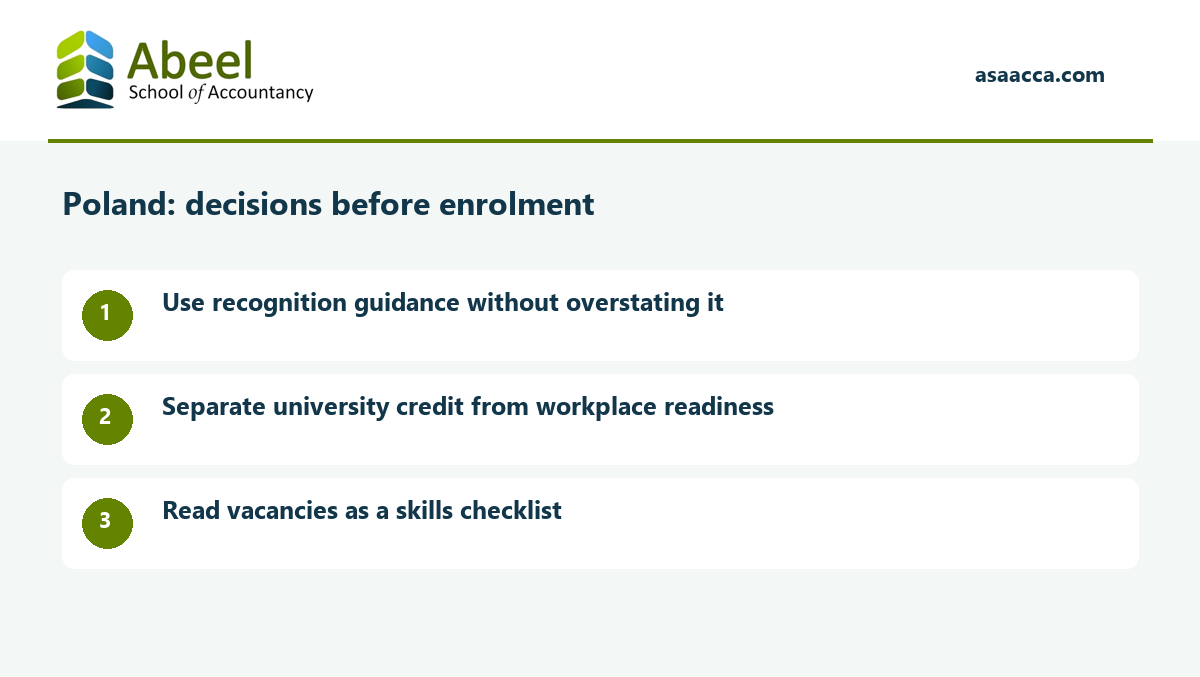
Read vacancies as a skills checklist
Collect a small sample of current advertisements for the type of role you actually want. Note the repeated requirements for systems, reporting knowledge, communication, languages and experience. Treat this as your own market research, not a statistical salary survey. Use it to prioritise learning and to ask informed questions at interview. Do not assume an English-language course removes language requirements that a particular employer places on client work or internal communication.
Plan examination practice alongside lessons
The current ACCA availability table lists centre-based options for Poland. Confirm the route and appointment for your intended paper through the official process. In preparation, practise the response style the paper requires instead of only watching technical explanations. When reviewing an answer, identify whether the weakness was knowledge, use of the scenario or presentation. Ask how tuition feedback addresses these differences and whether written mocks receive a reasoned review.
Make a decision you can revisit
Your initial plan should state the target role, confirmed starting point, next paper and review date. After a period of study, assess whether you can apply the material and whether the work still fits your career goal. Adjusting the sequence of papers or the support you use can be more useful than purchasing additional content immediately. Use the foundational ASA guides for qualification and study planning, and keep local recognition or practice questions with the relevant official authority.
Build on the ACCA foundations
Official references for this guide
Read job requirements as evidence, not as a recognition ruling
Compare several current vacancies for the kind of work you want and record the qualifications, software, languages and responsibilities they describe. This can help you understand an employer’s preferences, but an advertisement is not a legal decision about a professional qualification. A statement that ACCA is desirable for a reporting role does not establish permission to sign statutory reports or perform another regulated activity. Keep those questions separate and consult the relevant official rules for the activity. This distinction matters when a broad career ambition becomes a specific plan involving professional responsibility.
Design a language plan around the work you expect to perform
A student considering international reporting may need a different language-development plan from someone aiming for a role involving extensive local correspondence. Identify the tasks rather than making a blanket claim that one language is always enough. These tasks might include reading procedures, explaining a reconciliation or discussing an issue with colleagues. Practise the accounting content and the communication together. This helps you ask more useful questions when reviewing a vacancy or course. It also avoids treating an English examination qualification as proof that every possible workplace communication requirement has already been satisfied.
Use existing education as a starting point for investigation
If you have completed a degree or professional study, prepare the programme name, institution, graduation year and transcript before checking exemptions. Compare the official assessment with the exact programme you studied rather than assuming that all accounting degrees produce the same result. Consider readiness as well as formal eligibility: skipping an examination does not mean you remember every underlying concept needed later. A short diagnostic task can reveal where revision would help. Keep any exemption decision distinct from university credit, employment recognition or a local licence, since each may be governed by a different process.
Make the study timetable fit a working week
Start with a realistic account of commuting, work and family commitments. Protect blocks for attempting questions rather than allocating every available hour to watching lessons. If a busy period is predictable, move deeper practice earlier and retain smaller review tasks for the difficult weeks. Ask the provider when feedback is available and whether that timing matches your plan. Review progress before registering for another paper. A sustainable schedule gives you evidence that the chosen pace works; a timetable built around ideal weeks can conceal a workload that is already too large.
Keep a decision record when comparing qualifications
Write down the specific career problem you expect ACCA study to help solve. You might be seeking stronger reporting knowledge, a structured professional pathway or a way to demonstrate progress while employed. Compare alternatives against that purpose rather than relying on a general ranking of qualifications. Note what remains outside the proposed course, including practical experience, local requirements and employer selection. Revisit the record after speaking with a qualified adviser or reviewing official guidance. A clear purpose makes it easier to choose appropriate learning support without assuming that one qualification guarantees a job or professional entitlement.