
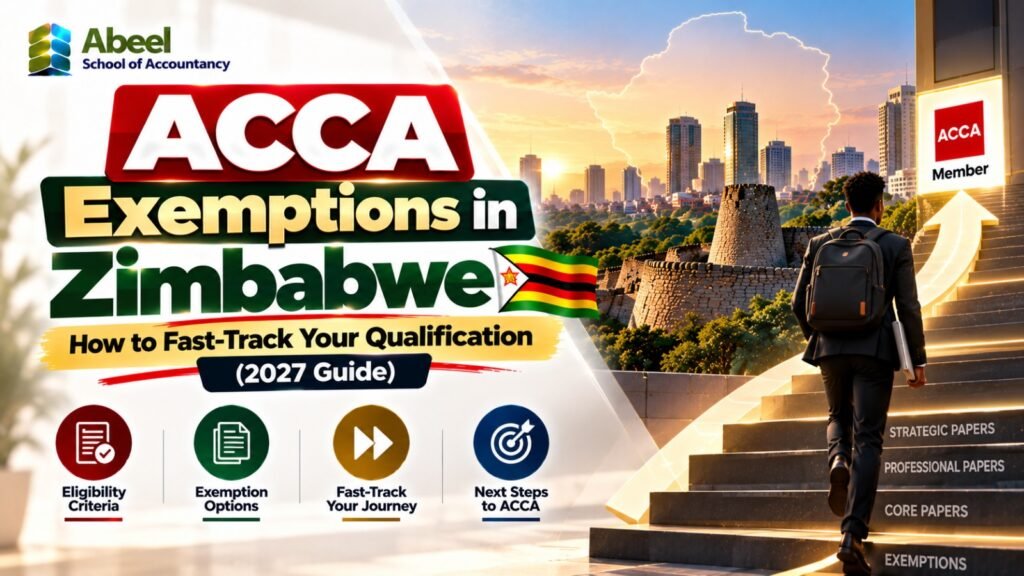
Picture two students starting ACCA in Harare on the same day. One has a BCom Accounting degree and a stack of certificates. The other has the same documents but never checked what they were worth. Three years later, the first student is sitting final-level papers. The second is still working through papers they could have skipped.
That gap is what ACCA exemptions are about. If you already hold an accounting-related qualification, you might not need to start from paper one. For Zimbabwean students who are working, paying fees in tough economic conditions and short on time, exemptions are the closest thing ACCA has to a fast lane.
This guide explains how ACCA exemptions in Zimbabwe work, what’s changing in 2027, and how to plan so you don’t waste time or money.
What Are ACCA Exemptions?
An ACCA exemption means ACCA recognises something you’ve already studied, such as a university degree or a professional qualification, and lets you skip the matching ACCA exam. You still end up with the same ACCA qualification. You just sit fewer papers to get there.
Under the current structure, the maximum is nine papers. ACCA can exempt you from up to nine papers: the three Applied Knowledge exams and the six Applied Skills exams. That can cut years off your timeline.
Two things surprise people:
- Exemptions are based on your qualifications, not your work experience. ACCA does not award ACCA Qualification exemptions on the basis of work experience. Ten years in a finance department is valuable, but it won’t earn you an exemption by itself.
- Exemptions aren’t free. ACCA charges an exemption fee per paper, so you should compare that cost against the time and tuition you’d spend on sitting the exam.
Who Can Get Exemptions in Zimbabwe?
Eligibility depends on what you studied and where. Typical routes include:
- Accounting or business degrees from universities and colleges that ACCA has accredited for exemptions. A Zimbabwean accounting degree commonly earns exemptions at the Applied Knowledge level, and sometimes more, depending on the programme.
- Other professional accounting qualifications that ACCA recognises.
- Diplomas and higher national qualifications that meet ACCA’s criteria.
The honest answer is that it varies by institution and programme. Two students with the same degree title can receive different awards. That’s why checking your actual transcripts matters more than guessing from a degree name.
Your first step: use ACCA’s official exemptions calculator on the ACCA Global website and enter your qualification details. It gives you an indicative result before you apply.
How to Claim ACCA Exemptions (Step by Step)
- Register as an ACCA student. Exemptions are claimed through your myACCA account.
- Gather your documents. Certificates, transcripts and syllabus details (sometimes) for each qualification.
- Check the exemptions calculator. It shows which papers you may be exempt from.
- Submit your application with supporting documents. Make sure copies are clear and, where needed, certified.
- Pay the exemption fees. Check the current fee per paper in your myACCA account.
- Plan your remaining papers. This is where most students need help.
At Abeel School of Accountancy, we help students review their qualifications, understand what they’re likely to receive, and build a realistic study plan around what remains. You can contact our admissions team or browse our ACCA programmes to get started. (Web team: replace these placeholder links with your live URLs.)
Should You Accept Every Exemption? Not Always
It sounds odd, but sometimes skipping an exemption makes sense. Consider declining one if:
- You completed the related study a long time ago and your knowledge has faded, especially for a paper that later exams build on.
- The paper is foundational to your job. If you’re in tax and the exemption covers a tax paper you’ve never really studied properly, sitting the exam might strengthen your career.
- You plan to pursue a degree pathway that has its own requirements. Check the rules before accepting exemptions, not after.
Think of exemptions as a tool, not a trophy. The goal is passing the qualification confidently, not reaching the finish line with gaps.
ACCA Changes in 2027: How They Affect Exemptions
This is the section every Zimbabwean student is searching for. ACCA is redesigning the qualification, and exemptions are part of that.
Timeline. The current structure runs to the June 2027 session, with the new Knowledge-level exams from July 2027 and the new Expertise and Strategic Professional exams from September 2027.
Where exemptions will be available. According to ACCA’s own policy for the redesigned qualification, exemptions are available for exams at the Knowledge and Expertise levels and for the Essential Employability Module at the Knowledge level. As with the current qualification, exemptions are not available for Strategic Professional exams, nor for the new Essential Employability Modules at the Expertise and Strategic Professional levels.
In plain English: the final stage still has to be earned in full, and the new workplace-skills modules at the higher levels can’t be waived.
Calculator update. ACCA’s exemptions calculator will be updated in July 2027 to reflect exemption availability towards the redesigned qualification. So the exact mapping between your degree and the new K, E and S papers won’t be fully visible until then.
What about accredited institutions? Programmes with current accreditation can run until the end of their accreditation period, with current assessments transitioned over to the new qualification. For students, that means a degree that earns exemptions today is not suddenly worthless.
The wider picture. Third-party guides report that the qualification reduces from 13 exams to 11. The new structure also introduces employability modules and a stronger focus on digital, ethical and sustainability skills. Our earlier guide to the best online ACCA classes in Zimbabwe for working students covers that in more detail, and providers like BPP publish helpful summaries too.
What this means for you:
- If you qualify for exemptions now, apply sooner rather than later. The calculator you can use today reflects the current structure, and certainty is worth a lot.
- If you’re mid-journey, continue as planned. Passed exams transfer through ACCA’s mapping and transition tools.
- If you’re unsure, ask before you pay. A wrong assumption about exemptions can mean paying for exams you didn’t need or skipping ones you should take.
Always verify details against ACCA’s official exemption policy page, since policies can be refined as 2027 approaches.
A Realistic Fast-Track Plan for Zimbabwean Students
Here’s how a working student with a relevant degree might approach it:
Month 1: Check and claim. Use the calculator, gather documents and apply for exemptions with guidance from Abeel School of Accountancy if you’d like a second pair of eyes.
Months 2 to 6: Start with your strongest remaining papers. Build momentum with early passes.
Months 6 to 18: Take one or two papers per sitting. Don’t stack three at once unless your schedule truly allows it.
Ongoing: Track the 2027 transition. Keep notes on which of your exams map to which new papers, and what remains.
Most importantly, don’t treat exemptions as permission to relax. You’ve saved time, but the papers left, especially at the strategic level, demand serious preparation.
Final Thoughts
ACCA exemptions in Zimbabwe can be a genuine shortcut, but only if you use them wisely. Know what you qualify for, understand the costs, think carefully about whether to accept every exemption, and stay informed about the 2027 changes.
If you’d like help working out your fast-track route, the team at Abeel School of Accountancy is ready to look at your qualifications and build a plan with you. A short conversation now could save you months, even years, later.
Frequently Asked Questions (FAQs)
1. What are ACCA exemptions?
They’re waivers that let you skip ACCA exams if you’ve already studied equivalent content in a recognised qualification.
2. How many ACCA exemptions can I get?
Under the current structure, up to nine papers. Under the redesigned qualification, exemptions apply at Knowledge and Expertise levels.
3. Can I get ACCA exemptions in Zimbabwe with work experience?
No. Exemptions are awarded for qualifications, not for work experience.
4. Which ACCA papers can’t be exempted?
Strategic Professional exams can’t be exempted, and neither can the new Essential Employability Modules at Expertise and Strategic Professional levels.
5. Will my exemptions still count after the 2027 changes?
Current guidance says accredited programmes continue until their accreditation ends, and ACCA will update its calculator in July 2027. Always check the official ACCA site.
6. How do I check which exemptions I qualify for?
Use ACCA’s exemptions calculator or contact our team at Abeel School of Accountancy for a review of your qualifications.
7. Do I have to pay for ACCA exemptions?
Yes. ACCA charges a fee per exempted paper, so compare that cost with sitting the exam.
8. Should I accept all my exemptions?
Not necessarily. If your knowledge is rusty or the paper matters for your career, sitting the exam can be the smarter choice.
9. When should I apply for exemptions?
As early as possible after registering with ACCA, before you start planning your exam schedule.
10. Can Abeel School of Accountancy help me plan my exemptions and study route?
Yes. We can review your documents, explain likely outcomes and build a timetable that fits your work schedule.