
A Nigerian applicant may be comparing school certificates, a national diploma, university admission or a completed degree. Those are not interchangeable documents. ACCA’s minimum-entrance database distinguishes several Nigerian qualifications; use the full applicable entry rather than assuming every school certificate supports the same route.

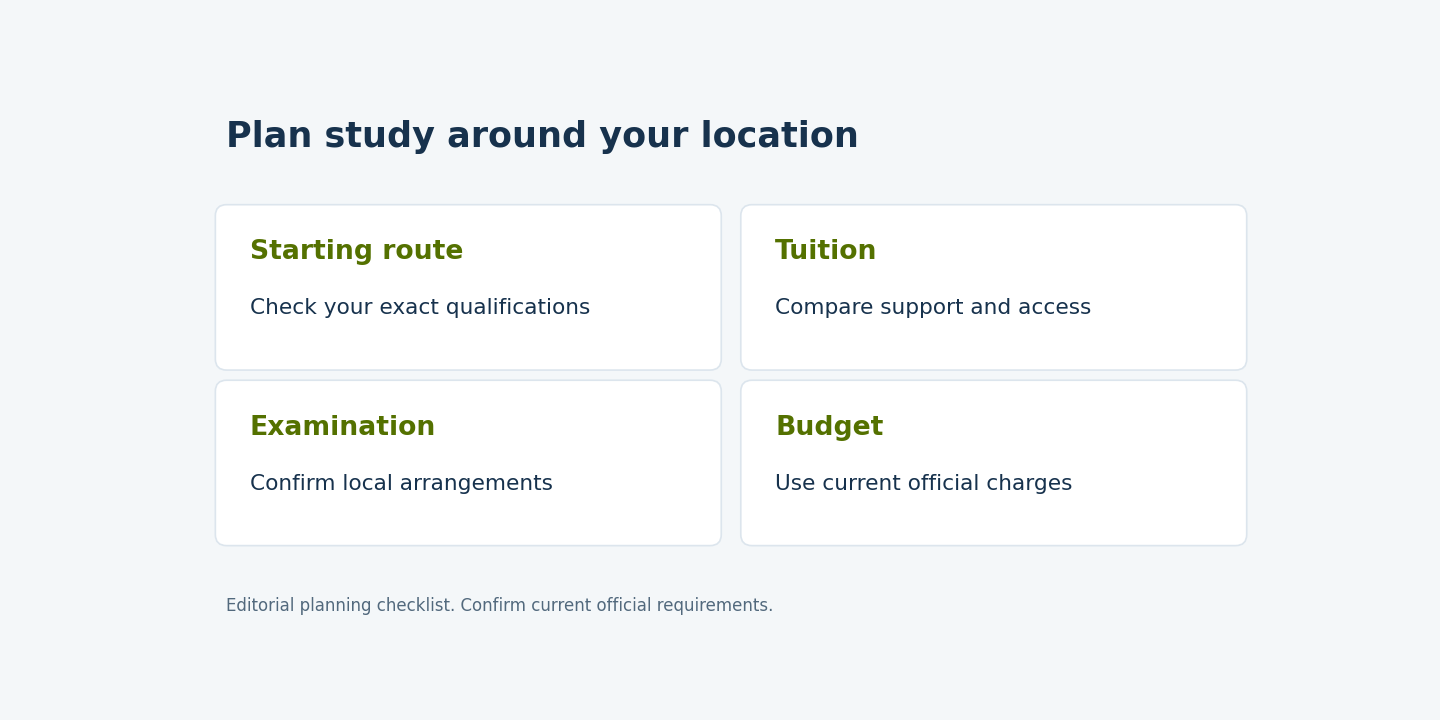
Build the record before choosing a course
Gather the certificate, detailed results and awarding information. Record the completion date and any document still pending. Use the full names shown on the documents instead of an informal qualification nickname.
If part of your education was completed in another system, check that award on its own terms. Your present residence does not turn an overseas qualification into a local school certificate. Ask for official clarification when a combination does not clearly match a published route.
Make unresolved questions visible
Keep a short list of decisions still needed: document completeness, qualification match, registration route, exemption position or intended paper. Mark each item as confirmed, pending or requiring clarification. Do not build the first tuition purchase on the most favourable possible answer to every pending item.
A school leaver and a national-diploma holder might attend the same demo lesson while needing different starting-route discussions. Keep their decisions tied to the actual documents, not the class timetable.
Separate registration from exemptions
An entry decision and an exemption decision answer different questions. Where relevant prior study may attract exemptions, use the correct institution, programme and completion details in ACCA’s official process. Keep the actual outcome rather than relying on a maximum-exemption advertisement.
An exemption can remove an exam requirement while leaving a need to refresh supporting knowledge. Try a short independent accounting question and identify what you can explain without the solution. Discuss the weak area with a tutor before selecting a heavier paper load.
Plan a realistic first study period
Put work, college, travel and family commitments on the calendar. Protect separate time for learning, active questions and reviewing mistakes. Include a recovery slot so one interrupted evening does not move the whole plan indefinitely.
Use a demo lesson to test the teaching language, pace and format. Then attempt a task independently. If following the lecturer is easier than answering a fresh requirement, ask about the course’s practice and feedback arrangements.
Compare costs and access terms
Request the current tuition charge, currency, payment recipient, access duration and included services. Keep external qualification charges separate. Read any transfer, deferral or refund conditions before paying.
For online tuition, test the actual platform on your normal device and connection. Confirm live-session times and recording access. For a classroom option, verify the actual address and timetable. Do not assume a local ASA branch follows from a country guide.
Check exams independently
Use ACCA’s current exam availability and booking instructions for the intended paper and location. Tuition enrolment does not complete exam entry, and online lectures do not establish remote exam eligibility. Keep the confirmed booking, payment record and reporting instructions with your private study files.
Discuss the next decision with ASA
Explore Abeel School of Accountancy and ASA course options. Contact ASA with your qualification details, location, intended paper and dependable study sessions. Confirm the actual course format and access terms before enrolling. Read the ACCA in Nigeria guide for the broader country picture.
Sources checked 13 October 2026: ACCA minimum entrance requirements, exemption guidance and exam booking. Examples are illustrative planning suggestions. Editorial draft: verify the matching ASA country hub, overlapping posts and local delivery before publication.
What Nigeria’s qualification listing actually distinguishes
The official ACCA entrance table reviewed for this guide treats the West African Senior School Certificate on its own differently from several other Nigerian routes. It lists that school certificate as insufficient for direct registration, while the Ordinary National Diploma, Nigeria Certificate in Education and JUPEB Certificate have sufficient entries. A combined advanced-level and school-level route also appears. These are examples from the official table, not an exhaustive eligibility decision for every applicant. Match your exact award and read the full entry before applying.
This distinction explains why the question “Can I start ACCA after school in Nigeria?” needs more detail. The next step for someone holding only a school certificate may differ from the next step for someone with a national diploma. ACCA identifies foundation-level awards as a starting option for people who do not meet direct-entry requirements. Do not interpret a foundation route as an admission failure: it is a different starting stage, and you should understand its progression before purchasing tuition.
A worked comparison: school certificate versus national diploma
Consider two fictional students, Chika and Musa. Neither example describes a real ASA learner or an official admission decision. Chika has a school certificate and is considering a package advertised as “ACCA classes.” She first needs to clarify the starting qualification and paper covered by that package. A broad course label does not establish that it is the right first stage. Her enquiry should include the exact award she holds and ask which starting-route decision needs confirmation before she buys classes.
Musa has an Ordinary National Diploma and has seen that award in the entry table. His next task is to organise the official documents and understand the application requirements. If he also wants exemptions, that is another enquiry. He should identify his institution, programme and completion year rather than assuming that every national-diploma holder receives the same exemption outcome. A tutor can then help him plan the papers remaining after the relevant decision.
Their study habits also differ. Chika may need to develop confidence with basic accounting language and numerical questions. Musa may need to refresh knowledge he has not used recently. Both can benefit from attempting a short independent task after a demonstration lesson. Their response to that task helps select support; it does not replace the qualification assessment.
Build a decision sheet that shows evidence and uncertainty
Use a notebook or spreadsheet with four columns: decision, evidence, status and next action. For example, the qualification decision might refer to a certificate and the matching official entry. The exemption decision might be pending an institution-specific check. The tuition decision might refer to a written offer and demonstration lesson. The exam decision should refer to current booking information. Keeping these records apart helps prevent a course salesperson’s answer from being mistaken for an official assessment.
| Decision | Evidence to keep | A useful next action |
|---|---|---|
| Starting route | Exact award and official entry information | Ask ACCA about any unclear qualification match |
| Exemptions | Correct programme details and actual outcome | Confirm required papers before buying a large package |
| Tuition | Timetable, access period and feedback description | Test a lesson and attempt an independent question |
| Examination | Booking conditions and confirmation | Check the paper, venue or delivery and reporting instructions |
Write “pending” when the evidence is not yet available. That is more useful than filling the blank with a favourable assumption. If a decision changes, update the affected row and revisit its consequences. An exemption outcome may change the paper list; a change in work hours may change the timetable. Neither automatically changes every other decision.
Plan the first month around active practice
After confirming the starting stage, divide the first month into small learning cycles. In week one, identify the syllabus area, attend a lesson and attempt a short task. In week two, revisit errors and answer a different task without copying the solution. In week three, practise combining concepts and write down where your explanation becomes unclear. In week four, review what improved and whether the protected study hours were realistic. This is an editorial planning example, not an ACCA-mandated timetable.
Track practice completed rather than videos watched. A useful entry says what question you attempted, what went wrong and what you changed next time. “Watched chapter three” records exposure to a lesson but says little about independent performance. If you repeatedly understand a worked solution and cannot begin a new question, ask for help with interpreting requirements and selecting the method.
Include a recovery session each week. A missed evening should move a specific task into that session, rather than making the whole timetable impossible. If you are missing most planned sessions, reduce the workload or change the format. Buying more subjects will not create more available hours.
Questions to ask before committing to a course
Ask which exact starting paper the course covers and whether its materials match the intended examination period. Request the start date, teaching times, access duration and the method for raising questions. Ask whether feedback means individual marking, group discussion or model answers only. These can all be useful services, but they are different services and should be described clearly.
For a quoted price, record the amount, currency, recipient, what is included and the date. Do not mix a tuition quotation with external registration or examination charges. If payment must be made in another currency, obtain the current conversion and payment information from the relevant provider rather than treating an old blog figure as a fixed rate. Also check what happens if your paper selection changes after an official decision.
Frequently asked questions
Can I assume my school certificate gives direct ACCA entry?
No. Identify the exact qualification and compare it with the current official table. The Nigerian listing distinguishes school-only and other qualification routes. Ask ACCA about your particular documents if the match is uncertain.
Does meeting entry requirements give automatic exemptions?
No. Entry and exemptions answer different questions. Use the relevant programme and institution information and retain the actual exemption outcome before deciding which classes you require.
Do online classes mean I can sit the exam from home?
Tuition delivery and examination delivery are separate. Confirm the current examination options for your paper and location through ACCA’s booking information before building a plan around a delivery method.
What should I send in an ASA study enquiry?
Describe your qualification, awarding institution, completion year, current ACCA stage, intended paper and reliable study hours. Use the enquiry form on this page for course-planning questions. Do not share account passwords or post identity documents publicly. An ASA tuition discussion helps compare study support; ACCA remains the source for official registration and exemption assessment.
Read the main ACCA in Nigeria guide for the wider country overview and visit Abeel School of Accountancy for ASA’s teaching information. Confirm actual course availability and terms before enrolling; this country article does not assert that ASA operates a physical branch in Nigeria.